


A pair of Japanese schoolgirls primp their hair before a long mirror, preparing for the perfect picture, but they are not taking a smartphone selfie, they are using a purikura photo booth.
Old-style photo booths have staged something of a comeback in parts of the world in the past few years, for their nostalgic value in the smartphone era, but the purikura — an abbreviation of the Japanese pronunciation of “print club” — offers much more than a simple strip of passport photographs.
Featuring a dizzying array of retouches, enhancements and adornments, they remain hugely popular 25 years after they debuted in Japan, particularly with teenage girls and young women enamored with their kawaii, or cute, output.
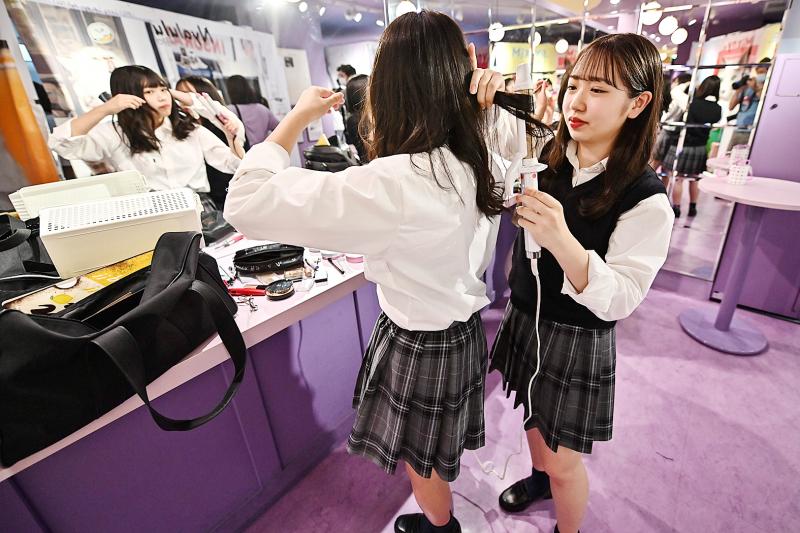
Photo: AFP
Despite competition from smartphones and increasingly sophisticated retouching apps, at least one Japanese firm is banking on the purikura’s enduring appeal and rolling out a new model this year.
Nonoka Yamada, 17, has been a purikura fan for almost a decade, and said that she and friends use them several times a week.
“All the girls in my class take purikura,” she said as she prepped for her picture at a department store in Tokyo’s Shibuya district.
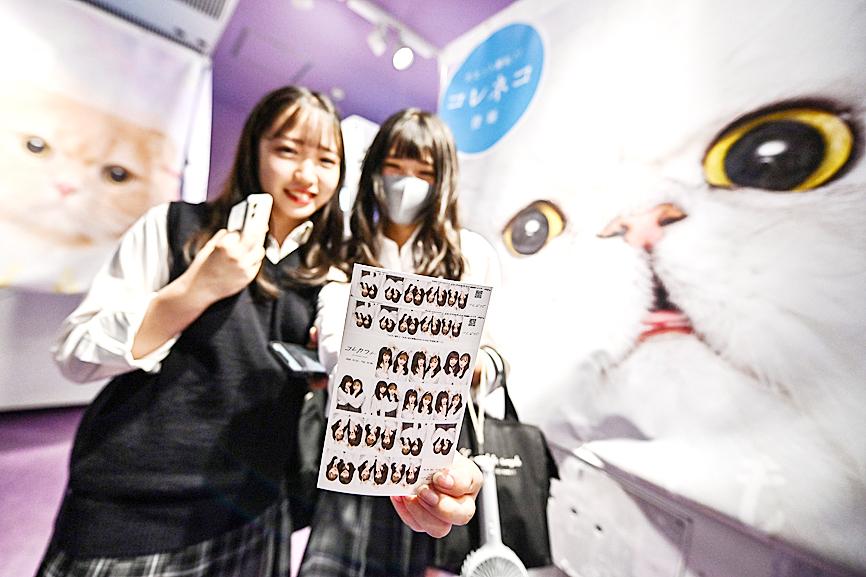
Photo: AFP
“The first time I used one I was eight, and the camera lens was too high so I had to stand on my tiptoes,” she said, adding that purikura offer more than a simple smartphone selfie.
“It lets you make yourself look cute, you can change your face,” she said. “I want to put the pictures on Instagram ... the images are good quality with good lighting.”
The first purikura was the brainchild of Japanese firm Atlus Co Ltd, which launched the product in partnership with Sega Corp in July 1995.
The booths quickly became a popular feature at Japanese gaming arcades, where long lines of schoolgirls waiting to have their photos taken transformed the previously male-dominated arcade customer base.
Other companies quickly jumped into the market, which by 1997 was worth more than US$950 million a year, but the selfie era took a toll, with users increasingly able to take and retouch photos free with their phones, rather than paying about ¥400 (US$3.78) for a sheet of about 16 photos.
Some manufacturers went under, while others abandoned the purikura business for more profitable ventures.
Today, just one manufacturer remains: FuRyu Corp, a former affiliate of the Japanese electronics firm Omron Corp.
“In 1997, we launched our first machine using Omron technology, which offered caricature faces. It was a total flop,” FuRyu spokeswoman Yuki Hikita said. “It had nothing to do with what young girls wanted, probably because it was developed by middle-aged men.”
The company began consulting customers directly and credits focus-grouping with its longevity.
In the past few years, the market has stabilized, with about 10,000 purikura dotted around the country — down from the 1997 peak of 50,000.
While the booths are less pervasive these days, they remain popular — a FuRyu phone app for receiving purikura photos had 19 million registered users in March.
Yuka Kubo, an independent researcher who studies the purikura phenomenon, has traced how the booths evolved over time.
Early models featured little more than cutesy borders around photos, with the first limited retouching tools debuting around 1998.
Facial recognition technology incorporated in 2003 allowed specific features to be altered, particularly the eyes.
“That was the start of the fashion for enormous eyes,” said Kubo, referring to a popular feature giving customers the doe-eyed gaze of anime characters.
“It started a competition between manufacturers, driven by demand from girls, over who could offer the biggest eyes,” she said.
In the past few years, retouching options have become more sophisticated, offering tints and shades to give the appearance of perfect skin or a slimmer face, and while smartphones and apps offer retouching features, Hikita said that there is still room for purikura.
“To take a good selfie with a phone, you need a bit of skill,” she said.
With purikura, “everything is automatic, with professional equipment and lighting, like a studio photo.”
The COVID-19 pandemic has meant new measures to keep customers safe, including disinfectant at every booth, but it has not kept fans away.
“Customers are already coming back, much faster than we had expected,” Hikita said.
In a sign of the sector’s enduring appeal, Sega announced this month that — more than two decades since it launched the first model — it would introduce a new version later this year, with the goal of “spreading purikura culture.”

The domestic unit of the Chinese-owned, Dutch-headquartered chipmaker Nexperia BV will soon be able to produce semiconductors locally within China, according to two company sources. Nexperia is at the center of a global tug-of-war over critical semiconductor technology, with a Dutch court in February ordering a probe into alleged mismanagement at the company. The geopolitical tussle has disrupted supply chains, with some carmakers reportedly forced to cut production due to chip shortages. Local production would allow Nexperia’s domestic arm, Nexperia Semiconductors (China) Ltd (安世半導體中國), to bypass restrictions in place since October on the supply of silicon wafers — etched with tiny components to

Singapore-based ride-hailing and delivery giant Grab Holdings Ltd has applied for regulatory approval to acquire the Taiwan operations of Germany-based Delivery Hero SE's Foodpanda in a deal valued at about US$600 million. Grab submitted the filing to the Fair Trade Commission on Friday last week, with the transaction subject to regulatory review and approval, the company said in a statement yesterday. Its independent governance structure would help foster a healthy and competitive market in Taiwan if the deal is approved, Grab said. Grab, which is listed on the NASDAQ, said in the filing that US-based Uber Technologies Inc holds about 13 percent of
Taiwan Semiconductor Manufacturing Co (TSMC, 台積電) yesterday received government approval to deploy its advanced 3-nanometer (3nm) process at its second fab currently under construction in Japan, the Ministry of Economic Affairs said in a news release. The ministry green-lit the plan for the facility in Kumamoto, which is scheduled to start installing equipment and come online in 2028 with a monthly production capacity of 15,000 12-inch wafers, the ministry said. The Department of Investment Review in June 2024 authorized a US$5.26 billion investment for the facility, slated to manufacture 6- to 12nm chips, significantly less advanced than 3nm process. At a meeting with

Taiwan’s food delivery market could undergo a major shift if Singapore-based Grab Holdings Ltd completes its planned acquisition of Delivery Hero SE’s Foodpanda business in Taiwan, industry experts said. Grab on Monday last week announced it would acquire Foodpanda’s Taiwan operations for US$600 million. The deal is expected to be finalized in the second half of this year, with Grab aiming to complete user migration to its platform by the first half of next year. A duopoly between Uber Eats and Foodpanda dominates Taiwan’s delivery market, a structure that has remained intact since the Fair Trade Commission (FTC) blocked Uber Technologies Inc’s


 RSS
RSS