


Taiwanese backlight module maker Darwin Precisions Corp (達運精密) has pledged to invest NT$1 billion (US$33.79 million) to expand its production capacity in Taiwan as part of the government’s Invest in Taiwan initiative, the Ministry of Economic Affairs said yesterday.
Darwin’s primary products are backlight modules, panel modules used in LCD TVs and precision components. The firm’s customers include AU Optronics Corp (友達光電), Sony Corp, Samsung Electronics Co and LG Electronics Co.
The company plans to set up automated production at its three existing facilities in Taichung and Hsinchu, while expanding production scale and developing high value-added products, such as active-matrix organic light emitting diode (AMOLED) displays, the ministry said.
The investment is expected to create 142 jobs, it added.
Increasing trade tensions between China and the US and post COVID-19 uncertainty have drawn more companies to look to Taiwan as a place to invest, said Ho Kun-sung (何坤松), chief operating officer and spokesman for the ministry’s InvesTaiwan Service Center.
Qualified companies receive help with bank loans, as well as assistance with finding the right site or suitable talent if needed, Ho said.
Darwin chief financial officer and spokesman Cathay Ching (荊國泰) said the government assistance played a minor role in the company’s latest investment decision.
“It is a supplement, but we have a lot of other considerations for expanding our production in Taiwan,” Ching told the Taipei Times.
Darwin said that its operations in Taiwan account for less than 20 percent of its total revenue, with the majority coming from China.
Aside from seeking to stabilize supply and reduce risks amid China-US trade tensions, Darwin aims to keep “sensitive” production in Taiwan, Ching said, citing the company’s desire to keep proprietary technologies at home.
“There are some technologies and resources, such as our fine-metal-mask production, that we will always keep in Taiwan,” he said.
“You can say we are coming back to Taiwan, but really we never left,” Ching said.
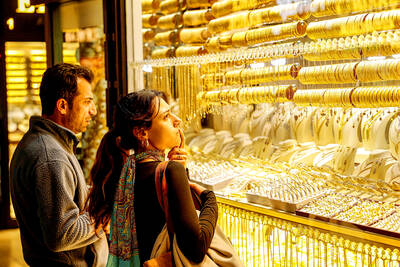
In Italy’s storied gold-making hubs, jewelers are reworking their designs to trim gold content as they race to blunt the effect of record prices and appeal to shoppers watching their budgets. Gold prices hit a record high on Thursday, surging near US$5,600 an ounce, more than double a year ago as geopolitical concerns and jitters over trade pushed investors toward the safe-haven asset. The rally is putting undue pressure on small artisans as they face mounting demands from customers, including international brands, to produce cheaper items, from signature pieces to wedding rings, according to interviews with four independent jewelers in Italy’s main

Japanese Prime Minister Sanae Takaichi has talked up the benefits of a weaker yen in a campaign speech, adopting a tone at odds with her finance ministry, which has refused to rule out any options to counter excessive foreign exchange volatility. Takaichi later softened her stance, saying she did not have a preference for the yen’s direction. “People say the weak yen is bad right now, but for export industries, it’s a major opportunity,” Takaichi said on Saturday at a rally for Liberal Democratic Party candidate Daishiro Yamagiwa in Kanagawa Prefecture ahead of a snap election on Sunday. “Whether it’s selling food or

CONCERNS: Tech companies investing in AI businesses that purchase their products have raised questions among investors that they are artificially propping up demand Nvidia Corp chief executive officer Jensen Huang (黃仁勳) on Saturday said that the company would be participating in OpenAI’s latest funding round, describing it as potentially “the largest investment we’ve ever made.” “We will invest a great deal of money,” Huang told reporters while visiting Taipei. “I believe in OpenAI. The work that they do is incredible. They’re one of the most consequential companies of our time.” Huang did not say exactly how much Nvidia might contribute, but described the investment as “huge.” “Let Sam announce how much he’s going to raise — it’s for him to decide,” Huang said, referring to OpenAI
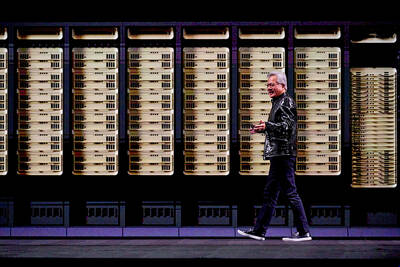
The global server market is expected to grow 12.8 percent annually this year, with artificial intelligence (AI) servers projected to account for 16.5 percent, driven by continued investment in AI infrastructure by major cloud service providers (CSPs), market researcher TrendForce Corp (集邦科技) said yesterday. Global AI server shipments this year are expected to increase 28 percent year-on-year to more than 2.7 million units, driven by sustained demand from CSPs and government sovereign cloud projects, TrendForce analyst Frank Kung (龔明德) told the Taipei Times. Demand for GPU-based AI servers, including Nvidia Corp’s GB and Vera Rubin rack systems, is expected to remain high,


 RSS
RSS