

Hon Hai Precision Industry Co (鴻海精密) is to build a joint IC packaging and testing plant in Qingdao in China’s Shandong Province as part of the company’s efforts to enter the semiconductor industry, Chinese media reported yesterday.
Among the reports that revealed Hon Hai’s plan, financial news Web site Sina.com said that Hon Hai chairman Young Liu (劉揚偉) on Wednesday signed an agreement with the Qingdao government for cooperation in technology development.
The reports said that under the accord, Hon Hai, known as Foxconn Technology Group (富士康科技集團) globally, would team up with Qingdao-based Rongkong Group (融控集團) to set up a high-end IC packaging and testing plant in the Qingdao West Coast New Zone later this year, with operations scheduled to begin next year.
The reports did not mention the financial terms of the plan or the stake the Taiwanese company would take in the joint venture.
Liu was cited in the reports as saying that high-end IC packaging and testing development is a critical part of the entire semiconductor industry and is expected to help Hon Hai upgrade its manufacturing technology.
Hon Hai’s efforts in semiconductor technology development are expected to lay a solid foundation for the company’s plans to develop emerging technologies, such as 5G applications, the Industrial Internet of Things and artificial intelligence (AI), he was cited as saying.
Liu has said that semiconductor technology is one of the core technologies that Hon Hai has set its sights on, along with AI and 5G/6G applications.
In August last year, Hon Hai formed a strategic partnership with the Zhuhai City Government in China’s Guangdong Province to enhance cooperation in semiconductor development, including IC design.
Hon Hai has been keen to transform itself from a pure hardware manufacturer into a company that can integrate its hardware and software capabilities.
Liu has said that the company has targeted electric vehicles, digital healthcare and robotics as next-generation industries.

EQUAL SHARE: A row over Micron’s payouts coincides with a global debate about who deserves a cut of the sudden wealth generated by the artificial intelligence boom Micron Technology Inc is to provide its engineers in Taiwan a cash bonus of NT$1 million (US$31,600) plus equity rewards, as the company’s local unions are demanding an additional payout to reflect their contribution to the chipmaker’s blowout profits. The Idaho-based chipmaker said in a statement yesterday that its entry-level, Taiwan-based engineers’ average compensation would reach NT$3.4 million for the past fiscal year after the cash and equities awards. All employees in Taiwan would receive equities as part of the annual merit grants, the company added. Before the announcement, Micron’s unions asked for a one-time cash payout equal to about seven years

UNDER PRESSURE: Samsung taunted Apple with sarcastic posts on X during its launch, saying ‘reheating our leftovers,’ and ‘so far, so same’ Samsung Electronics Co launched a publicity campaign for its foldable phones, touting its hardware advantage and its early entry into the segment as it seeks to fend off a major challenge from Apple Inc. Apple on Wednesday unveiled the Duo, a folding US$1,999 iPhone aimed at shaking up a category long dominated by Samsung and Chinese companies such as Huawei Technologies Co (華為), whose devices have struggled to move beyond a niche audience. Apple adopted the passport-shaped design that Samsung Electronics unveiled less than two months ago with the Galaxy Z Fold 8, priced at US$1,899 and powered by Alphabet Inc’s Gemini
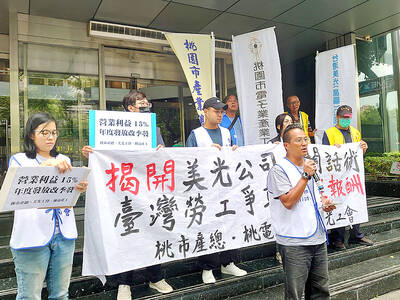
UNION DETERMINATION: Rejecting an offer for a one-time payout as an attempt to influence opinion, the union said a strike at the memory chip manufacturer is possible The Micron Taiwan workers’ union yesterday rejected a one-time payout unveiled by US-based Micron Technology Inc last week, saying it wants a long-term mechanism under which employees would share 15 percent of the company’s operating profits. While the union and the company are still in talks over the dispute, the reward package was proposed unilaterally by the employer without reaching an agreement with the union, union head Jerry Lin (林哲瑞) told reporters. Lin said he suspected the company was seeking to influence public opinion with the move. On Friday last week, Micron announced a reward package under which employees in Taiwan would receive

SOME CUSHION: Taiwan’s GDP is forecast to grow more than 11 percent this year, so the economy should be able to absorb the impact of a rate hike, an expert said With domestic inflation topping the 2 percent alert level for a fourth consecutive month last month and several major central banks around the world raising their key interest rates, Taiwan’s central bank is facing growing pressure to raise rates at its quarterly policymaking meeting on Thursday, economists said. At its June meeting, the central bank left interest rates unchanged for the ninth consecutive quarter, with the discount rate at 2 percent. Central Bank Governor Yang Chin-long (楊金龍) had said that the bank maintained a somewhat hawkish stance, with two board directors voicing support for a rate hike at the meeting. Cathay United


 RSS
RSS