


American owners of iPhones could get US$25 from Apple Inc after the company agreed to pay up to US$500 million to settle claims over it intentionally slowing down older models to preserve older batteries.
Apple and lawyers representing iPhone consumers agreed to a deal stemming from Apple’s 2017 admission that it was slowing down phone performance in older models to avoid unexpected shutdowns related to battery fatigue.
That admission led to Apple offering discounted battery replacements at US$29, but many people claimed they had already spent hundreds of dollars to buy a new phone because Apple did not reveal the cause of the problem. If they had known they could just buy new batteries, they might not have bought new phones, some consumers said.

Photo: AFP
Apple did not admit any wrongdoing.
As part of the settlement, the company is to pay US$310 million to US$500 million, including about US$93 million to lawyers representing consumers.
Owners of iPhones who were named in the class-action lawsuit are to get up to US$3,500 each. The rest of the settlement money is to be distributed to owners of the iPhone 6, 6S, 7 and SE models who meet eligibility requirements related to the operating system they had running.
They must file claims to get the award. If too many people file, the US$25 amount could shrink.
A US federal judge in San Jose, California, still needs to approve the settlement.
Separately, some products from Apple are in short supply in a possible sign of the COVID-19 outbreak’s effect on the global manufacturing system.
The iPad Pro tablet is seeing limited availability at stores in major cities in the US, Australia and Europe, according to a review of Apple’s Web site on Monday.
Some Apple store employees said that they started noticing reduced iPad Pro inventory in the past week. They asked not to be identified discussing private product information.
AirPods Pro earbuds and built-to-order Mac computers are also continuing to show shipping delays, while some Apple Watch Series 3 and Series 5 models are listed as unavailable to buy online.
Additional reporting by Bloomberg
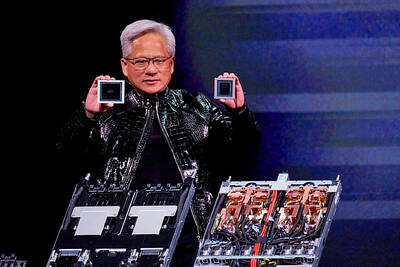
Nvidia Corp chief executive officer Jensen Huang (黃仁勳) on Monday introduced the company’s latest supercomputer platform, featuring six new chips made by Taiwan Semiconductor Manufacturing Co (TSMC, 台積電), saying that it is now “in full production.” “If Vera Rubin is going to be in time for this year, it must be in production by now, and so, today I can tell you that Vera Rubin is in full production,” Huang said during his keynote speech at CES in Las Vegas. The rollout of six concurrent chips for Vera Rubin — the company’s next-generation artificial intelligence (AI) computing platform — marks a strategic
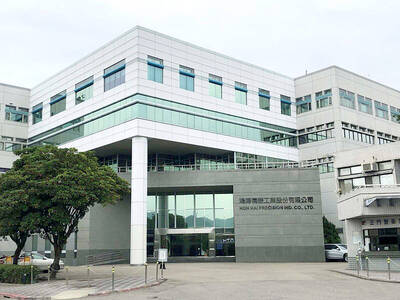
REVENUE PERFORMANCE: Cloud and network products, and electronic components saw strong increases, while smart consumer electronics and computing products fell Hon Hai Precision Industry Co (鴻海精密) yesterday posted 26.51 percent quarterly growth in revenue for last quarter to NT$2.6 trillion (US$82.44 billion), the strongest on record for the period and above expectations, but the company forecast a slight revenue dip this quarter due to seasonal factors. On an annual basis, revenue last quarter grew 22.07 percent, the company said. Analysts on average estimated about NT$2.4 trillion increase. Hon Hai, which assembles servers for Nvidia Corp and iPhones for Apple Inc, is expanding its capacity in the US, adding artificial intelligence (AI) server production in Wisconsin and Texas, where it operates established campuses. This
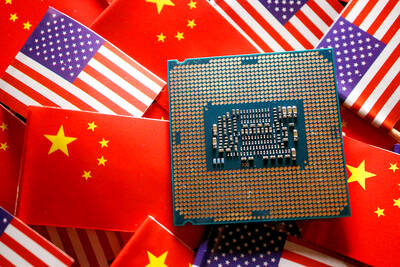
US President Donald Trump on Friday blocked US photonics firm HieFo Corp’s US$3 million acquisition of assets in New Jersey-based aerospace and defense specialist Emcore Corp, citing national security and China-related concerns. In an order released by the White House, Trump said HieFo was “controlled by a citizen of the People’s Republic of China” and that its 2024 acquisition of Emcore’s businesses led the US president to believe that it might “take action that threatens to impair the national security of the United States.” The order did not name the person or detail Trump’s concerns. “The Transaction is hereby prohibited,”
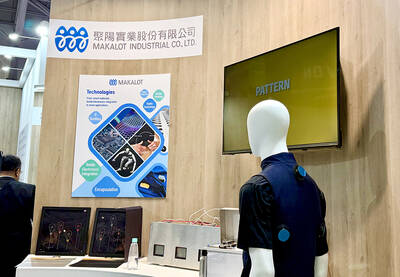
Garment maker Makalot Industrial Co (聚陽) yesterday reported lower-than-expected fourth-quarter revenue of NT$7.93 billion (US$251.44 million), down 9.48 percent from NT$8.76 billion a year earlier. On a quarterly basis, revenue fell 10.83 percent from NT$8.89 billion, company data showed. The figure was also lower than market expectations of NT$8.05 billion, according to data compiled by Yuanta Securities Investment and Consulting Co (元大投顧), which had projected NT$8.22 billion. Makalot’s revenue this quarter would likely increase by a mid-teens percentage as the industry is entering its high season, Yuanta said. Overall, Makalot’s revenue last year totaled NT$34.43 billion, down 3.08 percent from its record NT$35.52


 RSS
RSS