


Not every advance in electric-vehicle technology takes place inside the sterile calm of a research laboratory.
BMW AG, Volkswagen AG’s (VW) Audi and a Silicon Valley-based battery maker are helping push the boundaries with electric-powered race cars that whiz through Saudi Arabia, New York, London and Seoul at speeds topping 270kph.
Breakthroughs made by competitors in Formula E, starting its sixth season this week, are being incorporated into family sports utility vehicles (SUVs) and sedans — and even India’s electric rickshaws — as manufacturers seek to improve and extend their electric lineups, while nations gradually phase out gas guzzlers.
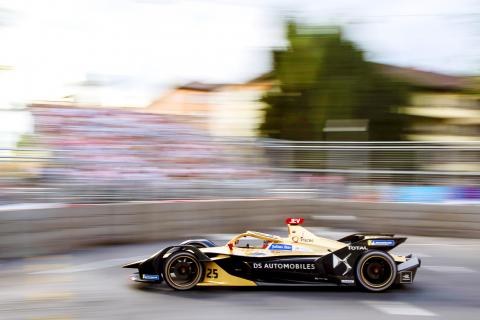
Photo: EPA-EFE
More powerful batteries and better motors, energy-management software and braking systems are all being transferred from the racetrack to the showroom.
“What we are doing in Formula E is highly relevant back on the road,” said Dilbagh Gill, chief executive officer and team principal of India’s Mahindra Racing, the motorsport unit of Mahindra & Mahindra Ltd. “We are able to come in and help them immediately in improving the product.”
Formula E, which began in 2014 with an E-Prix in Beijing, has 12 teams, almost all of which involve automakers producing or developing battery-powered vehicles for consumers, such as Nissan Motor Co and Tata Motors Ltd’s Jaguar brand.
VW’s Porsche and Daimler AG’s Mercedes-Benz brand are new participants in the 14-race season that opened on Friday in Saudi Arabia. The schedule runs through July, concluding with the two-day London E-Prix.
Last season’s champion was DS Techeetah, the Chinese-owned team of PSA Group’s DS Automobiles. Its DS E-Tense FE20 machine can accelerate from zero to 100kph in 2.8 seconds.
DS Automobiles is taking the power train — parts including the motor and inverter — from its Formula E entry and putting it inside a concept car called the DS X E-Tense. It also plans to use the same operating software across its planned range of electric passenger vehicles.
PSA Group, also home to the Peugeot and Citroen brands, is targeting a fully electrified fleet by 2025.
“The cars that win in Formula E are the most energy efficient, which is largely driven by software,” Paris-based DS Automobiles said. “Everything we do in Formula E with algorithms and software we try to replicate in series production.”
Rules intended to limit costs for teams and keep the series competitive mean racers use a standardized lithium-ion battery manufactured by a unit of Newark, California-based Lucid Motors Inc.
During the first four seasons of Formula E, drivers needed to change vehicles in the middle of a race — leaping from one cockpit into another — because the power packs could not complete a whole event, which typically lasts about 45 minutes.
Lucid’s batteries, introduced last season, eliminate the need for that switch.
“The real reason we are doing this is to demonstrate that we have world-class technology, which will find its way into our forthcoming road car,” Lucid chief executive officer Peter Rawlinson said.
The company plans to start producing its Lucid Air sedan in Arizona next year, boasting of a range of more than 644km and a speed exceeding 322kph.
Lucid’s Formula E batteries pack in more energy than alternatives that are commercially available for regular vehicles, said James Frith, a London-based analyst for BloombergNEF.
“If Lucid can transfer this technology to commercial electric vehicles, it could give them a real advantage,” he said.
Another key focus for Mahindra, DS Techeetah, Audi and the others is finding the best way to slow a vehicle down.
Since most vehicles lose energy as heat when a driver hits the brakes and causes friction, electric race cars use regenerative braking systems. In effect, a vehicle’s motor goes into reverse to slow the wheels and act as a generator to send power back into the battery.
The technology would help boost driving range, meaning passenger vehicles could use smaller batteries, Audi Sport ABT Schaeffler team principal Allan McNish said.
“Regenerating energy is going to be a key factor for the development of road cars,” said McNish, a former Formula One driver and a three-time winner of the 24 Hours of Le Mans endurance race.
For Nissan, the technology transfer goes both ways, spokeswoman Azusa Momose said.
Racing engineers working with the Nissan e.dams team are drawing on the company’s experience developing the electric Leaf hatchback.
“They share the same DNA,” Momose said in an e-mail.
Formula E cars are at the leading edge of energy management and power train development, she said.
Yet not all the gains are connected with technology or software.
Mumbai-based Mahindra plans to share racers’ cockpit tips with India’s auto rickshaw drivers to help them extend their battery’s range between refills.
India is home to about 1.5 million battery-powered, three-wheeled rickshaws. Mahindra is among the manufacturers of electric versions.
“As soon as they improve range, their earning capacity improves,” Gill said.
Putting high-speed electric vehicless onto circuits using regular city streets is considered another major benefit to the racing series, helping lift the profile of the battery-powered sector in key consumer markets.
Formula E races last season drew more than 400,000 spectators and a cumulative television audience of 411 million people, the series said in September.
Last season’s racers zipped along Brooklyn’s Clinton Wharf and Hong Kong’s Victoria Harbour. This season, competitors are to loop around the National Monument in Jakarta, and, in the UK, teams are to tackle a circuit that weaves inside the ExCeL London exhibition center and then back outside onto the city’s Royal Docks.
“You are racing in the heart of cities, and that’s where electric vehicles will be driven,” McNish said. “You are effectively taking your product to the people.”

The domestic unit of the Chinese-owned, Dutch-headquartered chipmaker Nexperia BV will soon be able to produce semiconductors locally within China, according to two company sources. Nexperia is at the center of a global tug-of-war over critical semiconductor technology, with a Dutch court in February ordering a probe into alleged mismanagement at the company. The geopolitical tussle has disrupted supply chains, with some carmakers reportedly forced to cut production due to chip shortages. Local production would allow Nexperia’s domestic arm, Nexperia Semiconductors (China) Ltd (安世半導體中國), to bypass restrictions in place since October on the supply of silicon wafers — etched with tiny components to

Singapore-based ride-hailing and delivery giant Grab Holdings Ltd has applied for regulatory approval to acquire the Taiwan operations of Germany-based Delivery Hero SE's Foodpanda in a deal valued at about US$600 million. Grab submitted the filing to the Fair Trade Commission on Friday last week, with the transaction subject to regulatory review and approval, the company said in a statement yesterday. Its independent governance structure would help foster a healthy and competitive market in Taiwan if the deal is approved, Grab said. Grab, which is listed on the NASDAQ, said in the filing that US-based Uber Technologies Inc holds about 13 percent of

Taiwan Semiconductor Manufacturing Co (TSMC, 台積電) yesterday received government approval to deploy its advanced 3-nanometer (3nm) process at its second fab currently under construction in Japan, the Ministry of Economic Affairs said in a news release. The ministry green-lit the plan for the facility in Kumamoto, which is scheduled to start installing equipment and come online in 2028 with a monthly production capacity of 15,000 12-inch wafers, the ministry said. The Department of Investment Review in June 2024 authorized a US$5.26 billion investment for the facility, slated to manufacture 6- to 12nm chips, significantly less advanced than 3nm process. At a meeting with
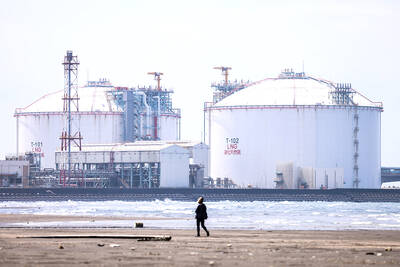
Taiwan is open to joining a global liquefied natural gas (LNG) program if one is created, but on the condition that countries provide delivery even in a scenario where there is a conflict with China, an energy department official said yesterday. While Taiwan’s priority is to have enough LNG at home, the nation is open to exploring potential strategic reserves in other countries such as Japan or South Korea, Energy Administration Deputy Director-General Chen Chung-hsien (陳崇憲) said. While the LNG market does not have a global reserve for emergencies like that of oil, the concept has been raised a few times —


 RSS
RSS