


Formosa Plastics Group’s (FPG, 台塑集團) four major subsidiaries yesterday said combined revenue last month increased 4 percent month-on-month thanks to higher shipments as some factories resumed production following regular maintenance.
However, weak prices and excessive inventory continued to take a toll on the companies. Overall revenue at the four subsidiaries tumbled 22 percent year-on-year from NT$151.53 billion to NT$117.25 billion (from US$4.99 billion to US$3.86 billion).
Global crude oil prices are likely to extend an uptrend until the end of this year, but the outlook for next year is gloomy, Chinese-language Unique Satellite TV quoted Formosa Petrochemical Co (FPCC, 台塑石化) president Tsao Minh (曹明) as saying.
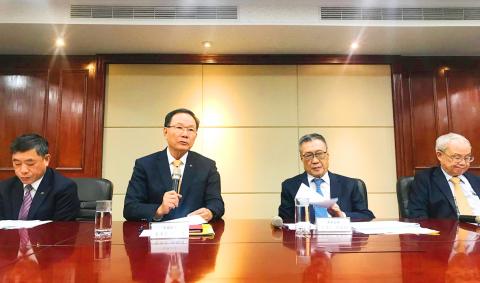
Photo: CNA
“Overall market demand does not look good for the first quarter of next year. Crude oil prices are likely to fall [again],” Tsao said.
Goldman Sachs Group Inc has forecast that global crude oil prices would stand at US$60 a barrel next year due to low demand, he added.
FPCC plans to fully utilize its fabs after maintenance ended last month, Tsao said.
The company said revenue last month rose 4.3 percent to NT$51.6 billion.
The utilization rate at its ethylene factories last month soared to 90 percent, from 66 percent in September, boosting output by about 28 percent month-on-month after one of the factories completed two months of annual maintenance, the company said.
However, ample supply drove ethylene prices down by NT$127 per tonne from a month earlier, it said.
Revenue plummeted 24.4 percent annually as refinery revenue contracted 22 percent annually on lower global crude oil prices, the company said.
Formosa Chemicals & Fibre Corp (FCFC, 台灣化纖) also had a conservative view for this quarter.
“Price is the main issue. As prices continue to fall, fourth-quarter revenue would be slightly lower than the third quarter. This is different from what I saw two months ago,” Unique Satellite TV quoted FCFC vice chairman Hong Fu-yuan (洪福源) as saying.
FCFC, which manufactures integrated plastic and nylon products, said that revenue last month rose 1.8 percent month-on-month to NT$24.87 billion. That represented an annual decline of 31 percent, as prices have been sliding since October last year amid a US-China trade dispute and new supply from China.
Nan Ya Plastics Corp (南亞塑膠), which makes plastics, chemicals and electronics materials, said revenue grew 2.8 percent monthly to NT$24.2 billion.
Output of bisphenol A (BPA), a chemical used in some plastics and resins, rose as its Fab 3 in Yunlin County’s Mailiao Township (麥寮) resumed production following regular maintenance, leading to an increase in BPA revenue.
Revenue from its electronics materials, including glass yarn, copper-clad laminates and printed circuit boards, fell due to a slow season, the company said.
Last month’s revenue represented an annual contraction of 12 percent from NT$27.51 billion, Nan Ya said.
Formosa Plastics Corp (FPC, 台塑), which makes intermediate raw materials for plastics, such as polyvinyl chloride and vinyl chloride, said revenue grew 8.7 percent monthly to NT$16.58 billion.
FPC attributed the growth to only three plants entering regular maintenance last month, compared with 10 plants that were under maintenance in September.
However, prices for its major products declined at an annual rate of 15 to 40 percent, causing revenue to fall 15.8 percent on an annual basis from NT$19.69 billion.

Cairo’s new monorail slices across the city skyline, running above the familiar chaos of blaring horns and aging buses’ exhaust fumes that mark rush hour below. The US$4.5 billion monorail, opened this month, is among Egypt’s most prominent new transport projects, part of a debt-funded infrastructure drive criticized for sapping state finances while bringing limited benefits to most of the country’s 109 million people. “It feels like you’re in a different country,” said Ramy Sayed, a restaurant manager, aboard a driverless Innovia 300 train. “No noise, no traffic, we’re not used to this.” The eastern line runs 56km from the bustling middle-class

Taiwanese firms have increased investment in the Philippines in recent years as Manila’s ties with Washington deepen and global supply chains continue to shift away from China, an expert at the Chung-Hua Institution for Economic Research (CIER, 中華經濟研究院) said yesterday. The Philippines had not been among Taiwanese investors’ top choices in Southeast Asia, CIER Taiwan ASEAN Studies Center director Kristy Hsu (徐遵慈) said at a seminar in Taipei. However, Taiwan’s investment in the country has grown significantly since the COVID-19 pandemic, reaching US $257 million last year, a high in recent years, she said. Although Taiwan’s total investment in the Philippines still lags

Intel Corp regards Taiwan Semiconductor Manufacturing Co (TSMC, 台積電) as a longstanding partner, as the US chipmaker would continue outsourcing production of advanced chips to TSMC, Intel chief executive officer Lip-Bu Tan (陳立武) said yesterday. “I don’t look at people as competitors. I look at the collaboration... Nvidia is also, you know, a good friend,” Tan told a news conference following his keynote speech at the Computex trade show in Taipei. “It’s a very trusted partnership for us... We are a big, top customer for them, and we’re going to continue doing that,” he said, referring to TSMC, the world’s largest foundry

Artificial intelligence (AI) agents would supplant smartphones as the center of people’s digital lives, fundamentally reshaping personal devices and driving a major computing upgrade cycle, Qualcomm Inc CEO Cristiano Amon said yesterday. In his keynote speech for this year’s Computex trade show in Taipei, Amon said that the rise of "agentic AI" — AI systems capable of reasoning, planning and carrying out tasks autonomously — would transform how people interact with technology across phones, PCs, vehicles and wearable devices. Describing the technology as the next major evolution in computing, Amon said that "2026 is the year of agents.” For decades, smartphones have sat


 RSS
RSS