


Apple Inc will continue manufacturing its Mac Pro computers in Texas after US President Donald Trump’s administration approved its request to waive tariffs on certain parts imported from China.
The commitment announced on Monday clears up several months of uncertainty while Apple mulled shifting production of the Mac Pro from an Austin, Texas, plant where it has been assembling the high-end computer since 2013.
In late June, the Wall Street Journal reported Apple was on the verge of shifting the Mac Pro’s assembly line to a factory near Shanghai.
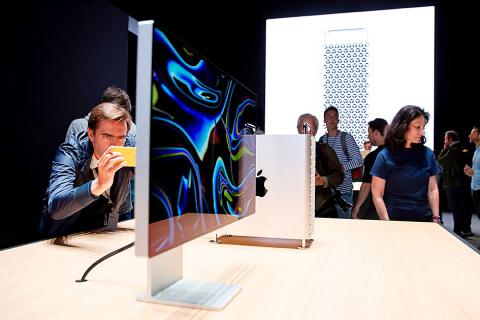
Photo: AFP
However, Apple apparently had a change of heart after the Office of the US Trade Representative agreed to waive tariffs on the Mac Pro parts made in China.
Those taxes could have made the US$6,000 Mac Pro even more expensive.
“We thank the administration for their support enabling this opportunity,” Apple CEO Tim Cook said in a statement.
Apple is deeply rooted in Austin, where it has built its second-
largest campus outside its Cupertino, California, headquarters.
The company says about 6,000 of its employees work in Austin and it has plans to create another 5,000 jobs as part of a US$1 billion expansion announced last year.
The Mac Pro assembly plant is run by Flex Ltd.
Apple said the new Mac Pro, unveiled in June with the company’s typical fanfare, also contains parts from more than a dozen US companies, and that the computer is also designed and engineered in its home country.
Even with the tariff break on the Mac Pro, Apple still could be hit later this year.
Trump has promised to broaden the penalties he has been rolling out in his trade war against China. A 10 percent tariff scheduled to take effect on Dec. 15 could affect Apple’s most popular product, the iPhone, which is mostly assembled in China.
If the tariffs are applied to the iPhone, Apple could be in a bind.
It would be forced to either pass the cost on to consumers and risk losing business at a time when sales of the device have been slumping, or undercut its profit margins by absorbing the tax itself.
Cook has proven adept at convincing Trump to protect the Apple from the China tariffs so far.
The Apple CEO has made a case that the tariffs would hurt the company’s ability to compete against key rivals, such as Samsung Electronics Co, and ultimately diminish its investments in the US.
Apple on Monday reiterated that it was on track to fulfill its promise to pour US$350 billion into the US economy, a pledge that Cook made last year shortly after Congress passes huge reductions in corporate taxes that Trump supported.
Wedbush Securities analyst Daniel Ives hailed Apple’s decision to keep making the Mac Pro in Texas as a “smart poker move.”

The domestic unit of the Chinese-owned, Dutch-headquartered chipmaker Nexperia BV will soon be able to produce semiconductors locally within China, according to two company sources. Nexperia is at the center of a global tug-of-war over critical semiconductor technology, with a Dutch court in February ordering a probe into alleged mismanagement at the company. The geopolitical tussle has disrupted supply chains, with some carmakers reportedly forced to cut production due to chip shortages. Local production would allow Nexperia’s domestic arm, Nexperia Semiconductors (China) Ltd (安世半導體中國), to bypass restrictions in place since October on the supply of silicon wafers — etched with tiny components to

Singapore-based ride-hailing and delivery giant Grab Holdings Ltd has applied for regulatory approval to acquire the Taiwan operations of Germany-based Delivery Hero SE's Foodpanda in a deal valued at about US$600 million. Grab submitted the filing to the Fair Trade Commission on Friday last week, with the transaction subject to regulatory review and approval, the company said in a statement yesterday. Its independent governance structure would help foster a healthy and competitive market in Taiwan if the deal is approved, Grab said. Grab, which is listed on the NASDAQ, said in the filing that US-based Uber Technologies Inc holds about 13 percent of

Taiwan Semiconductor Manufacturing Co (TSMC, 台積電) yesterday received government approval to deploy its advanced 3-nanometer (3nm) process at its second fab currently under construction in Japan, the Ministry of Economic Affairs said in a news release. The ministry green-lit the plan for the facility in Kumamoto, which is scheduled to start installing equipment and come online in 2028 with a monthly production capacity of 15,000 12-inch wafers, the ministry said. The Department of Investment Review in June 2024 authorized a US$5.26 billion investment for the facility, slated to manufacture 6- to 12nm chips, significantly less advanced than 3nm process. At a meeting with

Taiwan’s food delivery market could undergo a major shift if Singapore-based Grab Holdings Ltd completes its planned acquisition of Delivery Hero SE’s Foodpanda business in Taiwan, industry experts said. Grab on Monday last week announced it would acquire Foodpanda’s Taiwan operations for US$600 million. The deal is expected to be finalized in the second half of this year, with Grab aiming to complete user migration to its platform by the first half of next year. A duopoly between Uber Eats and Foodpanda dominates Taiwan’s delivery market, a structure that has remained intact since the Fair Trade Commission (FTC) blocked Uber Technologies Inc’s


 RSS
RSS