


The Taipei District Court on Friday last week acquitted former CTBC Financial Holding Co (中信金控) vice chairman Jeffrey Koo Jr (辜仲諒) and several CTBC executives of embezzlement and breach of trust.
The six defendants were accused of embezzling US$300 million in company funds as well as other illegal financial dealings during CTBC Life Insurance Co Ltd’s (中國信託人壽) acquisition of Taiwan Life Insurance Co (台灣人壽保險).
After a nearly three-year trial, the court cleared Koo, former CTBC Financial chief financial officer Perry Chang (張明田), CTBC executives Wu Feng-fu (吳豐富) and Chang Yu-chen (張友琛), major shareholder Chang Su-chu (張素珠) and former CTBC Securities Investment Service Co (中國信託證券投顧) board director Lee Sheng-kai (李聲凱), citing lack of evidence.
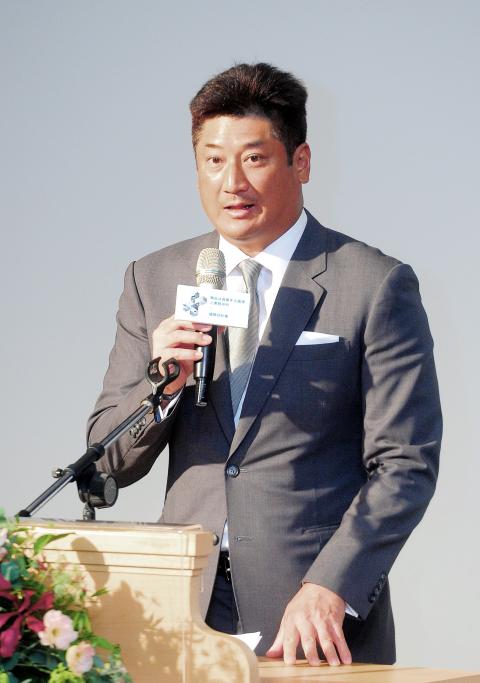
Photo: Wang Yi-sung, Taipei Times
However, the court sentenced Gobo Group (國寶集團) president Chu Guo-rong (朱國榮) to 12 years and four months in prison for making illegal profits through insider trading of Taiwan Life shares and manipulating the stock price of Long Bon International Co (龍邦), one of the largest shareholders in Taiwan Life at the time.
The ruling can be appealed.
Koo’s lawyer, Yeh Chien-ting (葉建廷), said that his client respects and appreciates the ruling.
CTBC Financial said that its subsidiary has suffered no losses and recovered from the costs of the investment in overseas non-performing assets.
CTBC Financial has also suffered no losses in the process of acquiring Taiwan Life, it said in a statement on Sunday, adding that the benefits generated by the acquisition have been fully reflected in its financial statements, with substantial revenue growth achieved.
An investigation by the now-defunct Special Investigation Division of the Supreme Prosecutors’ Office found that from 2004 to 2007, Koo and other senior CTBC Financial executives transferred money to an offshore shell company controlled by Koo and his father, Jeffrey Koo Sr (辜濂松), as well as to accounts set up by Koo Sr’s son-in-law Steven Chen (陳俊哲), allowing them to embezzle about US$300 million from the company.
The court said that Koo Sr and Chen led the action. The charges against Koo Sr were dropped after he died in December 2012, while Chen went to the US.
During a remote interrogation by the division in 2015, Chen exercised his right to silence and did not testify that Koo Jr and other senior CTBC executives were involved in the case, so there is no evidence that Koo Jr and the other executives participated in the crime, the court said.
As for the Gobo Group case in which Koo Jr was indicted for intending to offer profits to Chu through financial deals, the court said that Koo Jr does not bear any legal responsibility, as the deals did not harm CTBC Financial, but were to secure Chu’s support for CTBC Life’s merger with Taiwan Life.

The domestic unit of the Chinese-owned, Dutch-headquartered chipmaker Nexperia BV will soon be able to produce semiconductors locally within China, according to two company sources. Nexperia is at the center of a global tug-of-war over critical semiconductor technology, with a Dutch court in February ordering a probe into alleged mismanagement at the company. The geopolitical tussle has disrupted supply chains, with some carmakers reportedly forced to cut production due to chip shortages. Local production would allow Nexperia’s domestic arm, Nexperia Semiconductors (China) Ltd (安世半導體中國), to bypass restrictions in place since October on the supply of silicon wafers — etched with tiny components to

Singapore-based ride-hailing and delivery giant Grab Holdings Ltd has applied for regulatory approval to acquire the Taiwan operations of Germany-based Delivery Hero SE's Foodpanda in a deal valued at about US$600 million. Grab submitted the filing to the Fair Trade Commission on Friday last week, with the transaction subject to regulatory review and approval, the company said in a statement yesterday. Its independent governance structure would help foster a healthy and competitive market in Taiwan if the deal is approved, Grab said. Grab, which is listed on the NASDAQ, said in the filing that US-based Uber Technologies Inc holds about 13 percent of

Taiwan Semiconductor Manufacturing Co (TSMC, 台積電) yesterday received government approval to deploy its advanced 3-nanometer (3nm) process at its second fab currently under construction in Japan, the Ministry of Economic Affairs said in a news release. The ministry green-lit the plan for the facility in Kumamoto, which is scheduled to start installing equipment and come online in 2028 with a monthly production capacity of 15,000 12-inch wafers, the ministry said. The Department of Investment Review in June 2024 authorized a US$5.26 billion investment for the facility, slated to manufacture 6- to 12nm chips, significantly less advanced than 3nm process. At a meeting with

Taiwan’s food delivery market could undergo a major shift if Singapore-based Grab Holdings Ltd completes its planned acquisition of Delivery Hero SE’s Foodpanda business in Taiwan, industry experts said. Grab on Monday last week announced it would acquire Foodpanda’s Taiwan operations for US$600 million. The deal is expected to be finalized in the second half of this year, with Grab aiming to complete user migration to its platform by the first half of next year. A duopoly between Uber Eats and Foodpanda dominates Taiwan’s delivery market, a structure that has remained intact since the Fair Trade Commission (FTC) blocked Uber Technologies Inc’s


 RSS
RSS