


Uber Technologies Inc yesterday appealed to the government to halt its “heavy handed” regulatory changes, while Uber drivers are planning a protest this month over the Ministry of Transportation and Communications’ new rules that they say would damage the firm’s ride-hailing business.
The ministry in February proposed a draft amendment to Article 103-1 of the Transportation Management Regulations (汽車運輸業管理規則), which would prohibit payment regimes for rental vehicles of less than one hour, and limit discounts and promotional deals. The proposed rules would also require rental vehicles to “return to the garage” after every trip.
Uber Taiwan has petitioned the ministry, but to no avail, it said.
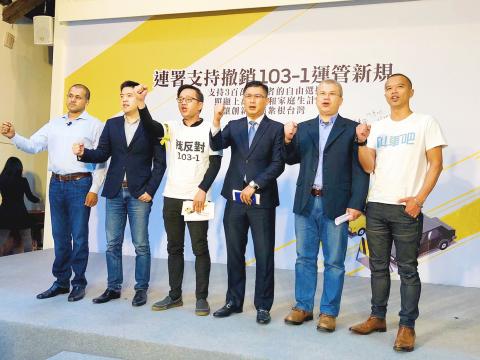
Photo: Kao Shih Ching, Taipei Times
The consultation period for the proposed changes is to end on April 26.
“We call on the government to extend the consultation period and invite all parties to talk, as it has had no or limited talks with ride-hail platforms, driver-partners and riders,” Uber regional general manager for Asia Pacific Amit Jain told a news conference in Taipei.
Jain, who was in charge of Uber’s India operations, told the Taipei Times that when he dealt with regulatory headwinds in his previous role, the firm and the Indian government had comprehensive discussions about regulatory changes, but such dialogue is lacking in Taiwan.
He would continue to petition the government at meetings, Jain said.
“We remain hopeful that our voices will be heard by the ministry and we will continue to work with our partners,” he said.
As it is difficult to forecast the worst-case scenario at the moment, Uber could not confidently say it would leave Taiwan, he said.
The ministry has suggested that Uber Taiwan transfer its drivers to the ministry’s multi-purpose taxi (MPT) program, but the firm would not consider that option, as it is similar to a traditional taxi system and requires drivers to adopt fixed fares, Jain said.
“The MPT system is the opposite of Uber and far from our vision to change the taxi industry,” he said.
The ministry’s planned changes would hurt not only Uber, but also local platform operators, said Johnny Lai (賴群森), founder of locally developed cab-hailing start-up Call Car Bar (叫車吧), which has 1,000 drivers.
If drivers join the MPT program, they would need to comply with taxi regulations and would no longer be allowed to offer airport pickup services, Lai said.
In light of advanced technologies, the government should adapt to new concepts and supervisory methods for taxi and cab-hailing businesses such as Call Car Bar and Uber, Lai said.
“We are all angry, as the ministry is to sacrifice our rights to protect taxi drivers,” said Well Lee (李威爾), spokesperson of the Platform Driver Alliance, a group organized by Uber drivers.
The alliance is to protest, with a tentative date of April 21, he said, adding that most of Uber’s 10,000 drivers would participate.
The alliance has launched a petition urging the ministry to drop the proposed amendments, Lee said.
The petition has gained more than 100,000 signatures from Uber riders, he said.

The domestic unit of the Chinese-owned, Dutch-headquartered chipmaker Nexperia BV will soon be able to produce semiconductors locally within China, according to two company sources. Nexperia is at the center of a global tug-of-war over critical semiconductor technology, with a Dutch court in February ordering a probe into alleged mismanagement at the company. The geopolitical tussle has disrupted supply chains, with some carmakers reportedly forced to cut production due to chip shortages. Local production would allow Nexperia’s domestic arm, Nexperia Semiconductors (China) Ltd (安世半導體中國), to bypass restrictions in place since October on the supply of silicon wafers — etched with tiny components to

Singapore-based ride-hailing and delivery giant Grab Holdings Ltd has applied for regulatory approval to acquire the Taiwan operations of Germany-based Delivery Hero SE's Foodpanda in a deal valued at about US$600 million. Grab submitted the filing to the Fair Trade Commission on Friday last week, with the transaction subject to regulatory review and approval, the company said in a statement yesterday. Its independent governance structure would help foster a healthy and competitive market in Taiwan if the deal is approved, Grab said. Grab, which is listed on the NASDAQ, said in the filing that US-based Uber Technologies Inc holds about 13 percent of

Taiwan Semiconductor Manufacturing Co (TSMC, 台積電) yesterday received government approval to deploy its advanced 3-nanometer (3nm) process at its second fab currently under construction in Japan, the Ministry of Economic Affairs said in a news release. The ministry green-lit the plan for the facility in Kumamoto, which is scheduled to start installing equipment and come online in 2028 with a monthly production capacity of 15,000 12-inch wafers, the ministry said. The Department of Investment Review in June 2024 authorized a US$5.26 billion investment for the facility, slated to manufacture 6- to 12nm chips, significantly less advanced than 3nm process. At a meeting with

Taiwan is open to joining a global liquefied natural gas (LNG) program if one is created, but on the condition that countries provide delivery even in a scenario where there is a conflict with China, an energy department official said yesterday. While Taiwan’s priority is to have enough LNG at home, the nation is open to exploring potential strategic reserves in other countries such as Japan or South Korea, Energy Administration Deputy Director-General Chen Chung-hsien (陳崇憲) said. While the LNG market does not have a global reserve for emergencies like that of oil, the concept has been raised a few times —


 RSS
RSS