


Shares of Shanghai Commercial and Savings Bank Ltd (SCSB, 上海商業儲蓄銀行) surged on their debut on the local bourse yesterday, boosting the bank’s market value past some of its local peers.
While the TAIEX closed 0.35 percent lower at 9,919.26 points, shares of the 103-year-old bank advanced 14.24 percent and outpaced the financial subindex’s gain of 0.13 percent.
SCSB shares opened at NT$35 and gradually climbed to close at NT$36.9, boosting its market capitalization to NT$151.36 billion (US$4.89 billion).
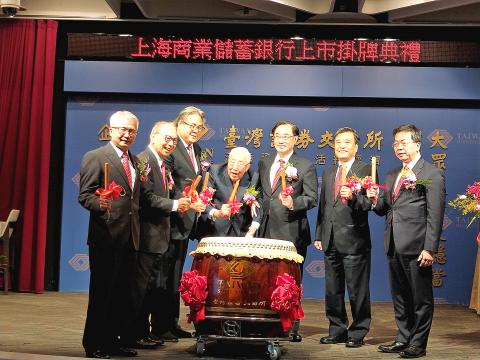
Photo: Lee Chin-hui, Taipei Times
“The bank could rank among the top 50 listed firms in Taiwan thanks to its new market value,” SCSB general manager John S.C. Chen (陳善忠) said.
As the share price of a number of financial holding companies have stayed at about NT$10, “a lot of people do not understand why our share price is higher than the others,” Chen said.
Given a net asset value per share of NT$30.35 and the second-highest earnings per share (EPS) of NT$1.63 among local banks in the first half, it is reasonable for SCSB’s share price to move higher than its peers, he said.
SCSB’s market value has surpassed that of China Development Financial Holding Corp (中華開發金控), Shin King Financial Holding Co (新光金控) and SinoPac Financial Holdings Co (永豐金控), SCSB executive vice president Alex Lin (林志宏) said.
The bank reported an EPS of NT$3.04 for last year and distributed a cash dividend of NT$1.80 per share.
STEADY GROWTH
First-half net income increased 6.8 percent year-on-year to NT$6.65 billion, with EPS gaining 6.54 percent from NT$1.53 over the same period, company data showed.
The bank, which has 69 branches in Taiwan, plans to set up three branches in Taipei, New Taipei City and Hsinchu by June next year, Lin said.
The Financial Supervisory Commission has approved its application, he added.
SCSB last month said it would consider mergers and acquisitions (M&As) after its market debut to expand its business scale, but Lin said that the bank favors setting up new branches rather than relying on M&As.

The domestic unit of the Chinese-owned, Dutch-headquartered chipmaker Nexperia BV will soon be able to produce semiconductors locally within China, according to two company sources. Nexperia is at the center of a global tug-of-war over critical semiconductor technology, with a Dutch court in February ordering a probe into alleged mismanagement at the company. The geopolitical tussle has disrupted supply chains, with some carmakers reportedly forced to cut production due to chip shortages. Local production would allow Nexperia’s domestic arm, Nexperia Semiconductors (China) Ltd (安世半導體中國), to bypass restrictions in place since October on the supply of silicon wafers — etched with tiny components to

Singapore-based ride-hailing and delivery giant Grab Holdings Ltd has applied for regulatory approval to acquire the Taiwan operations of Germany-based Delivery Hero SE's Foodpanda in a deal valued at about US$600 million. Grab submitted the filing to the Fair Trade Commission on Friday last week, with the transaction subject to regulatory review and approval, the company said in a statement yesterday. Its independent governance structure would help foster a healthy and competitive market in Taiwan if the deal is approved, Grab said. Grab, which is listed on the NASDAQ, said in the filing that US-based Uber Technologies Inc holds about 13 percent of

Taiwan Semiconductor Manufacturing Co (TSMC, 台積電) yesterday received government approval to deploy its advanced 3-nanometer (3nm) process at its second fab currently under construction in Japan, the Ministry of Economic Affairs said in a news release. The ministry green-lit the plan for the facility in Kumamoto, which is scheduled to start installing equipment and come online in 2028 with a monthly production capacity of 15,000 12-inch wafers, the ministry said. The Department of Investment Review in June 2024 authorized a US$5.26 billion investment for the facility, slated to manufacture 6- to 12nm chips, significantly less advanced than 3nm process. At a meeting with

Taiwan’s food delivery market could undergo a major shift if Singapore-based Grab Holdings Ltd completes its planned acquisition of Delivery Hero SE’s Foodpanda business in Taiwan, industry experts said. Grab on Monday last week announced it would acquire Foodpanda’s Taiwan operations for US$600 million. The deal is expected to be finalized in the second half of this year, with Grab aiming to complete user migration to its platform by the first half of next year. A duopoly between Uber Eats and Foodpanda dominates Taiwan’s delivery market, a structure that has remained intact since the Fair Trade Commission (FTC) blocked Uber Technologies Inc’s


 RSS
RSS