


One of the cryptocurrency world’s most powerful, controversial and secretive companies just opened its books for the first time.
Bitmain Technologies Ltd (比特大陸), the virtual currency mining firm cofounded by billionaires Jihan Wu (吳忌寒) and Micree Zhan (詹克團), late on Wednesday released its first public financial statements in a Hong Kong regulatory filing.
The disclosure, which also confirmed Bitmain’s intention to pursue an initial public offering (IPO), follows months of speculation about the company’s listing plans and its potential vulnerability to a more than US$600 billion rout in digital assets since January.
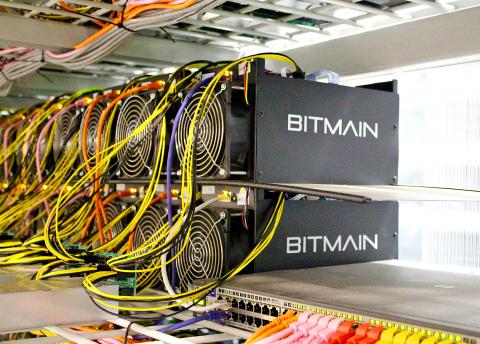
Photo: REUTERS
Profit rose almost ninefold to US$742.7 million in the first half from a year earlier, and revenue rose about 10-fold to US$2.8 billion in same period, with an adjusted return on equity of 58.9 percent, Bitmain said in its filing.
Mining hardware sales made up 94.3 percent of revenue, it said.
Bitmain held US$886.9 million of cryptocurrency assets at the end of June, or about 28 percent of its total assets, it said, adding that volatile markets might require “significant provisions” on inventories and cryptoholdings.
China International Capital Corp (中國國際金融) is the IPO sponsor.
Founded in 2013, Bitmain is one of the biggest companies to emerge from the boom in digital assets that propelled bitcoin to a 15-fold gain last year.
As both the largest operator of bitcoin mining collectives and the dominant supplier of virtual currency mining machines, the firm has enormous influence over the global cryptoecosystem — a role that has troubled members of the community who disdain anything resembling a centralization of power.
Yet questions over the sustainability of Bitmain’s meteoric rise have been multiplying in recent months. This year’s tumble in virtual currency prices threatens both the profitability of Bitmain’s mining operations and demand for the custom chips it sells to other miners.
Meanwhile, competition in the mining-gear business has grown more intense.
Two of Bitmain’s biggest rivals — Canaan Inc and Ebang International Holdings Inc (億邦國際控股公司) — are also pursuing IPOs in Hong Kong as they seek funding for a technological arms race.
Bitmain risks losing its competitive edge, Sanford C. Bernstein & Co analysts wrote in a report last month.
For now though, Bitmain is still the industry bellwether, with a market share in cryptomining gear estimated by Frost & Sullivan at nearly 75 percent.
If the company proceeds with the IPO, it will represent a major test of whether investors view virtual currencies as a temporary fad or an innovation with staying power.
A Bitmain listing — with its myriad public disclosure requirements — might also help reduce the opacity of an industry that skeptics say is under-regulated and prone to misbehavior.
“From the initial numbers I saw, it’s quite encouraging,” said Jehan Chu, managing partner at blockchain investment and advisory company Kenetic Capital.
The firm invested in Bitmain during an earlier round of funding, he said.
“It’s great to have actual clarity, validated documents to shed some light on the company’s actual status and actual performance,” Chu said.
The company has yet to disclose a target valuation or say how much it wants to raise from its IPO. People familiar with Bitmain’s plans told Bloomberg last month that the share sale could raise as much as US$3 billion.
Bitmain’s main product is called the Antminer, a server-sized box that sells for a few hundred to a few thousand US dollars.
Instead of the various parts that make up a traditional PC, Antminers are filled with dozens or hundreds of high-powered chips, known as application-specific ICs, that perform the brute-force number crunching needed to verify virtual currency transactions. Customers are mostly large mining operators in places with cheap electricity.
While Bitmain gets most of its revenue from mining equipment sales, the company also runs some of the world’s biggest mining collectives, in which members combine their processing capacity and split the rewards.

The domestic unit of the Chinese-owned, Dutch-headquartered chipmaker Nexperia BV will soon be able to produce semiconductors locally within China, according to two company sources. Nexperia is at the center of a global tug-of-war over critical semiconductor technology, with a Dutch court in February ordering a probe into alleged mismanagement at the company. The geopolitical tussle has disrupted supply chains, with some carmakers reportedly forced to cut production due to chip shortages. Local production would allow Nexperia’s domestic arm, Nexperia Semiconductors (China) Ltd (安世半導體中國), to bypass restrictions in place since October on the supply of silicon wafers — etched with tiny components to

Singapore-based ride-hailing and delivery giant Grab Holdings Ltd has applied for regulatory approval to acquire the Taiwan operations of Germany-based Delivery Hero SE's Foodpanda in a deal valued at about US$600 million. Grab submitted the filing to the Fair Trade Commission on Friday last week, with the transaction subject to regulatory review and approval, the company said in a statement yesterday. Its independent governance structure would help foster a healthy and competitive market in Taiwan if the deal is approved, Grab said. Grab, which is listed on the NASDAQ, said in the filing that US-based Uber Technologies Inc holds about 13 percent of

Taiwan Semiconductor Manufacturing Co (TSMC, 台積電) yesterday received government approval to deploy its advanced 3-nanometer (3nm) process at its second fab currently under construction in Japan, the Ministry of Economic Affairs said in a news release. The ministry green-lit the plan for the facility in Kumamoto, which is scheduled to start installing equipment and come online in 2028 with a monthly production capacity of 15,000 12-inch wafers, the ministry said. The Department of Investment Review in June 2024 authorized a US$5.26 billion investment for the facility, slated to manufacture 6- to 12nm chips, significantly less advanced than 3nm process. At a meeting with
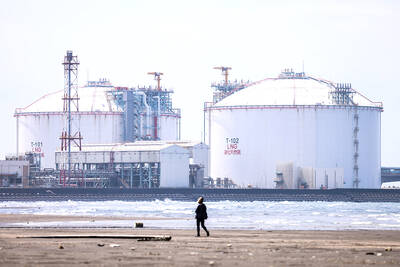
Taiwan is open to joining a global liquefied natural gas (LNG) program if one is created, but on the condition that countries provide delivery even in a scenario where there is a conflict with China, an energy department official said yesterday. While Taiwan’s priority is to have enough LNG at home, the nation is open to exploring potential strategic reserves in other countries such as Japan or South Korea, Energy Administration Deputy Director-General Chen Chung-hsien (陳崇憲) said. While the LNG market does not have a global reserve for emergencies like that of oil, the concept has been raised a few times —


 RSS
RSS