


Core Pacific City Co (京華城) has set a floor price of NT$38 billion (US$1.23 billion) for its gigantic central Taipei retail complex, also branded “Living Mall,” targeting buyers at home and abroad, auctioneers said yesterday.
It is the largest private property available for sale in recent decades as most high-profile transactions, including Taipei 101, Regent Taipei (台北晶華酒店), Taipei Nan Shan Plaza (台北南山廣場) and Taipei Garden Hotel (台北花園大酒店) are on leasehold contracts for 50 to 70 years, Cushman & Wakefield Inc told a tender briefing.
“It is not the best timing to sell properties these days, so I recommended a price concession and the owner accepted it,” Cushman & Wakefield Taiwan general manager Billy Yen (顏炳立) said, adding that the property could sell at a much higher price in a boom market.
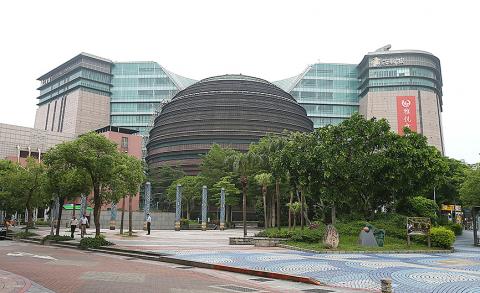
Photo: Hsu Yi-ping, Taipei Times
Core Pacific Group (威京集團), which owns the mall and interests in the civil engineering, construction, petrochemical, financial and entertainment sectors, has decided to dispose of the Living Mall, calling it “a failure,” Yen said.
The mall sits on a 4,986 ping (16,483m2) land plot in the city’s Songshan District (松山) with floor space of 62,000 ping on 12 floors above ground and eight below.
The developer took out a syndicated loan of NT$12 billion two decades ago to finance construction of the L-shaped complex and the debt is due to mature next year, sources said on condition of anonymity.
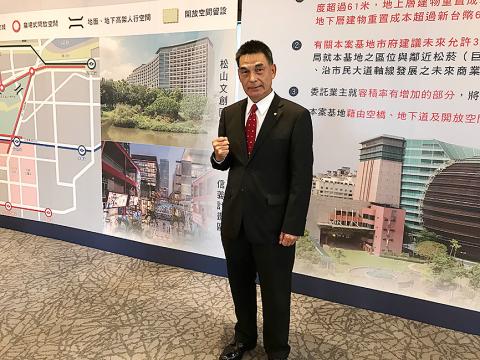
Photo: CNA
Prospective buyers could acquire the property as a whole for NT$38 billion or in four lots for a total of NT$51.7 billion, with the former option preferred and carrying incentives, the property consultancy said.
Land use for the complex is limited to the development of international tourist hotels, office space and department stores, meaning that buyers who wish to develop the property into luxury residential property would have to file rezoning requests.
That would generate rental incomes of 3.6 percent based on average rent prices of NT$2,500 per ping in Taipei, Yen said, adding that the figure is NT$5,000 in the adjacent Xinyi District (信義).
Winning bidders could also wait and file for urban redevelopment in 2031, while gaining bonus floor space in the meantime, Yen said, adding that the Living Mall would be an ideal investment for domestic life insurance companies that want to increase their real-estate stakes and trim idle cash.
Foreign investors in Singapore, Hong Kong and China have expressed strong interest, and the consultancy has set the auction for Dec. 12 to accommodate their fund relocation needs, he said.
Foreign investors would face capital gains taxes of 35 percent to 45 percent if they resell the property within two years of purchase.

Cairo’s new monorail slices across the city skyline, running above the familiar chaos of blaring horns and aging buses’ exhaust fumes that mark rush hour below. The US$4.5 billion monorail, opened this month, is among Egypt’s most prominent new transport projects, part of a debt-funded infrastructure drive criticized for sapping state finances while bringing limited benefits to most of the country’s 109 million people. “It feels like you’re in a different country,” said Ramy Sayed, a restaurant manager, aboard a driverless Innovia 300 train. “No noise, no traffic, we’re not used to this.” The eastern line runs 56km from the bustling middle-class

Taiwanese firms have increased investment in the Philippines in recent years as Manila’s ties with Washington deepen and global supply chains continue to shift away from China, an expert at the Chung-Hua Institution for Economic Research (CIER, 中華經濟研究院) said yesterday. The Philippines had not been among Taiwanese investors’ top choices in Southeast Asia, CIER Taiwan ASEAN Studies Center director Kristy Hsu (徐遵慈) said at a seminar in Taipei. However, Taiwan’s investment in the country has grown significantly since the COVID-19 pandemic, reaching US $257 million last year, a high in recent years, she said. Although Taiwan’s total investment in the Philippines still lags
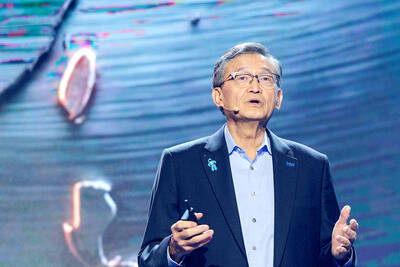
Intel Corp regards Taiwan Semiconductor Manufacturing Co (TSMC, 台積電) as a longstanding partner, as the US chipmaker would continue outsourcing production of advanced chips to TSMC, Intel chief executive officer Lip-Bu Tan (陳立武) said yesterday. “I don’t look at people as competitors. I look at the collaboration... Nvidia is also, you know, a good friend,” Tan told a news conference following his keynote speech at the Computex trade show in Taipei. “It’s a very trusted partnership for us... We are a big, top customer for them, and we’re going to continue doing that,” he said, referring to TSMC, the world’s largest foundry

Artificial intelligence (AI) agents would supplant smartphones as the center of people’s digital lives, fundamentally reshaping personal devices and driving a major computing upgrade cycle, Qualcomm Inc CEO Cristiano Amon said yesterday. In his keynote speech for this year’s Computex trade show in Taipei, Amon said that the rise of "agentic AI" — AI systems capable of reasoning, planning and carrying out tasks autonomously — would transform how people interact with technology across phones, PCs, vehicles and wearable devices. Describing the technology as the next major evolution in computing, Amon said that "2026 is the year of agents.” For decades, smartphones have sat


 RSS
RSS