


Compal Electronics Inc (仁寶), which manufactures notebook computers on a contract basis, yesterday gave a positive outlook on shipments of non-PC products this quarter as the company continues to adjust its product mix.
Shipments of tablet computers, wearables, e-readers and other consumer electronics are expected to rise 30 to 40 percent this quarter from last quarter ahead of Christmas, besting the 10 percent sequential growth that the company recorded in the first quarter of the year, Compal president Martin Wong (翁宗斌) said at an investors conference in Taipei.
Non-PC and non-notebook products started shipping last month and this month, and volumes are to increase in November and December, Wong said, adding that notebook shipments could rise up to 5 percent sequentially this quarter.
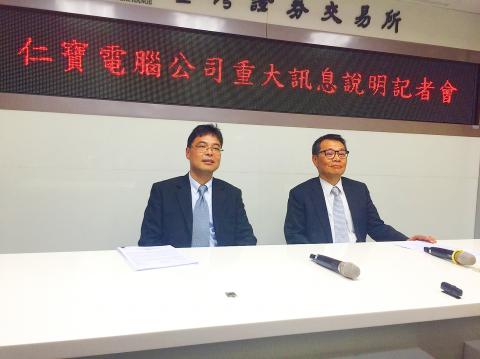
Photo: Chuo Yi-chun, Taipei Times
By the end of this year, non-notebook and non-PC sales could make up 35 percent of the company’s total annual sales revenue this year, Wong said.
Regarding the ongoing shortage of passive components, Wong said that Compal is better prepared than some of its peers, as the company has established close ties with suppliers over the past few decades and has secured long-term contracts.
“Our contracts with suppliers were inked many years before the latest shortage,” Wong said.
However, the poor yield rate for Intel Corp’s latest 10-nanometer CPUs could be a concern and delay shipments of notebook computers further down the line, he said.
Regarding the escalating US-China trade war, Wong said that the projected effects are minimal and it is unlikely that the countries would announce a “third round” of tit-for-tat tariffs.
“If implemented, third-phase tariff hikes would cause tremendous damage and I trust that the parties involved will show restraint,” Wong said.
“Compal is not part of the iPhone supply chain,” Compal vice chairman Ray Chen (陳瑞聰) added, referring to possible US tariffs on the smartphones, which are assembled in China.
The company has not actively been working on contingency plans, Chen said, adding that while it is not difficult to reallocate production and assembly lines, shifting entire supply chains and industry hubs would pose a daunting challenge.
“Components and products in different stages of completion would still need to be shipped from major hubs in Taiwan, leading to an estimated 3 percent in additional costs,” Chen said, adding that the company has production bases in Taiwan, Mexico, Poland and Vietnam.
The company reported that net income last quarter rose 449 percent annually to NT$2.29 billion (US$74.77 million) as profits bounced back from a low comparison base in the same period last year that was caused by bad debt.
Net sales rose 11 percent annually to NT$237.88 billion and earnings per share were NT$0.48.
Gross margin was 3.3 percent, down from 3.7 percent, with operating margin improving to 1.1 percent, from 0.4 percent in the same quarter last year.

The domestic unit of the Chinese-owned, Dutch-headquartered chipmaker Nexperia BV will soon be able to produce semiconductors locally within China, according to two company sources. Nexperia is at the center of a global tug-of-war over critical semiconductor technology, with a Dutch court in February ordering a probe into alleged mismanagement at the company. The geopolitical tussle has disrupted supply chains, with some carmakers reportedly forced to cut production due to chip shortages. Local production would allow Nexperia’s domestic arm, Nexperia Semiconductors (China) Ltd (安世半導體中國), to bypass restrictions in place since October on the supply of silicon wafers — etched with tiny components to

Singapore-based ride-hailing and delivery giant Grab Holdings Ltd has applied for regulatory approval to acquire the Taiwan operations of Germany-based Delivery Hero SE's Foodpanda in a deal valued at about US$600 million. Grab submitted the filing to the Fair Trade Commission on Friday last week, with the transaction subject to regulatory review and approval, the company said in a statement yesterday. Its independent governance structure would help foster a healthy and competitive market in Taiwan if the deal is approved, Grab said. Grab, which is listed on the NASDAQ, said in the filing that US-based Uber Technologies Inc holds about 13 percent of

Taiwan Semiconductor Manufacturing Co (TSMC, 台積電) yesterday received government approval to deploy its advanced 3-nanometer (3nm) process at its second fab currently under construction in Japan, the Ministry of Economic Affairs said in a news release. The ministry green-lit the plan for the facility in Kumamoto, which is scheduled to start installing equipment and come online in 2028 with a monthly production capacity of 15,000 12-inch wafers, the ministry said. The Department of Investment Review in June 2024 authorized a US$5.26 billion investment for the facility, slated to manufacture 6- to 12nm chips, significantly less advanced than 3nm process. At a meeting with

Taiwan’s food delivery market could undergo a major shift if Singapore-based Grab Holdings Ltd completes its planned acquisition of Delivery Hero SE’s Foodpanda business in Taiwan, industry experts said. Grab on Monday last week announced it would acquire Foodpanda’s Taiwan operations for US$600 million. The deal is expected to be finalized in the second half of this year, with Grab aiming to complete user migration to its platform by the first half of next year. A duopoly between Uber Eats and Foodpanda dominates Taiwan’s delivery market, a structure that has remained intact since the Fair Trade Commission (FTC) blocked Uber Technologies Inc’s


 RSS
RSS