


Cryptocurrencies are not scalable and are more likely to suffer a breakdown in trust and efficiency the greater the number of people using them, the Bank of International Settlements (BIS) said on Sunday in its latest warning about the rise of virtual currencies.
For any form of money to work across large networks it requires trust in the stability of its value and in its ability to scale efficiently, the BIS, an umbrella group for the world’s central banks, said in its annual report.
However, trust can disappear instantly because of the fragility of the decentralized networks on which cryptocurrencies depend, it said.
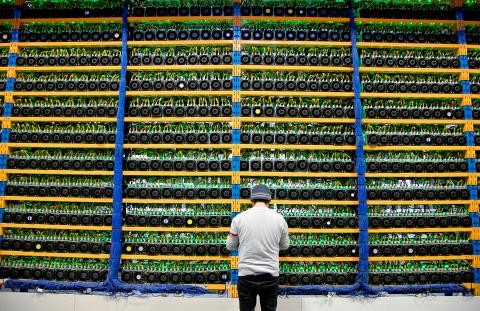
Photo: Reuters
Those networks are also prone to congestion the bigger they become, said the BSI, citing the high transaction fees of the best-known digital currency — bitcoin — and the limited number of transactions per second they can handle.
“Trust can evaporate at any time because of the fragility of the decentralized consensus through which transactions are recorded,” it said.
“Not only does this call into question the finality of individual payments, it also means that a cryptocurrency can simply stop functioning, resulting in a complete loss of value,” it said.
BIS head of research Hyun Song-shin said that sovereign money had value because it had users, but many people holding cryptocurrencies did so often purely for speculative purposes.
“Without users, it would simply be a worthless token. That’s true whether it’s a piece of paper with a face on it, or a digital token,” he said.
The dependency of users on so-called miners to record and verify cryptotransactions is also flawed, the BIS said, requiring vast and costly energy use.
It has issued a series of warnings this year after an explosive rise in cryptocurrency values attracted a wave of followers.
BIS general manager Agustin Carstens has described bitcoin as “a combination of a bubble, a Ponzi scheme and an environmental disaster.”
The BIS has told central banks to think hard about the potential risks before issuing their own cryptocurrencies.
No central bank has issued a digital currency, though the Riksbank in Sweden, where the use of cash has fallen, is studying a retail e-krona for small payments.
The BIS added that effective regulation of digital coins needed to be global, targeting regulated financial institutions and companies offering crypto-related services.

Singapore-based ride-hailing and delivery giant Grab Holdings Ltd has applied for regulatory approval to acquire the Taiwan operations of Germany-based Delivery Hero SE's Foodpanda in a deal valued at about US$600 million. Grab submitted the filing to the Fair Trade Commission on Friday last week, with the transaction subject to regulatory review and approval, the company said in a statement yesterday. Its independent governance structure would help foster a healthy and competitive market in Taiwan if the deal is approved, Grab said. Grab, which is listed on the NASDAQ, said in the filing that US-based Uber Technologies Inc holds about 13 percent of

The domestic unit of the Chinese-owned, Dutch-headquartered chipmaker Nexperia BV will soon be able to produce semiconductors locally within China, according to two company sources. Nexperia is at the center of a global tug-of-war over critical semiconductor technology, with a Dutch court in February ordering a probe into alleged mismanagement at the company. The geopolitical tussle has disrupted supply chains, with some carmakers reportedly forced to cut production due to chip shortages. Local production would allow Nexperia’s domestic arm, Nexperia Semiconductors (China) Ltd (安世半導體中國), to bypass restrictions in place since October on the supply of silicon wafers — etched with tiny components to

Taiwan Semiconductor Manufacturing Co (TSMC, 台積電) yesterday received government approval to deploy its advanced 3-nanometer (3nm) process at its second fab currently under construction in Japan, the Ministry of Economic Affairs said in a news release. The ministry green-lit the plan for the facility in Kumamoto, which is scheduled to start installing equipment and come online in 2028 with a monthly production capacity of 15,000 12-inch wafers, the ministry said. The Department of Investment Review in June 2024 authorized a US$5.26 billion investment for the facility, slated to manufacture 6- to 12nm chips, significantly less advanced than 3nm process. At a meeting with

Taiwan’s food delivery market could undergo a major shift if Singapore-based Grab Holdings Ltd completes its planned acquisition of Delivery Hero SE’s Foodpanda business in Taiwan, industry experts said. Grab on Monday last week announced it would acquire Foodpanda’s Taiwan operations for US$600 million. The deal is expected to be finalized in the second half of this year, with Grab aiming to complete user migration to its platform by the first half of next year. A duopoly between Uber Eats and Foodpanda dominates Taiwan’s delivery market, a structure that has remained intact since the Fair Trade Commission (FTC) blocked Uber Technologies Inc’s


 RSS
RSS