


Touchpanel supplier TPK Holding Co (宸鴻) yesterday said it expects to post its first operating loss in two years this quarter, as customers are reducing shipments of older-generation products ahead of new product launches in the second half of this year.
Revenue is projected to plunge about 20 percent this quarter, compared with NT$20.85 billion (US$701 million) during the first three months of this year.
“The second quarter will be the trough this year. Our clients have released their outlook for the next two quarters and we are basically following their business pattern,” TPK chief strategist Freddie Liu (劉詩亮) told investors. “Clients are adjusting [downward] during the product transition period... There have been drastic changes in [client] orders lately.”
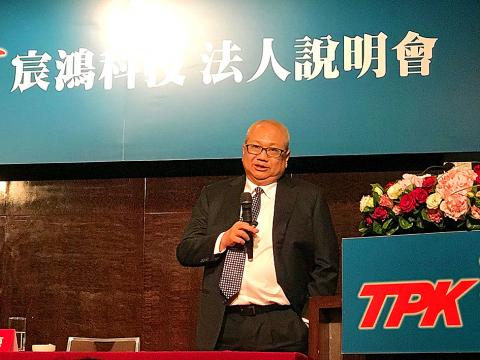
Photo: Chen Mei-ying, Taipei Times
TPK now expects its factory utilization to trend down further from last quarter and anticipates an operating loss this quarter, he said.
However, it expects a significant rebound in the second half, when customers begin shipping new products in August, he added.
TPK is expected to return to Apple Inc’s iPhone supply chain by assembling touch modules for a lower-priced model, sharing orders with local rival General Interface Solution (GIS) Holding Ltd (業成), IHS Markit said last month.
To cope with clients’ new demand, TPK plans to boost capital expenditure by 62 percent to NT$7.5 billion this year.
It would be challenging for the company to stay profitable, as the new LCD touch module assembly business has a lower average selling price, it said.
First-quarter operating profit grew 85 percent year-on-year to NT$223 million from NT$120 million, but dropped 69 percent quarter-on-quarter from NT$718 million due to seasonal weakness and fewer working days.
Net profit sank to NT$68 million from NT$616 million a year ago, when it booked a major disposal gain, and NT$591 million a quarter ago.
Earnings per share contracted to NT$0.17 last quarter, compared with NT$1.78 a year earlier and NT$1.53 in the previous quarter.
Touch module shipments fell 26 percent to 35.7 million units last quarter, from 48.5 million units in the fourth quarter last year.
Talking about the company’s long-term development plans, CEO H.H. Chiang (江懷海) said that TPK aims to become the touch module supplier for the world’s first bendable smartphones, no matter which brand first offers such devices.
Chiang, who took the company’s helm seven months ago, expressed confidence in the company’s ability, citing its leadership in the new silver nanowire technology, which could replace rigid indium–tin-oxide (ITO) film and metal mesh currently used in smartphones and tablet sensors.
TPK’s silver nanowire technology is suitable for flexible OLED displays and bendable or rollable handsets, given its stretchable transparent conductive film.
Panasonic Corp has adopted its silver nanowire technology for a notebook computer, TPK said.
TPK expects the new-generation silver nanowire technology to be commercial in the first half of next year.

The domestic unit of the Chinese-owned, Dutch-headquartered chipmaker Nexperia BV will soon be able to produce semiconductors locally within China, according to two company sources. Nexperia is at the center of a global tug-of-war over critical semiconductor technology, with a Dutch court in February ordering a probe into alleged mismanagement at the company. The geopolitical tussle has disrupted supply chains, with some carmakers reportedly forced to cut production due to chip shortages. Local production would allow Nexperia’s domestic arm, Nexperia Semiconductors (China) Ltd (安世半導體中國), to bypass restrictions in place since October on the supply of silicon wafers — etched with tiny components to

Singapore-based ride-hailing and delivery giant Grab Holdings Ltd has applied for regulatory approval to acquire the Taiwan operations of Germany-based Delivery Hero SE's Foodpanda in a deal valued at about US$600 million. Grab submitted the filing to the Fair Trade Commission on Friday last week, with the transaction subject to regulatory review and approval, the company said in a statement yesterday. Its independent governance structure would help foster a healthy and competitive market in Taiwan if the deal is approved, Grab said. Grab, which is listed on the NASDAQ, said in the filing that US-based Uber Technologies Inc holds about 13 percent of

Taiwan Semiconductor Manufacturing Co (TSMC, 台積電) yesterday received government approval to deploy its advanced 3-nanometer (3nm) process at its second fab currently under construction in Japan, the Ministry of Economic Affairs said in a news release. The ministry green-lit the plan for the facility in Kumamoto, which is scheduled to start installing equipment and come online in 2028 with a monthly production capacity of 15,000 12-inch wafers, the ministry said. The Department of Investment Review in June 2024 authorized a US$5.26 billion investment for the facility, slated to manufacture 6- to 12nm chips, significantly less advanced than 3nm process. At a meeting with

Taiwan is open to joining a global liquefied natural gas (LNG) program if one is created, but on the condition that countries provide delivery even in a scenario where there is a conflict with China, an energy department official said yesterday. While Taiwan’s priority is to have enough LNG at home, the nation is open to exploring potential strategic reserves in other countries such as Japan or South Korea, Energy Administration Deputy Director-General Chen Chung-hsien (陳崇憲) said. While the LNG market does not have a global reserve for emergencies like that of oil, the concept has been raised a few times —


 RSS
RSS