


Novartis AG agreed to acquire AveXis Inc for US$8.7 billion to gain a promising drug to treat a rare disease that afflicts infants, hastening a shift toward gene therapy and precision medicines.
Shareholders of the Bannockburn, Illinois-based company would receive US$218 a share in cash in a tender offer, Novartis said in a statement yesterday.
The price is 88 percent above where AveXis closed on Friday.
The transaction is Novartis’ second deal to advance in gene therapy this year — and the first led by new chief executive officer Vas Narasimhan.
The Swiss drugmaker is redeploying some of the US$13 billion in proceeds from the sale of its stake in a consumer-health joint venture to partner GlaxoSmithKline PLC to gain more firepower in prescription medicines before some of its existing best-sellers lose patent protection.
“Our goal is to build on a core of medicines as a medicines company powered by data and digital,” Narasimhan said in a conference call with investors. “A deal like this fits right in that sweet spot.”
AveXis is developing a product to treat spinal muscular atrophy, an inherited neurodegenerative disease caused by a defect in a single gene, which shows the potential to become a blockbuster, a Novartis statement said.
In buying AveXis, the Swiss drugmaker is also gaining the company’s AVXS-101 product to address a rare disease. Like gene therapies, such treatments command high prices that have sparked interest even from unexpected players in the industry.
AveXis also has valuable manufacturing and research capabilities that would give its Swiss buyer a platform alongside its research on chimeric antigen receptor T-cell therapy (CAR-T) in cancer “to advance a growing pipeline of gene therapies across therapeutic areas,” Narasimhan said.
Novartis’ Kymriah won US regulatory approval in August last year, making it the first drug approved from a new class of treatments called CAR-Ts that have been heralded as a promising approach to treating and potentially curing cancers as well as genetic conditions such as blindness. Like other gene therapies, it is used only once on a patient, and thus carries a high price tag — US$475,000, in the case of Kymriah.
AVXS-101 helped a small group of babies with spinal muscular atrophy hit development milestones at a rate previously unseen, a study showed in November last year.
The first medication for the disease, Biogen Inc’s Spinraza, won approval less than a year ago. Babies with the most severe form of the disease typically die before age two.
“This acquisition makes strategic sense,” Vontobel AG analyst Stefan Schneider wrote in a note to clients.
Novartis’ drugs Gilenya and Afinitor would probably face competition from cheaper generics next year — about the same time that AveXis’ first experimental drug might reach the market, Schneider said.

ENERGY ISSUES: The TSIA urged the government to increase natural gas and helium reserves to reduce the impact of the Middle East war on semiconductor supply stability Chip testing and packaging service provider ASE Technology Holding Co (日月光投控) yesterday said it planned to invest more than NT$100 billion (US$3.15 billion) in building a new advanced chip testing facility in Kaohsiung to keep up with customer demand driven by the artificial intelligence (AI) boom. That would be included in the company’s capital expenditure budget next year, ASE said. There is also room to raise this year’s capital spending budget from a record-high US$7 billion estimated three months ago, it added. ASE would have six factories under construction this year, another record-breaking number, ASE chief operating officer Tien Wu

The EU and US are nearing an agreement to coordinate on producing and securing critical minerals, part of a push to break reliance on Chinese supplies. The potential deal would create incentives, such as minimum prices, that could advantage non-Chinese suppliers, according to a draft of an “action plan” seen by Bloomberg. The EU and US would also cooperate on standards, investments and joint projects, as well as coordinate on any supply disruptions by countries like China. The two sides are additionally seeking other “like-minded partners” to join a multicountry accord to help create these new critical mineral supply chains, which feed into

For weeks now, the global tech industry has been waiting for a major artificial intelligence (AI) launch from DeepSeek (深度求索), seen as a benchmark for China’s progress in the fast-moving field. More than a year has passed since the start-up put Chinese AI on the map in early last year with a low-cost chatbot that performed at a similar level to US rivals. However, despite reports and rumors about its imminent release, DeepSeek’s next-generation “V4” model is nowhere in sight. Speculation is also swirling over the geopolitical implications of which computer chips were chosen to train and power the new
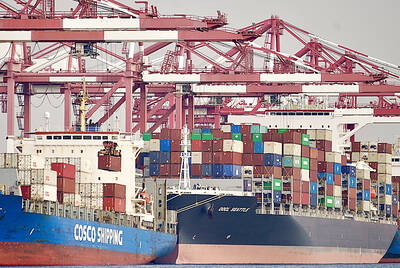
TECH WINNERS: Taiwan and South Korea reported robust trade, which suggests that they have critical advantages in the rapidly expanding AI supply chain, an official said Exports last month surged to a new high, as booming demand tied to artificial intelligence (AI) infrastructure fueled shipments of advanced technology components, underscoring the nation’s pivotal role in the global semiconductor supply chain. Outbound shipments climbed to US$80.18 billion, the highest ever for a single month, rising 61.8 percent from a year earlier and marking the 29th consecutive month of growth, the Ministry of Finance said yesterday. “The surge was driven primarily by global investment in AI infrastructure,” Department of Statistics Director-General Beatrice Tsai (蔡美娜) said. The mass production of next-generation AI computing systems has accelerated procurement across the semiconductor supply


 RSS
RSS