


Taipei Times: Why did Ten Drum Art Percussion Group (十鼓擊樂團) want to enter into business and operate a creative park?
Yang Yu-wen (楊有文): In 2000, a group of young people who loved traditional percussion established Ten Drum Art Percussion Group with an aim to promote and pass down Taiwan’s unique percussion music, which is different from Taiwanese opera, puppet shows and lion dances that are also associated with temple culture.
The group decided to search for a practice venue after residents lodged noise complaints.
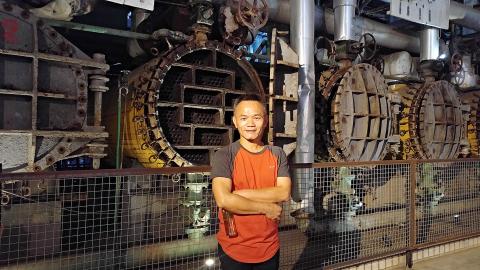
Photo: Crystal Hsu, Taipei Times
It chose Taiwan Sugar Corp’s (Taisugar, 台糖) Rende Sugar Refinery (仁德糖廠), which had been idle for decades.
The mill had no water or electricity, but had heaps of waste. Mosquitoes, bugs, cobras and other wild animals occupied the space.
At first we took up only five warehouses to create Ten Drum Rende Creative Park (十鼓仁糖文創園區), but had to rent more over the years after Taisugar indicated that it had plans to dispose of idle assets.
Today, the rental space has grown from 1.5 hectares to 7.5 hectares, with the number of warehouses increasing from five to 17. This accounts for two-thirds of the Rende mill, which was established in 1909.
The complex now features a drum museum, drumming experience rooms, a medium-sized theater, a cafe, a children’s playground and retail space, all converted from old, but well-preserved warehouses, molasses storage tanks, pipelines and other factory facilities.
It also offers various extreme sport facilities, such as indoor rock climbing and bungee jumping, which appeal to visitors who enjoy speed, height and survival experiences in a rough industrial environment.
TT: What have been the biggest difficulties in building an industrial wasteland into a landmark recreational facility in southern Taiwan?
Yang: A lack of funding poses the No. 1 headache and remains a challenge today. Funding was insufficient and unstable in the beginning, while personnel was limited. Moreover, there were also negotiations with Taisugar.
We thought hard work would translate into a balanced finance sheet, but the reality did not lend support. We had to adjust and redefined our role.
The group’s founder, Hsieh Shih (謝十), had to take on multiple roles, including president, CEO, artistic director, director of creative innovation, construction supervisor and field worker.
Full-time group members also had to handle administration work while doubling as performers, tour guides, theater cleaning staff and delivery drivers, as well as cafeteria staff.
I first volunteered to help on a part-time basis after listening to the group’s performance. I used to own a small advertising company and developed an acumen for identifying creative talent. I closed the firm a few years later to concentrate on managing Ten Drum and pushing it to the world stage.
Both Hsieh and I had to mortgage our apartments to help support that goal.
We almost gave up after consecutive years of losses. Then came a turning point in 2009, when our album Drum Music Land (鼓之島), in collaboration with Taiwan Wind Music (風潮音樂), was nominated at the Grammys and the Independent Music Awards — unprecedented honors in Taiwan’s music history.
The nominations attracted visitors to the park and invitations to perform increased sharply. The group has performed in numerous cities worldwide, was featured in the Federation for Asian Cultural Promotion conference’s “Asian Gem in the Arts” segment and was selected as the best musical group at Scotland’s Edinburgh Festival Fringe.
We now have 100 employees, regular and part-time.
TT: Would you disclose the park’s financial performance for last year and provide its business outlook for this year and beyond?
Yang: We managed to break even last year, when we entertained 650,000 visitors in three venues; we have two other properties in Chiayi County and Kaohsiung.
The number of visitors should climb higher this year, because the Chaiyi outlet was opened in October last year.
However, we decided to shut down a property in Hualien County early this year, as concerns about bad weather and inconvenient transportation proved too heavy downside risks.
We expect to turn a mild profit this year, encouraged by a 5 percent to 10 percent increase in ticket sales in the first quarter. We raised evening ticket charges this month from NT$150 to NT$200 (US$5.15 to US$6.86) to help cover wage increases and other costs.
The park will stay in the red if it fails to generate between NT$160 million and NT$170 million per year. Operating costs average NT$500,000 per day.
The outbreak of a disease like SARS would wreak havoc on the property. Still, uncertainty — such as typhoon and maintenance expenses — might create extra overhead and derail the growth forecast.
TT: What are Ten Drum’s future development plans?
Yang: We are in talks with Taisugar to rent an additional 3.5 hectares that might allow us to better preserve the industrial complex and improve its facilities. We see the complex as a great historical treasure and aim to build it into an international tourist site, generating funds from admission ticket sales.
We will stand by our faith to rebuild the Rende Sugar Refinery into a space that values and combines percussion, industrial heritage, stories about humanity and environmental friendliness.
That effort has already yielded fruit, as we have been nominated by the World Architecture Festival in the “Old Completed Buildings” category.
In addition, a local construction company has inked a deal with Formosa International Hotels Corp (晶華酒店) to build a hotel in the complex to meet lodging demand in the area. Ten Drum is adjacent to Chimei Museum and both are a 15-minute car ride from Tainan High Speed Rail Station. The 129-guest room hotel is likely to operate under the Just Sleep (捷絲旅) brand and begin operations in three years.
TT: Do you have any overseas expansion plans?
Yang: We have turned down invitations to copy the business model and build a creative park in China, where it might be more profitable given the large size of the market. The group has performed in China. All we want is to preserve and promote local music and art.
Profitability is not our top concern. The group is no longer seeking government subsidies after qualifying for NT$1 million in financial aid for three years. Hsieh believes that Ten Drum should yield the opportunity to other groups that are in worse financial situations.
The Tainan City Government and Taisugar have placed their trust in Ten Drum and we will strive to promote percussion arts and protect the industrial heritage.

Cairo’s new monorail slices across the city skyline, running above the familiar chaos of blaring horns and aging buses’ exhaust fumes that mark rush hour below. The US$4.5 billion monorail, opened this month, is among Egypt’s most prominent new transport projects, part of a debt-funded infrastructure drive criticized for sapping state finances while bringing limited benefits to most of the country’s 109 million people. “It feels like you’re in a different country,” said Ramy Sayed, a restaurant manager, aboard a driverless Innovia 300 train. “No noise, no traffic, we’re not used to this.” The eastern line runs 56km from the bustling middle-class

Taiwanese firms have increased investment in the Philippines in recent years as Manila’s ties with Washington deepen and global supply chains continue to shift away from China, an expert at the Chung-Hua Institution for Economic Research (CIER, 中華經濟研究院) said yesterday. The Philippines had not been among Taiwanese investors’ top choices in Southeast Asia, CIER Taiwan ASEAN Studies Center director Kristy Hsu (徐遵慈) said at a seminar in Taipei. However, Taiwan’s investment in the country has grown significantly since the COVID-19 pandemic, reaching US $257 million last year, a high in recent years, she said. Although Taiwan’s total investment in the Philippines still lags

Intel Corp regards Taiwan Semiconductor Manufacturing Co (TSMC, 台積電) as a longstanding partner, as the US chipmaker would continue outsourcing production of advanced chips to TSMC, Intel chief executive officer Lip-Bu Tan (陳立武) said yesterday. “I don’t look at people as competitors. I look at the collaboration... Nvidia is also, you know, a good friend,” Tan told a news conference following his keynote speech at the Computex trade show in Taipei. “It’s a very trusted partnership for us... We are a big, top customer for them, and we’re going to continue doing that,” he said, referring to TSMC, the world’s largest foundry

Artificial intelligence (AI) agents would supplant smartphones as the center of people’s digital lives, fundamentally reshaping personal devices and driving a major computing upgrade cycle, Qualcomm Inc CEO Cristiano Amon said yesterday. In his keynote speech for this year’s Computex trade show in Taipei, Amon said that the rise of "agentic AI" — AI systems capable of reasoning, planning and carrying out tasks autonomously — would transform how people interact with technology across phones, PCs, vehicles and wearable devices. Describing the technology as the next major evolution in computing, Amon said that "2026 is the year of agents.” For decades, smartphones have sat


 RSS
RSS