


The scabies on Indonesian rice farmer Yusuf Supriyadi’s limbs are a daily reminder of the costs of living next to the “world’s dirtiest river.”
Supriyadi depends on the Citarum River’s murky waters — a floating carpet of household garbage, toxic chemicals and animal feces — to irrigate a small rice plot in West Java Province that sustains his family of six.
The farmer’s rice yield is now down by two-thirds in the rainy season as textile factories dump increasing amounts of industrial waste into the river, but he has few other options.
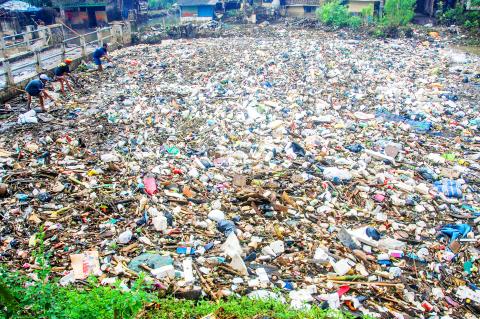
Photo: AFP
“There are floods during the rainy season. My hands get itchy and the harvest is damaged,” the 54-year-old told Agence France-Presse. “Pollution makes my rice hollow. If I keep going I’ll lose money, but if I don’t, I’ll have no other job.”
Now faced with a health emergency after decades of failed cleanup efforts, Jakarta is stepping in with a seemingly impossible goal: make the Citarum’s water drinkable by 2025.
Using this polluted water is a risky calculation for many of the 30 million people who rely on it for irrigation, washing and even drinking water — including about 80 percent of residents in the sprawling capital, Jakarta.
At nearly 300km long, the river is also a key source for hydroelectric power for Indonesia’s most populated island, Java, and tourism hot spot Bali.
The World Bank declared it the most polluted river in the world a decade ago, a description widely picked up by media and environmentalists.
Waste levels can vary depending on how pollution is measured and the time of the year, but the Citarum is dangerous by almost any standard.
Previous research has shown it has alarming levels of toxic chemicals — including 1,000 times more lead than the US standard for safe drinking water.
It regularly appears on most polluted lists alongside India’s Ganges River, the US’ Mississippi River and China’s Yellow River.
In January, Jakarta yanked responsibility away from local governments and vowed to get tough on business owners who ignore waste disposal rules. Factories that fall short could have operating permits revoked.
CCTV cameras are to be installed along the river’s banks to keep an eye out for offenders dumping waste in the early morning hours to evade detection.
Meanwhile, dredging equipment is to be used to clean up the filthy river, Indonesian Ministry of Maritime Affairs and Fisheries spokesman Djoko Hartoyo said.
“We are not playing around this time,” he said. “We’re going in with a holistic approach, so we are optimistic we can make Citarum clean again, just like it was 50 or 60 years ago.”
In the 1980s, a new industrial zone sprang up around the small town of Majalaya, about 170km east of Jakarta, and things quickly changed for the pristine river.
About 2,000 textile factories in the area have provided much-needed jobs, but they came with a heavy cost: About 280 tonnes of industrial waste are dumped into the river each day, government and environmental group data showed.
Making matters worse, many locals think nothing of tossing their household waste into its toxic waters.
“When it rains and my house gets flooded, the smell is awful,” Achmad Fachrureza said from inside an inflatable dingy as he navigated the river’s polystyrene foam containers, fabric, empty cans, plastic bottles and garbage bags.
The 57-year-old villager said he was fired from his job as a textile factory security guard after asking questions about the firm’s waste disposal system.
Factory pipes dump waste directly into waters bubbling with chemical dyes used in textiles, creating an overwhelming stench.
“Most factories here have a waste disposal system, but they don’t work properly, because it’s just a formality,” said Deni Riswandani of Elingan, a local environmental group.
That poses a serious health risk, especially for the 5 million people living in the river’s basin. Many locals suffer from skin diseases such as scabies and dermatitis, as well as respiratory infections from inhaling factory pollution.
“The number of people going to the health clinic is very high,” Riswandani said. “We keep reporting these issues to the government, but we never get a solution.”
He and other frustrated activists have blocked some waste pipes with rocks and concrete, but the factories usually remove the blockage right away.
Locals hope Jakarta’s new goals can be achieved, but they are also skeptical given the scale of the task and endemic corruption that could see factory owners try to buy their way out of trouble.
“I long to see the Citarum like it was when I was young,” Fachrureza said. “I could swim in it and drink the water. It was so clean.”

DIVIDED VIEWS: Although the Fed agreed on holding rates steady, some officials see no rate cuts for this year, while 10 policymakers foresee two or more cuts There are a lot of unknowns about the outlook for the economy and interest rates, but US Federal Reserve Chair Jerome Powell signaled at least one thing seems certain: Higher prices are coming. Fed policymakers voted unanimously to hold interest rates steady at a range of 4.25 percent to 4.50 percent for a fourth straight meeting on Wednesday, as they await clarity on whether tariffs would leave a one-time or more lasting mark on inflation. Powell said it is still unclear how much of the bill would fall on the shoulders of consumers, but he expects to learn more about tariffs

Meta Platforms Inc offered US$100 million bonuses to OpenAI employees in an unsuccessful bid to poach the ChatGPT maker’s talent and strengthen its own generative artificial intelligence (AI) teams, OpenAI CEO Sam Altman has said. Facebook’s parent company — a competitor of OpenAI — also offered “giant” annual salaries exceeding US$100 million to OpenAI staffers, Altman said in an interview on the Uncapped with Jack Altman podcast released on Tuesday. “It is crazy,” Sam Altman told his brother Jack in the interview. “I’m really happy that at least so far none of our best people have decided to take them
PLANS: MSI is also planning to upgrade its service center in the Netherlands Micro-Star International Co (MSI, 微星) yesterday said it plans to set up a server assembly line at its Poland service center this year at the earliest. The computer and peripherals manufacturer expects that the new server assembly line would shorten transportation times in shipments to European countries, a company spokesperson told the Taipei Times by telephone. MSI manufactures motherboards, graphics cards, notebook computers, servers, optical storage devices and communication devices. The company operates plants in Taiwan and China, and runs a global network of service centers. The company is also considering upgrading its service center in the Netherlands into a

NOT JUSTIFIED: The bank’s governor said there would only be a rate cut if inflation falls below 1.5% and economic conditions deteriorate, which have not been detected The central bank yesterday kept its key interest rates unchanged for a fifth consecutive quarter, aligning with market expectations, while slightly lowering its inflation outlook amid signs of cooling price pressures. The move came after the US Federal Reserve held rates steady overnight, despite pressure from US President Donald Trump to cut borrowing costs. Central bank board members unanimously voted to maintain the discount rate at 2 percent, the secured loan rate at 2.375 percent and the overnight lending rate at 4.25 percent. “We consider the policy decision appropriate, although it suggests tightening leaning after factoring in slackening inflation and stable GDP growth,”


 RSS
RSS