


China’s wealthiest man, Jack Ma (馬雲), has locked horns with the nation’s fourth-richest in an escalating dispute over the lucrative business of shipping Alibaba Group Holding Ltd’s (阿里巴巴) parcels to millions of shoppers nationwide.
In an exchange filing yesterday billionaire Wang Wei’s (王衛) SF Holding Co (順豐控股) accused Alibaba’s delivery affiliate of removing the company as a shipping option and blocking access to vital data.
The affiliate backed by Ma, known as Cainiao (菜鳥), fired back by saying it was SF that first walled off information it needed to get parcels to customers.
It is unclear what triggered the spat, which threatens a symbiotic relationship that underpinned SF’s listing this year and helped Wang accumulate a fortune of about US$21.5 billion.
Alibaba’s part-owned Cainiao depends on services such as SF Express (順豐快遞) — the largest of a handful of domestic delivery businesses — to get parcels to customers’ doorsteps.
However, the falling out was serious enough that China’s postal bureau, which also regulates the industry, urged both parties to resolve their differences as soon as possible to avoid throwing the market into disarray.
The dispute might have arisen over a desire to control the valuable customer information generated through the millions of orders and shipments that flow through Alibaba’s massive e-commerce operation.
SF would not provide data Cainiao demanded last month, because they were not relevant, the delivery firm said in a microblog post on Sina Weibo (新浪微博) on Thursday.
“The heart of this conflict revolves around how Cainiao wants access to SF’s data and SF getting more reluctant,” said Marie Sun, a Shenzhen-based analyst at Morningstar Investment Service.
“SF probably wants to maximize its own interest and in the short term it has options to work with other e-commerce platforms,” she said.
Cainiao and SF Express have been close partners in a parcel delivery business underpinning China’s 6.2 trillion yuan (US$910 billion) online retail market. Alibaba’s 450 million active buyers helped spur more than 30 billion express deliveries in China last year, a significant proportion of which were shipped via Shenzhen-listed SF.
Wang’s company said Cainiao accounts for about a fifth of its total deliveries, though it maintained the dispute would not affect the company’s profit projections for this year and next.
“We are surprised and disappointed by SF’s abrupt action to stop providing the information that is necessary for the smooth completion of parcel deliveries,” Cainiao said in an e-mailed statement.
“To protect more than a million of consumers and merchants from potential parcel losses, we have no option but to remove SF as a delivery option on Cainiao’s network,” it said.
SF declined to comment on the latest developments.
Zhejiang Cainiao Supply Chain Management Co (浙江菜鳥供應鏈管理), of which Alibaba owns 48 percent, has been building a software platform to connect other delivery providers and speed the shipment of packages across China.
Alibaba’s shoppers can track their parcels via Cainiao, while actual delivery is carried out by third-party services such as SF Express.

SECOND-RATE: Models distilled from US products do not perform the same as the original and undo measures that ensure the systems are neutral, the US’ cable said The US Department of State has ordered a global push to bring attention to what it said are widespread efforts by Chinese companies, including artificial intelligence (AI) start-up DeepSeek (深度求索), to steal intellectual property from US AI labs, according to a diplomatic cable. The cable, dated Friday and sent to diplomatic and consular posts around the world, instructs diplomatic staff to speak to their foreign counterparts about “concerns over adversaries’ extraction and distillation of US AI models.” Distillation is the process of training smaller AI models using output from larger, more expensive ones to lower the costs of training a powerful new

Singapore-based ride-hailing and delivery giant Grab Holdings’ planned acquisition of Foodpanda’s Taiwan operations has yet to enter the formal review stage, as regulators await supplementary documents, the Fair Trade Commission (FTC) said yesterday. Acting FTC Chairman Chen Chih-min (陳志民) told the legislature’s Economics Committee that although Grab submitted its application on March 27, the case has not been officially accepted because required materials remain incomplete. Once the filing is finalized, the FTC would launch a formal probe into the deal, focusing on issues such as cross-shareholding and potential restrictions on market competition, Chen told lawmakers. Grab last month announced that it would acquire
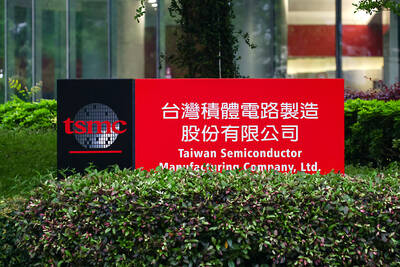
Shares of Taiwan Semiconductor Manufacturing Co (TSMC, 台積電) have repeatedly hit new highs, but an equity analyst said the stock’s valuation remains within a reasonable range and any pullback would likely be technical. The contract chipmaker’s historical price-to-earnings (P/E) ratio has ranged between 20 and 30, Cathay Futures Consultant Co (國泰證期) analyst Tsai Ming-han (蔡明翰) told Central News Agency. With market consensus projecting that TSMC would post earnings per share of about NT$100 (US$3.17) this year, supported by strong global demand for artificial intelligence (AI) applications, and the stock currently trading at a P/E ratio of below 25, Tsai said the valuation

The artificial intelligence (AI) boom has triggered a seismic reshuffling of global equity markets, with Taiwan and South Korea muscling past European nations one by one. With its stock market now valued at nearly US$4.3 trillion, Taiwan surpassed the UK, Europe’s biggest market, earlier this month, data compiled by Bloomberg showed. South Korea is about US$140 billion away from doing the same. The tech-heavy Asian markets have shot past Germany and France in the past seven months. The shift is largely down to massive gains in shares of three companies that provide essential hardware for AI: Taiwan Semiconductor Manufacturing Co (TSMC, 台積電),


 RSS
RSS