


Android Pay, a mobile digital wallet platform developed by Google, was launched nationwide yesterday, with thousands of stores joining the new payment service.
Users of smartphones or tablets equipped with near-field communication and Android Kitkat 4.4 or more advanced operating systems are to have access to the new service, Google Taiwan said.
Android Pay has been rolled out in 13 nations since September 2015, including the US, UK, Canada, Hong Kong and Singapore.
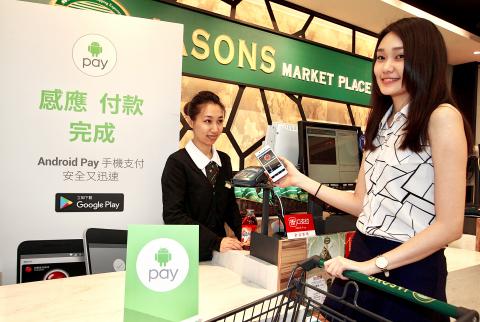
Photo: CNA
Taiwan is the fourth market in Asia to have the service, Google Taiwan managing director Chien Lee-feng (簡立峰) said.
Holders of Visa and MasterCard credit cards issued by CTBC Bank (中國信託銀行) and First Commercial Bank (第一銀行) can make use of the service, Google Taiwan said.
As long as credit card holders from the two participating banks install the Android Pay app and add their cards, they will be able to make tap-to-pay purchases in participating stores online and offline, it said.
Android Pay also incorporates Google Maps services to remind consumers of coupons, membership cards and discounts when they visit stores, it added.
HappyGo, the largest point-collecting platform in the nation, is also to allow people to add their cards to Android Pay, Google Taiwan said, adding that purchases at certain shops would contribute points that can be used for discounts on future purchases.
Stores in Taiwan that accept Android Pay include Carrefour, A-Mart (愛買), RT-Mart (大潤發), Pxmart (全聯), Taipei 101, Pacific Sogo Department Store (太平洋崇光百貨), Starbucks and Watsons, the company said.
Taiwan is an important market for Android Pay because it has a fast-growing e-commerce market and great potential for mobile payment growth, Chien said.
According to Google Taiwan, 62 percent of consumers in Taiwan have made purchases over the Internet, posting about US$38 billion in aggregate transaction value to date.
Smartphones account for 82 percent of the nation’s cellphone market and it is the fifth-largest market for Android Play: further evidence of its growth potential, Chien said.
The introduction of Android Pay is expected to be welcomed by Taiwanese who are keen to have alternative payment methods, he said, adding that it would likely accelerate the pace of mobile payment adoption.
Android Pay is the third major foreign mobile payment platform available in Taiwan, following Apple Pay, which started in late March, and Samsung Pay, which began early last month.

The domestic unit of the Chinese-owned, Dutch-headquartered chipmaker Nexperia BV will soon be able to produce semiconductors locally within China, according to two company sources. Nexperia is at the center of a global tug-of-war over critical semiconductor technology, with a Dutch court in February ordering a probe into alleged mismanagement at the company. The geopolitical tussle has disrupted supply chains, with some carmakers reportedly forced to cut production due to chip shortages. Local production would allow Nexperia’s domestic arm, Nexperia Semiconductors (China) Ltd (安世半導體中國), to bypass restrictions in place since October on the supply of silicon wafers — etched with tiny components to

Singapore-based ride-hailing and delivery giant Grab Holdings Ltd has applied for regulatory approval to acquire the Taiwan operations of Germany-based Delivery Hero SE's Foodpanda in a deal valued at about US$600 million. Grab submitted the filing to the Fair Trade Commission on Friday last week, with the transaction subject to regulatory review and approval, the company said in a statement yesterday. Its independent governance structure would help foster a healthy and competitive market in Taiwan if the deal is approved, Grab said. Grab, which is listed on the NASDAQ, said in the filing that US-based Uber Technologies Inc holds about 13 percent of

Taiwan Semiconductor Manufacturing Co (TSMC, 台積電) yesterday received government approval to deploy its advanced 3-nanometer (3nm) process at its second fab currently under construction in Japan, the Ministry of Economic Affairs said in a news release. The ministry green-lit the plan for the facility in Kumamoto, which is scheduled to start installing equipment and come online in 2028 with a monthly production capacity of 15,000 12-inch wafers, the ministry said. The Department of Investment Review in June 2024 authorized a US$5.26 billion investment for the facility, slated to manufacture 6- to 12nm chips, significantly less advanced than 3nm process. At a meeting with

Taiwan’s food delivery market could undergo a major shift if Singapore-based Grab Holdings Ltd completes its planned acquisition of Delivery Hero SE’s Foodpanda business in Taiwan, industry experts said. Grab on Monday last week announced it would acquire Foodpanda’s Taiwan operations for US$600 million. The deal is expected to be finalized in the second half of this year, with Grab aiming to complete user migration to its platform by the first half of next year. A duopoly between Uber Eats and Foodpanda dominates Taiwan’s delivery market, a structure that has remained intact since the Fair Trade Commission (FTC) blocked Uber Technologies Inc’s


 RSS
RSS