


MANUFACTURERS
Compeq expects revenue fall
Compeq Manufacturing Co (華通), which produces multilayer and double-sided printed circuit boards, yesterday said revenue for this quarter would be lower than last quarter because of the effects of major clients’ product transitions and seasonal weakness. The company made the remarks after reporting stronger-than-expected results for the first quarter. Net income was NT$398 million (US$13.17 million) in the January-to-March quarter, up 51.9 percent year-on-year, with earnings per share of NT$0.33. Consolidated revenue grew 19.44 percent annually to NT$11.214 billion, while gross margin improved from 11.63 percent to 13.11 percent over the period, the company said. As clients are to prepare for the launch of Apple Inc’s new iPhones in the second half, the company said a recovery in sales would emerge in July at the earliest.
CHIPMAKERS
GUC expects growth
Chip designer Global Unichip Corp (GUC, 創意電子) yesterday said it expects stable growth in revenue and earnings this year, adding that it is targeting artificial intelligence, cloud technology and data storage to boost growth momentum. Global Unichip president Chen Chao-chein (陳超乾) told the company’s annual general meeting in Hsinchu that the market situation has been improving over the past three to six months and there is a growing consensus in the industry on how to deal with applications that require more intense data and machine learning. Shareholders approved a company plan to distribute cash dividends of NT$3.5 per share based on last year’s earnings per share of NT$4.11. Last year, net income grew 11.5 percent annually to NT$551 million and revenue increased 20 percent to NT$9.29 billion, while gross margin decreased by 2.6 percentage points to 25.7 percent, company data showed.
TRANSPORTATION
Gogoro eyes Paris debut
Electric scooter maker Gogoro Inc (睿能創意) yesterday said it is working with strategic partner Coup Mobility GmbH — a subsidiary of Bosch — to launch electric scooter rental services in Paris this summer as part of the Taiwanese firm’s strategy to increase its global presence. Gogoro is to station 600 of its SmartScooters in the city and people can use Coup’s mobile application to access the rental service, Gogoro said in a statement. Gogoro collaborated with Coup to provide an electric scooter sharing system for 200 SmartScooters in Berlin in August last year, which marked Gogoro’s entry into the European market.
INDUSTRY
FPG’s Wangs to withdraw
Formosa Plastics Group (FPG, 台塑集團), the nation’s largest industrial conglomerate, yesterday said its founding Wang (王) family is to withdraw from the nine-member management team next month in an effort to separate ownership from management. The new management team would consist of professionals from the group’s five major units, including Formosa Plastics Corp (台塑) and Formosa Ha Tinh Steel Corp (台塑河靜鋼廠), the group said in a statement. The decision was made to enhance the group’s sustainable development and to train successors, the statement said. The younger Wangs — including William Wong (王文淵), Susan Wang (王瑞華), Wilfred Wang (王文潮) and Sandy Wang (王瑞瑜) — have been in charge of the 63-year-old group since its founder, Wang Yung-ching (王永慶), retired in 2006.

The domestic unit of the Chinese-owned, Dutch-headquartered chipmaker Nexperia BV will soon be able to produce semiconductors locally within China, according to two company sources. Nexperia is at the center of a global tug-of-war over critical semiconductor technology, with a Dutch court in February ordering a probe into alleged mismanagement at the company. The geopolitical tussle has disrupted supply chains, with some carmakers reportedly forced to cut production due to chip shortages. Local production would allow Nexperia’s domestic arm, Nexperia Semiconductors (China) Ltd (安世半導體中國), to bypass restrictions in place since October on the supply of silicon wafers — etched with tiny components to

Singapore-based ride-hailing and delivery giant Grab Holdings Ltd has applied for regulatory approval to acquire the Taiwan operations of Germany-based Delivery Hero SE's Foodpanda in a deal valued at about US$600 million. Grab submitted the filing to the Fair Trade Commission on Friday last week, with the transaction subject to regulatory review and approval, the company said in a statement yesterday. Its independent governance structure would help foster a healthy and competitive market in Taiwan if the deal is approved, Grab said. Grab, which is listed on the NASDAQ, said in the filing that US-based Uber Technologies Inc holds about 13 percent of
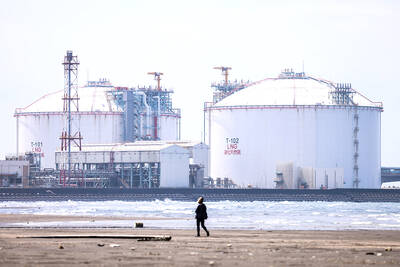
Taiwan is open to joining a global liquefied natural gas (LNG) program if one is created, but on the condition that countries provide delivery even in a scenario where there is a conflict with China, an energy department official said yesterday. While Taiwan’s priority is to have enough LNG at home, the nation is open to exploring potential strategic reserves in other countries such as Japan or South Korea, Energy Administration Deputy Director-General Chen Chung-hsien (陳崇憲) said. While the LNG market does not have a global reserve for emergencies like that of oil, the concept has been raised a few times —

Taiwan Semiconductor Manufacturing Co (TSMC, 台積電) yesterday received government approval to deploy its advanced 3-nanometer (3nm) process at its second fab currently under construction in Japan, the Ministry of Economic Affairs said in a news release. The ministry green-lit the plan for the facility in Kumamoto, which is scheduled to start installing equipment and come online in 2028 with a monthly production capacity of 15,000 12-inch wafers, the ministry said. The Department of Investment Review in June 2024 authorized a US$5.26 billion investment for the facility, slated to manufacture 6- to 12nm chips, significantly less advanced than 3nm process. At a meeting with


 RSS
RSS