


With scorching summer temperatures and little rainfall, the barren scrublands around the port of Aqaba in Jordan, one of the world’s most arid countries, might seem ill suited to cultivating cucumbers.
Yet, a Norwegian company is planning to set up a solar-powered, 20 hectare facility that promises to grow a variety of vegetables without wasting a drop of fresh water.
“We take what we have enough of — sunlight, carbon dioxide, seawater and desert — to produce what we need more of — food, water and energy,” Sahara Forest Project (SFP) chief executive Joakim Hauge said.
Harnessing abundant resources to generate scarce ones will be key to feeding a growing global population, set to reach 9 billion by 2050, without damaging the environment or accelerating climate change, he said.
Food production must rise by about 60 percent by 2050 to generate enough for everyone to eat, according to the UN’s Food and Agriculture Organisation (FAO).
Agriculture already accounts for 70 percent of global fresh water use, while the food sector is responsible for more than 20 percent of planet-warming emissions and 30 percent of world energy consumption.
“We can no longer make solutions that come at the expense of other sectors,” Hauge said. “There is a need for a more integrated approach.”
The Aqaba complex, set to open in the summer, evaporates salt water piped from the nearby Red Sea to cool greenhouses, creating conditions for crops to grow all year round.
Sea water is also desalinated to generate salt and fresh water for irrigation, while vapor from greenhouses is used to humidify surrounding patches of parched land so plants can grow.
A pilot project in the Persian Gulf state of Qatar generated cucumber yields comparable to those of European farms, SFP said, adding that plans are under way to expand operations to Tunisia.
However, FAO experts said high costs limit the potential of such projects to ramp up food production on a global scale.
“You need a lot of energy and a lot of money so ... the question may arise whether the same resources could be put to better use,” FAO natural resources officer Alessandro Flammini said.
To be financially viable, production must focus on high-value crops, like cucumbers and tomatoes, which poor countries might find cheaper to import, said Flammini, who analyzed the Qatar pilot for a 2014 FAO report.
“It’s an interesting concept for fulfilling local needs and especially in terms of food independence and to meet the demand of a niche market,” he said.
The initial phase of the Aqaba complex had a US$3.7 million budget and received financial support from Norway, the EU and other investors, SFP said.
Besides producing food, the complex, which is to include a laboratory and research facilities, would produce side benefits by greening arid areas and creating jobs, Hauge said.
“We believe that this is part of the agriculture of tomorrow,” the biologist-turned-entrepreneur told the Thomson Reuters Foundation by telephone.
Several other companies are employing similar technologies in other arid corners of the world.
Last year, Britain-based agribusiness Sundrop Farms Holding Ltd opened a vast greenhouse for tomato farming in the Australian outback near Port Augusta, 300km north of Adelaide.
The facility runs on energy mostly produced by a 115m-tall solar tower that draws sunlight from 23,000 mirrors surrounding it.
“Traditional agriculture is wasteful in terms of water and fossil fuels. In addition, unprotected crops are at the mercy of the elements, causing gaps in supply, quality issues and price spikes,” Sundrop CEO Philipp Saumweber said in an e-mail.
The company has signed a 10-year contract to supply Coles Supermarkets Australia Pty Ltd with truss tomatoes and received investments of about US$100 million from private equity firm KKR & Co LP, a 2014 statement showed.
“While the capital expenditure required to build our farms is slightly more expensive due to its cutting-edge nature, we reap the benefits of this initial investment in the long run through savings of fossil inputs,” Saumweber said.
About 11,265km away, in sunbaked and drought-hit Somaliland, another British-based venture, Seawater Greenhouse, is setting up a pilot facility aimed at making high-tech greenhouse production more affordable.
“We have eliminated using fans,” said British inventor Charlie Paton, a former business partner of Saumweber, who pioneered the use of solar energy and salt water for irrigation in the 1990s.
“We designed [the greenhouse] to be cool by exploiting the prevailing wind. So it’s a wind-cooled greenhouse,” he said in a telephone interview.
The 1 hectare complex, which received funding from the British government, cost about US$100,000, he said, adding that he expected it to produce about 30 tonnes of tomatoes per year and 16 liters of drinking water per day for irrigation and livestock.
Paton said he hoped the greenhouse, which employs mostly local staff, would serve as a hub for expansion across the Horn of Africa.
“The region gets a lot of humanitarian aid and that’s arguably detrimental, because if you give free food to people, you put farmers out of business,” he said. “It has more chances of success if people can make money out of it.”

The domestic unit of the Chinese-owned, Dutch-headquartered chipmaker Nexperia BV will soon be able to produce semiconductors locally within China, according to two company sources. Nexperia is at the center of a global tug-of-war over critical semiconductor technology, with a Dutch court in February ordering a probe into alleged mismanagement at the company. The geopolitical tussle has disrupted supply chains, with some carmakers reportedly forced to cut production due to chip shortages. Local production would allow Nexperia’s domestic arm, Nexperia Semiconductors (China) Ltd (安世半導體中國), to bypass restrictions in place since October on the supply of silicon wafers — etched with tiny components to

Singapore-based ride-hailing and delivery giant Grab Holdings Ltd has applied for regulatory approval to acquire the Taiwan operations of Germany-based Delivery Hero SE's Foodpanda in a deal valued at about US$600 million. Grab submitted the filing to the Fair Trade Commission on Friday last week, with the transaction subject to regulatory review and approval, the company said in a statement yesterday. Its independent governance structure would help foster a healthy and competitive market in Taiwan if the deal is approved, Grab said. Grab, which is listed on the NASDAQ, said in the filing that US-based Uber Technologies Inc holds about 13 percent of
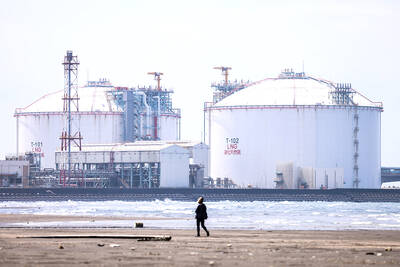
Taiwan is open to joining a global liquefied natural gas (LNG) program if one is created, but on the condition that countries provide delivery even in a scenario where there is a conflict with China, an energy department official said yesterday. While Taiwan’s priority is to have enough LNG at home, the nation is open to exploring potential strategic reserves in other countries such as Japan or South Korea, Energy Administration Deputy Director-General Chen Chung-hsien (陳崇憲) said. While the LNG market does not have a global reserve for emergencies like that of oil, the concept has been raised a few times —

Taiwan Semiconductor Manufacturing Co (TSMC, 台積電) yesterday received government approval to deploy its advanced 3-nanometer (3nm) process at its second fab currently under construction in Japan, the Ministry of Economic Affairs said in a news release. The ministry green-lit the plan for the facility in Kumamoto, which is scheduled to start installing equipment and come online in 2028 with a monthly production capacity of 15,000 12-inch wafers, the ministry said. The Department of Investment Review in June 2024 authorized a US$5.26 billion investment for the facility, slated to manufacture 6- to 12nm chips, significantly less advanced than 3nm process. At a meeting with


 RSS
RSS