


They are agnostic on market direction, but ubiquitous in markets. Firms like Goldman Sachs and Morgan Stanley might get the headlines, but algorithms are the real force today on Wall Street.
The mysterious programs were at the center of the so-called “Flash Crash” in May 2010, when the US stock market plunged more than 9 percent in a matter of minutes for no discernible reason.
The swoon, which was reversed within a matter of minutes, was sparked by a computerized order to sell a large quantity of S&P 500 futures in a short period. That, in turn, triggered a chain reaction of other computerized orders by high-frequency traders.
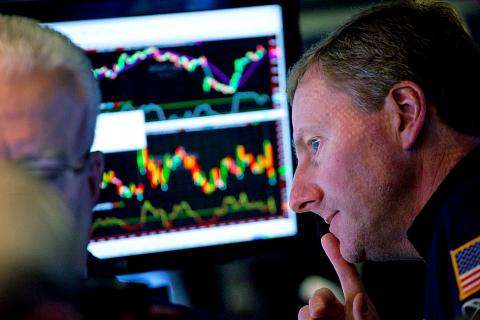
Photo: Bloomberg
The quickfire crash and recovery underscored the pivotal role of algorithms, which execute automated trades after taking instantaneous readings of inputs that can include news events, economic data and stock price movements.
The era of automated trading began with the 1971 founding of the NASDAQ Composite market, which introduced computers to Wall Street in a significant way.
Today, algorithms are the dominant force in markets, playing a role in the vast majority of securities transactions.
“I would say it is 90 percent algorithmic, but there is not a great way to quantify that,” said Valerie Bogard, an equity analyst at Tabb Group, a research and consulting firm. “Even though [people] may send an order through a sales desk, it is possible it is going through an algo.”
Algorithmic trades vary in complexity and can be carried out with minimal human involvement once they are set up.
For example, the branding and technology company T3 has created a robotic, or “bot,” system that reads US President Donald Trump’s Twitter feed and implements stock trades if it determines based on a quickfire reading that there will likely be a negative impact on a company’s shares.
Other firms, such as QuantCube Technology, use algorithms to make trades following analysis of so-called “Big Data.”
FAKE TRADES
However, the most controversial type of algorithms are those that do high-frequency trading, which execute buy and sell orders that individually result in minuscule gains, but can add up to great amounts at large volumes.
High-frequency trades make up a rising share of overall market transactions and are often criticized due to their opacity.
Traders in this area have at times engaged in “spoofing” — placing thousands of computer-generated rapid-fire fake trades that are quickly canceled.
The objective is to coax other traders into making bets at artificially high or low prices.
“That is just a violation of some of the rules of trading,” said Eric Noll, chief executive of Convergex Group, a New York brokerage firm.
The US Securities and Exchange Commission (SEC) in 2014 levied its first fine for such bogus trades. Since then, US regulators have pumped more resources into enforcing the rules on electronic trading.
The SEC now requires firms to identify those who design and operate algorithms and can subpoena documents from firms employing the technology.
There has also been a preference among some investors to rein in the machines. The New York Stock Exchange has announced plans to slow down transactions in one of its platforms, following the introduction of a similar mechanism by IEX Group, which delays transactions by microseconds.
These moves were taken in response to criticism that high-frequency traders were stiffing investors by driving up transaction costs.
However, market insiders say there is no evidence of a clear trend as far as whether high-frequency trading makes the market more prone to crises than with conventional trading. After all, markets were also prone to violent gyrations prior to when the machines took over.
“When the crash in 1987 happened, it was before algos,” Noll said. “It is a somewhat harsh reality but true.”

Elon Musk’s lieutenants have reached out to chip industry suppliers, including Applied Materials Inc, Tokyo Electron Ltd and Lam Research Corp, for his envisioned Terafab, early steps in an audacious and likely arduous attempt to break into the production of cutting-edge chips. Staff working for the joint venture between Tesla Inc and Space Exploration Technologies Corp (SpaceX) have sought price quotes and delivery times for an array of chipmaking gear, people familiar with the matter said. In past weeks, they’ve contacted makers of photomasks, substrates, etchers, depositors, cleaning devices, testers and other tools, according to the people, who asked not to
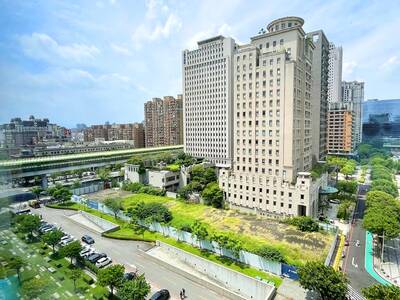
Taichung reported the steepest fall in completed home prices among the six special municipalities in the first quarter of this year, data compiled by Taiwan Realty Co (台灣房屋) showed yesterday. From January through last month, the average transaction price for completed homes in Taichung fell 8 percent from a year earlier to NT$299,000 (US$9,483) per ping (3.3m²), said Taiwan Realty, which compiled the data based on the government’s price registration platform. The decline could be attributed to many home buyers choosing relatively affordable used homes to live in themselves, instead of newly built homes in the city’s prime property market, Taiwan Realty
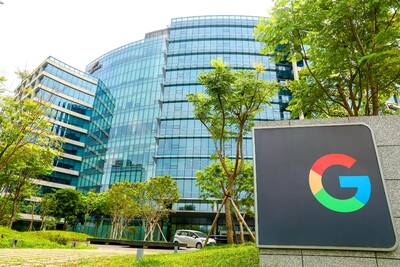
The government yesterday approved applications by Alphabet Inc’s Google to invest NT$27.08 billion (US$859.98 million) in Taiwan, the Ministry of Economic Affairs said in a statement. The Department of Investment Review approved two investments proposed by Google, with much of the funds to be used for data processing and electronic information supply services, as well as inventory procurement businesses in the semiconductor field, the ministry said. It marks the second consecutive year that Google has applied to increase its investment in Taiwan. Google plans to infuse NT$25.34 billion into Charter Investments Ltd (特許投資顧問) through its Singapore-based subsidiary Fructan Holdings Singapore Pte Ltd, and

JET JUICE: The war on Iran’s secondary effects have seen fuel prices skyrocket, knocking flight schedules down to earth in return as airlines struggle with costs Airline passengers should brace for more irritation in the next few months as carriers worldwide cancel flights and ground planes to cope with stratospheric increases in jet-fuel prices. Dutch flag carrier KLM is the latest company to cut its schedule, saying on Thursday that it would scrap 80 return flights at Amsterdam’s Schiphol Airport in the coming month. That puts it in the same league as United Airlines Holdings Inc, Deutsche Lufthansa AG and Cathay Pacific Airways Ltd, which have all pruned itineraries to mitigate costs. Global capacity for next month has been reduced by about 3 percentage points, with all


 RSS
RSS