


The nation’s two largest convenience store operators expect their coffee business to grow further next year, due to rising demand for Americano coffee, company executives said yesterday.
Revenue from coffee is expected to grow 10 percent this year on a yearly basis and the growth will extend into next year, Tony Hsieh (謝蓮塘), marketing group chief at President Chain Store Corp (PCSC, 統一超商), told reporters.
PCSC, the nation’s largest convenience store chain, which runs 7-Eleven in Taiwan, plans to improve the quality of coffee beans to attract customers based on their preferences, rather than offering more discounts, Hsieh told a press conference yesterday.
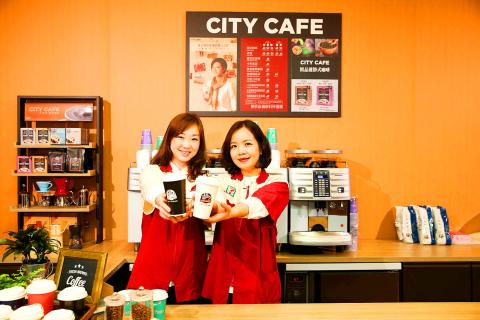
Photo: Yang Ya-min, Taipei Times
“We have imported some high-priced coffee beans from Ethiopia to make flavors better, as we found that customers are more into Americano coffee,” he said, adding that the company would not pass on the increase in production costs to customers.
PCSC is also considering offering more products to satisfy growing demand for drip bag coffee and pour-over coffee, such as coffee kettles and cups.
Those new coffee-related products will be available by the end of this year at 800 of the company’s outlets across the nation.
PCSC said it aims to increase coffee sales to NT$11.8 billion (US$369 million) this year, compared with last year’s NT$10.6 billion.
That translates into 300 million cups of coffee served, PCSC said.
Coffee-related sales contributed nearly 8 percent of PCSC’s annual revenue last year, company data showed.
Taiwan FamilyMart Co (全家便利商店), the nation’s second-largest convenience store operator, also expects big things from its coffee business.
Local customers are getting pickier about coffee flavors and the origin of coffee beans, helping lift sales of Americano coffee by 40 percent this year, FamilyMart said in a statement released yesterday.
The company expects its revenue from coffee to reach NT$3 billion this year, with total sales reaching 100 million cups.

The domestic unit of the Chinese-owned, Dutch-headquartered chipmaker Nexperia BV will soon be able to produce semiconductors locally within China, according to two company sources. Nexperia is at the center of a global tug-of-war over critical semiconductor technology, with a Dutch court in February ordering a probe into alleged mismanagement at the company. The geopolitical tussle has disrupted supply chains, with some carmakers reportedly forced to cut production due to chip shortages. Local production would allow Nexperia’s domestic arm, Nexperia Semiconductors (China) Ltd (安世半導體中國), to bypass restrictions in place since October on the supply of silicon wafers — etched with tiny components to

Singapore-based ride-hailing and delivery giant Grab Holdings Ltd has applied for regulatory approval to acquire the Taiwan operations of Germany-based Delivery Hero SE's Foodpanda in a deal valued at about US$600 million. Grab submitted the filing to the Fair Trade Commission on Friday last week, with the transaction subject to regulatory review and approval, the company said in a statement yesterday. Its independent governance structure would help foster a healthy and competitive market in Taiwan if the deal is approved, Grab said. Grab, which is listed on the NASDAQ, said in the filing that US-based Uber Technologies Inc holds about 13 percent of

Taiwan Semiconductor Manufacturing Co (TSMC, 台積電) yesterday received government approval to deploy its advanced 3-nanometer (3nm) process at its second fab currently under construction in Japan, the Ministry of Economic Affairs said in a news release. The ministry green-lit the plan for the facility in Kumamoto, which is scheduled to start installing equipment and come online in 2028 with a monthly production capacity of 15,000 12-inch wafers, the ministry said. The Department of Investment Review in June 2024 authorized a US$5.26 billion investment for the facility, slated to manufacture 6- to 12nm chips, significantly less advanced than 3nm process. At a meeting with

Taiwan’s food delivery market could undergo a major shift if Singapore-based Grab Holdings Ltd completes its planned acquisition of Delivery Hero SE’s Foodpanda business in Taiwan, industry experts said. Grab on Monday last week announced it would acquire Foodpanda’s Taiwan operations for US$600 million. The deal is expected to be finalized in the second half of this year, with Grab aiming to complete user migration to its platform by the first half of next year. A duopoly between Uber Eats and Foodpanda dominates Taiwan’s delivery market, a structure that has remained intact since the Fair Trade Commission (FTC) blocked Uber Technologies Inc’s


 RSS
RSS