


Rupert Murdoch’s Twenty-First Century Fox Inc has struck a preliminary deal to buy the 61 percent of British pay-TV firm Sky PLC it does not already own for about US$14 billion, five years after a political scandal wrecked a previous bid.
The proposed offer of £10.75 per share in cash, which is backed by Sky’s independent directors, would strengthen the position of James Murdoch — who is both chief executive of Fox and chairman of Sky — in his 85-year-old father’s media empire.
People familiar with the matter said Fox had pounced after Britain’s vote to leave the EU in June sent the pound down about 14 percent against the US dollar and Sky’s share price tumbling.
Owning Sky would give Fox, whose cable networks include Fox News and FX, control of a pay-TV network spanning 22 million households in Britain, Ireland, Austria, Germany and Italy.
It would also be the latest deal to marry distribution with content after AT&T Inc announced an US$85 billion bid to buy Time Warner Inc earlier this year. While Sky does produce some of its own content, including in news and sport, the deal would give Fox full ownership of a wider distribution platform in Europe.
Rupert Murdoch’s previous attempt to buy Sky through his News Corp business provoked uproar among some UK politicians, who said it would give the billionaire owner of the Sun and the Times newspapers too much control over the country’s media.
That bid collapsed in 2011 when Murdoch’s UK newspaper business was engulfed in a phone hacking scandal that intensified political opposition, resulted in a criminal trial that led to the closure of his News of the World tabloid.
Liberum Capital Ltd analysts said Friday’s proposal was likely to have an easier ride, partly because News Corp has now separated from Fox, which means the bidding firm no longer owns UK newspapers, and because there are no competition issues.
They also said the British government was keen to promote investment in the wake of the Brexit vote and could present the deal as a sign of confidence in the economy.
British Prime Minister Theresa May met Rupert Murdoch after a visit to the UN in September, according to media reports.
Fox said it would reinforce Britain’s standing as a top global hub for content generation and technological innovation.
Tom Watson, deputy leader of Britain’s opposition Labour Party and a key critic of the Murdochs during the 2011 scandal, called on regulators to be ready to properly vet the deal — but did not oppose it outright.
“This bid has been expected since 2011,” he said.
Fox’s proposed bid is a 36.2 percent premium to Sky’s closing share price on Thursday. It values the company at about £18.5 billion (US$23.26 billion) and the stake Fox does not already own at £11.25 billion, according to Reuters calculations.
Sky’s shares closed up 26.7 percent at about £10, while Fox’s were down 1.8 percent at US$28.12 at 8:20pm GMT.
Britain’s takeover watchdog has set Fox a deadline of Jan. 6 to make a firm bid or walk away.
Sky said that “certain material offer terms” remained under discussion, and that there could be no certainty that an offer would be made by Fox.
The terms still under discussion include the size of the break-up fee, as well as some other contractual obligations of the two companies to close the deal, according to people familiar with the matter.
These are not expected to present any major hurdle to agreeing a deal, the people added.

The domestic unit of the Chinese-owned, Dutch-headquartered chipmaker Nexperia BV will soon be able to produce semiconductors locally within China, according to two company sources. Nexperia is at the center of a global tug-of-war over critical semiconductor technology, with a Dutch court in February ordering a probe into alleged mismanagement at the company. The geopolitical tussle has disrupted supply chains, with some carmakers reportedly forced to cut production due to chip shortages. Local production would allow Nexperia’s domestic arm, Nexperia Semiconductors (China) Ltd (安世半導體中國), to bypass restrictions in place since October on the supply of silicon wafers — etched with tiny components to

Singapore-based ride-hailing and delivery giant Grab Holdings Ltd has applied for regulatory approval to acquire the Taiwan operations of Germany-based Delivery Hero SE's Foodpanda in a deal valued at about US$600 million. Grab submitted the filing to the Fair Trade Commission on Friday last week, with the transaction subject to regulatory review and approval, the company said in a statement yesterday. Its independent governance structure would help foster a healthy and competitive market in Taiwan if the deal is approved, Grab said. Grab, which is listed on the NASDAQ, said in the filing that US-based Uber Technologies Inc holds about 13 percent of
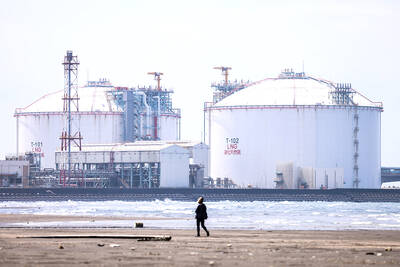
Taiwan is open to joining a global liquefied natural gas (LNG) program if one is created, but on the condition that countries provide delivery even in a scenario where there is a conflict with China, an energy department official said yesterday. While Taiwan’s priority is to have enough LNG at home, the nation is open to exploring potential strategic reserves in other countries such as Japan or South Korea, Energy Administration Deputy Director-General Chen Chung-hsien (陳崇憲) said. While the LNG market does not have a global reserve for emergencies like that of oil, the concept has been raised a few times —
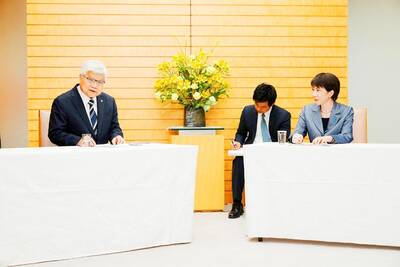
Taiwan Semiconductor Manufacturing Co (TSMC, 台積電) yesterday received government approval to deploy its advanced 3-nanometer (3nm) process at its second fab currently under construction in Japan, the Ministry of Economic Affairs said in a news release. The ministry green-lit the plan for the facility in Kumamoto, which is scheduled to start installing equipment and come online in 2028 with a monthly production capacity of 15,000 12-inch wafers, the ministry said. The Department of Investment Review in June 2024 authorized a US$5.26 billion investment for the facility, slated to manufacture 6- to 12nm chips, significantly less advanced than 3nm process. At a meeting with


 RSS
RSS