


Asian stocks fell, with the regional gauge falling for a fourth consecutive week, after US Federal Reserve Chair Janet Yellen signaled the US central bank was close to raising interest rates.
The MSCI Asia Pacific Index retreated 0.5 percent to 134.12 as of 4:01pm in Hong Kong, taking its loss this week to 0.9 percent.
Asian equity markets have been whipsawed since Republican candidate Donald Trump’s shock election victory on Nov. 8.
Emerging market assets have been hit by expectations of faster US interest-rate increases amid speculation Trump’s spending plans will boost inflation.
Fed funds futures are showing a 96 percent chance of a US rate hike next month, compared with 80 percent before the election.
“People are expecting that hike to come through,” Hong Kong-based Haitong International Securities Group (海通國際證券) managing director for sales trading Andrew Sullivan said. “Next week is going to be a quite a quiet week as we have Thanksgiving, so the US is going to be closed next Thursday and a lot of people are likely to take a holiday, so that could be something that bears on the market.”
In her first public statement since the election, Yellen on Thursday told US lawmakers that the Fed was close to boosting borrowing costs as the economy continued to gain traction. The comments torpedoed US Treasuries, pushing up yields.
In Taipei, the TAIEX on Friday closed up 13.53 points, or 0.15 percent, at 9,008.79. That brought the weekly gains to 0.6 percent from last week’s close at 8,957.76.
In Japan, the Nikkei 225 on Friday advanced 0.6 percent and was up more than 20 percent from a June low, meeting the common definition of a bull market. The TOPIX closed up 0.4 percent, taking its weekly gain to 3.6 percent.
A weaker yen has buoyed exporters, while Japanese lenders have benefited from a rebound in global borrowing costs.
Japanese Prime Minister Shinzo Abe on Thursday had his first meeting with Trump in New York as he sought to build a personal relationship that would deter Trump from pursuing the trade and security policies he advocated during his election campaign.
Hong Kong’s Hang Seng Index closed up 0.5 percent and the Hang Seng China Enterprises Index of Chinese companies listed in the territory advanced 0.4 percent.
The Shanghai Composite Index declined 0.5 percent.
South Korea’s KOSPI slipped 0.3 percent.
Singapore’s Straits Times Index added 0.8 percent, Australia’s S&P/ASX 200 Index rose 0.4 percent and New Zealand’s S&P/NZX 50 Index closed 0.6 percent higher.
The Jakarta Composite Index fell 0.7 percent and Malaysia’s benchmark measure declined 0.3 percent.
India’s S&P BSE Sensex Index rose 0.2 percent after being down as much as 0.4 percent earlier.

The domestic unit of the Chinese-owned, Dutch-headquartered chipmaker Nexperia BV will soon be able to produce semiconductors locally within China, according to two company sources. Nexperia is at the center of a global tug-of-war over critical semiconductor technology, with a Dutch court in February ordering a probe into alleged mismanagement at the company. The geopolitical tussle has disrupted supply chains, with some carmakers reportedly forced to cut production due to chip shortages. Local production would allow Nexperia’s domestic arm, Nexperia Semiconductors (China) Ltd (安世半導體中國), to bypass restrictions in place since October on the supply of silicon wafers — etched with tiny components to

Singapore-based ride-hailing and delivery giant Grab Holdings Ltd has applied for regulatory approval to acquire the Taiwan operations of Germany-based Delivery Hero SE's Foodpanda in a deal valued at about US$600 million. Grab submitted the filing to the Fair Trade Commission on Friday last week, with the transaction subject to regulatory review and approval, the company said in a statement yesterday. Its independent governance structure would help foster a healthy and competitive market in Taiwan if the deal is approved, Grab said. Grab, which is listed on the NASDAQ, said in the filing that US-based Uber Technologies Inc holds about 13 percent of

Taiwan Semiconductor Manufacturing Co (TSMC, 台積電) yesterday received government approval to deploy its advanced 3-nanometer (3nm) process at its second fab currently under construction in Japan, the Ministry of Economic Affairs said in a news release. The ministry green-lit the plan for the facility in Kumamoto, which is scheduled to start installing equipment and come online in 2028 with a monthly production capacity of 15,000 12-inch wafers, the ministry said. The Department of Investment Review in June 2024 authorized a US$5.26 billion investment for the facility, slated to manufacture 6- to 12nm chips, significantly less advanced than 3nm process. At a meeting with
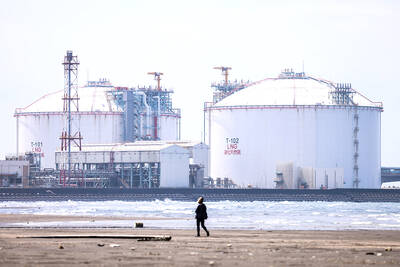
Taiwan is open to joining a global liquefied natural gas (LNG) program if one is created, but on the condition that countries provide delivery even in a scenario where there is a conflict with China, an energy department official said yesterday. While Taiwan’s priority is to have enough LNG at home, the nation is open to exploring potential strategic reserves in other countries such as Japan or South Korea, Energy Administration Deputy Director-General Chen Chung-hsien (陳崇憲) said. While the LNG market does not have a global reserve for emergencies like that of oil, the concept has been raised a few times —


 RSS
RSS