


Casetek Holdings Ltd (鎧勝), a metal casing supplier for Apple Inc’s MacBooks and iPads, yesterday reported its lowest quarterly earnings performance in its history, due to the delayed launch of the new MacBook Pro.
Casetek’s net profit plunged 77.4 percent annually and 15.8 percent quarterly to NT$366 million (US$11.62 million) in the third quarter, company data showed.
Gross margin over the period dropped to 11.8 percent, a decline of 14.8 percentage points from last year’s 26.6 percent and 4.8 percentage points from the previous quarter’s 16.6 percent.
Operating margin also fell to a record low of 3.9 percent, compared with the same period last year’s 17.4 percent and the previous quarter’s 6.1 percent.
“The weaker-than-expected profitability and gross margin are mainly due to postponed shipments of new notebook computers,” Casetek chief financial officer Jonathan Chang (張昭平) told a teleconference.
Casetek chief executive officer Gary Chuang (莊育志) said revenues should begin to pick up this quarter, and that the recovery would extend through next quarter, as Apple started to ship the new 13-inch and 15-inch MacBook Pros at the end of last month.
Chuang said Casetek secured the orders for the 12-inch MacBook last year and entered the supply chain for the 13-inch and 15-inch MacBook Pros for the first time this year.
“We foresee the revenue contribution from notebooks rising significantly next year,” Chuang said.
Notebooks accounted for 40 percent of the company’s total revenue, while its tablet segment contributed 50 to 60 percent, Casetek said.
When asked if Casetek has made progress winning a smartphone contract with its major client — as the company has for years been trying to enter the supply chain for iPhones — Chuang said: “I believe we will have a good chance next year, given the client’s positive feedback.”
“From iMacs, iPads to MacBooks … the [iPhone] is the only product we have not supplied. We will focus on developing this business next year,” Chuang said.
Chuang said he would not be worried if Apple decided to adopt glass back covers for its new range of iPhones instead of full metal casings next year, because both materials would require casing suppliers’ computer numerical control (CNC) machines and technologies.
Casetek’s board yesterday approved a capital expenditure plan of US$66.12 million for the purchase of 1,000 CNC machines over the end of this year and the beginning of next year, the company said in a filing with the Taiwan Stock Exchange.
Casetek said in a separate filing that its revenue plummeted 37 percent annually and 2.3 percent monthly to NT$2.54 billion last month.
That brought its combined revenues for the first 10 months of the year to NT$25.01 billion, the filing showed.
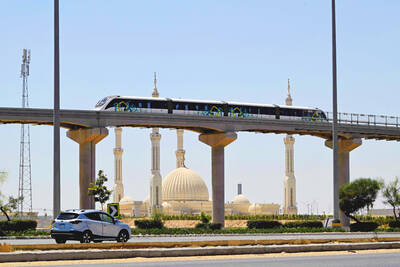
Cairo’s new monorail slices across the city skyline, running above the familiar chaos of blaring horns and aging buses’ exhaust fumes that mark rush hour below. The US$4.5 billion monorail, opened this month, is among Egypt’s most prominent new transport projects, part of a debt-funded infrastructure drive criticized for sapping state finances while bringing limited benefits to most of the country’s 109 million people. “It feels like you’re in a different country,” said Ramy Sayed, a restaurant manager, aboard a driverless Innovia 300 train. “No noise, no traffic, we’re not used to this.” The eastern line runs 56km from the bustling middle-class
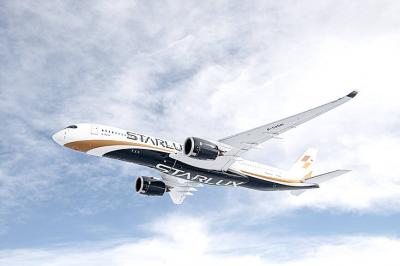
Starlux Airlines Co (星宇航空) today unveiled a long-haul network expansion plan at a shareholders’ meeting in Taipei, including direct flights to Barcelona, Spain, and Zurich, Switzerland, as well as a service connecting Taipei, Sydney and New Zealand. Starlux is to become the first Taiwanese carrier to offer non-stop services to the two European cities, while the inaugural oceanic route is expected to expand transit opportunities within the Australia-New Zealand market, Starlux said. Flight services to Chicago, Dallas, Washington and New York are under evaluation, the airline added. Prior to the shareholders’ meeting, the airline earlier this year announced that it would be
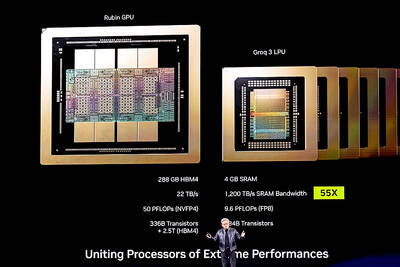
Taiwanese prosecutors suspect that three people successfully smuggled at least one shipment of Nvidia Corp artificial intelligence (AI) chips to China after first exporting them to Japan, people familiar with the matter said. The trio was detained last week by the Keelung District Prosecutors’ Office for allegedly falsifying documents related to exports of Super Micro Computer Inc servers containing advanced Nvidia chips, which the US has barred from sale to China without a license from Washington. The move marked Taiwan’s first public crackdown on AI chip diversion after years of pressure from the US to take a more active role in curtailing
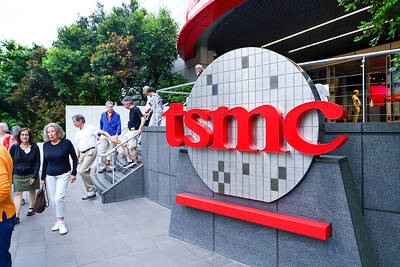
Taiwan Semiconductor Manufacturing Co (TSMC, 台積電) employee bonuses are likely to grow more than 30 percent this year, in line with the past few years as the company’s profits continue to set new records, an anonymous source cited TSMC chairman C.C. Wei (魏哲家) as saying yesterday. TSMC, the world’s largest contract chipmaker, is committed to taking care of its workers, the source said, citing Wei’s meeting with employees yesterday morning. Wei also expressed gratitude to employees for their contribution to the company’s improving bottom line, the source added. Since 2023, TSMC’s employee bonuses have grown at an annual rate of


 RSS
RSS