


Virtual reality (VR) has arrived for real at the Tokyo Game Show, one of the world’s biggest exhibitions for the latest in fun and games.
That is evident everywhere. Players at the booths are donning chunky headgear covering their eyes and ears, immersed in their own worlds, shooting imaginary monsters or dancing with virtual partners at Makuhari Messe hall in the Tokyo suburb of Chiba.
The show, which gave a preview to reporters yesterday ahead of its opening to the public over the weekend, features 614 companies demonstrating more than 1,500 software titles.
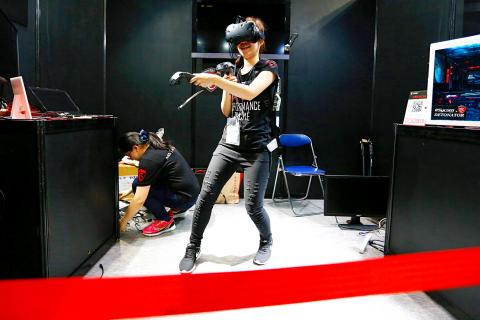
Photo: EPA
It is still anyone’s guess how VR will play out as a business in years ahead, but most agree that it is the way of the future and Yasuo Takahashi, director at Sony Interactive Entertainment, the game division of Japanese electronics and entertainment giant Sony Corp, believes this year will mark VR’s debut year, helping revive an industry that has languished with the advent of smartphones.
“Up to now games were played on a TV set. With VR, players can enter the worlds portrayed in games. It’s a totally new experience,” Takahashi said at Sony’s booth at the show, stressing that VR cannot really be played on a phone.
That also means VR’s impact will be widespread, in genres such as movies and virtual travel, he added.
One reason for Sony’s high hopes for VR is Tokyo-based Sony’s PlayStation VR headgear device, going on sale next month for about US$400, which is the first that might put VR within reach for many regular homes, according to some analysts.
Rival VR headsets cost more — Oculus Rift goes for about US$600 and the HTC Vive for US$800.
Although VR’s applications vary from job training and real-estate previews to news reporting and education, it is expected to take off in games first.
A recent survey of 635 industry experts, including start-up executives and investors, carried out jointly by legal company Perkins Cole and Upload, cited “lack of compelling content” as the biggest challenge for VR’s future.
Respondents were most focused on games. They also cited obstacles to VR’s popularity, such as cost, bulky hardware and technical glitches, but most respondents were planning to invest in VR, if cautiously at first.
Tetsuya Mizuguchi, founder and president of game maker Enhance, believes VR is exactly the kind of technology his game Rez Infinite has been waiting for. The game’s original version went on sale in 2001 for an earlier console called the Sega Dreamcast.
The new VR version of the game, one of the highlights of the Tokyo Game Show, delivers a dreamlike experience.
Once players put on the headgear and earphones, they find themselves virtually flying through an abyss-like universe resembling outer space or the bottom of the ocean, a black that seems to spread in all directions.
Then colorful geometric designs pop up, bursting in flashes of light with the aim of the cursor or a shift of a VR player’s vision. Electronic music, synchronized to the player’s moves and virtual explosions, add to the thrill.
“This is about a new way of storytelling. It’s a new journey and so this is not confined to just realism, but it can provoke the creative imagination,” Mizuguchi said this week at his Tokyo office. “I want to move people in new ways. As a concept, it’s about appealing to the senses, but it’s actually also very emotional. VR can liberate one’s experience from the film frame, which has existed over the 130 years of movies.”
The visual abstractness and musical focus of Mizuguchi’s game contrast with other VR games that seek to more literally approximate reality, using VR’s ability to convey an illusion of 3D depth and 360-degree surroundings.
Mizuguchi stressed that his designers, and Sony, were careful to make sure VR did not make players nauseous.
“If someone’s first experience with VR turns out to be negative, there might never be a second experience,” he said.
Hisakazu Hirabayashi, game analyst and president of game industry consulting firm Interact, said VR is so powerful that creators are still choosing to tone it down to minimize potential risks, including venturing into untested territory such as VR pornography.
“VR is a fabulous technology, but it can be even used for torture,” he said. “So game creators are still trying to play it safe.”
Shares of contract chipmaker Taiwan Semiconductor Manufacturing Co (TSMC, 台積電) came under pressure yesterday after a report that Apple Inc is looking to shift some orders from the Taiwanese company to Intel Corp. TSMC shares fell NT$55, or 2.4 percent, to close at NT$2,235 on the local main board, Taiwan Stock Exchange data showed. Despite the losses, TSMC is expected to continue to benefit from sound fundamentals, as it maintains a lead over its peers in high-end process development, analysts said. “The selling was a knee-jerk reaction to an Intel-Apple report over the weekend,” Mega International Investment Services Corp (兆豐國際投顧) analyst Alex Huang
Taiwan Semiconductor Manufacturing Co (TSMC, 台積電) is expected to remain Apple Inc’s primary chip manufacturing partner despite reports that Apple could shift some orders to Intel Corp, industry experts said yesterday. The comments came after The Wall Street Journal reported on Friday that Apple and Intel had reached a preliminary agreement following more than a year of negotiations for Intel to manufacture some chips for Apple devices. Taiwan Institute of Economic Research (台灣經濟研究院) economist Arisa Liu (劉佩真) said TSMC’s advanced packaging technologies, including integrated fan-out and chip-on-wafer-on-substrate, remain critical to the performance of Apple’s A-series and M-series chips. She said Intel and Samsung
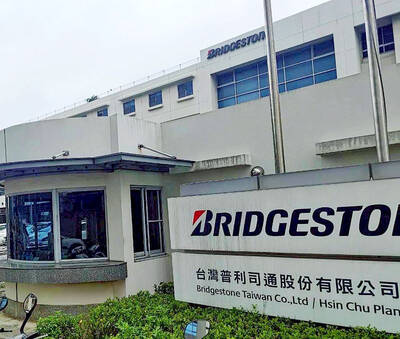
TRANSITION: With the closure, the company would reorganize its Taiwanese unit to a sales and service-focused model, Bridgestone said Bridgestone Corp yesterday announced it would cease manufacturing operations at its tire plant in Hsinchu County’s Hukou Township (湖口), affecting more than 500 workers. Bridgestone Taiwan Co (台灣普利司通) said in a statement that the decision was based on the Tokyo-based tire maker’s adjustments to its global operational strategy and long-term market development considerations. The Taiwanese unit would be reorganized as part of the closure, effective yesterday, and all related production activities would be concluded, the statement said. Under the plan, Bridgestone would continue to deepen its presence in the Taiwanese market, while transitioning to a sales and service-focused business model, it added. The Hsinchu
Taiwan Semiconductor Manufacturing Co (TSMC, 台積電) has approved a capital budget of US$31.28 billion for production expansion to meet long-term development needs during the artificial intelligence (AI) boom. The company’s board meeting yesterday approved the capital appropriation plan for purposes such as the installation of advanced technology capacity and fab construction, the world’s largest contract chipmaker said in a statement. At an earnings conference last month, TSMC forecast that its capital expenditure for this year would be at the higher end of the US$52 billion to US$56 billion range it forecast in January in response to robust demand for 5G, AI and


 RSS
RSS