


Paywalls were supposed to help rescue newspapers from the crisis of sinking print circulation as readers shifted to getting their news online.
However, with a few exceptions, they have failed to deliver much relief, prompting some news organizations to rethink their digital strategies.
Newspapers in the English-speaking world ended paywalls 69 times through May last year, including 41 temporary and 28 permanent drops, according to a study by University of Southern California (USC) researchers.
Photo: AP
Paywalls “generate only a small fraction of industry revenue,” with estimates ranging from 1 percent in the US to 10 percent internationally, the study in last month’s International Journal of Communication said.
“People are far less willing to pay for online news than for print,” said USC journalism professor Mike Ananny, an author of the study.
Newspapers are in a difficult spot, he added, because online advertising generates a fraction of print’s revenue, and news organizations are already pressured by falling print circulation.
Alan Mutter, a former newspaper editor who now consults for media organizations, said the research confirms that paywalls have value in rare circumstances.
The New York Times, Wall Street Journal and Financial Times have been relatively successful with paywalls because of their unique content, he said.
“It’s hard for a general-interest Web site to charge for news that you can get for free with a few clicks,” he said.
Paywalls can also backfire “because they put a barrier between the newspaper and the casual reader,” he added. “They are truncating the size of the digital market, when the most important factor for digital is scale.”
A survey this year by the American Press Institute showed 77 of the 98 US newspapers with circulations above 50,000 used some type of online subscription, which could be a “hard” paywall that fences off all content or allows some free.
However, a number of English-language news organizations have dropped their paywalls in recent months, including the Toronto Star, and British dailies the Independent and the Sun.
Among US dailies, the San Francisco Chronicle dropped its paywall in 2013. The Dallas Morning News did the same in 2014, before reinstituting a “metered” system allowing up to 10 free articles.
Newsweek lifted its paywall for most content in February, limiting the number of free magazine features for nonsubscribers.
A study this year by Oxford University’s Reuters Institute for the Study of Journalism found only 10 percent of readers in English-speaking countries were willing to pay for digital news.
That number rose to 15 percent in Denmark and Finland, 20 percent in Poland and Sweden and 27 percent in Norway.
“English-language publishers face a more difficult task in trying to build a large paywall business because there is so much free English content,” Mutter said.
Of the paywalls erected in the past few years, many have delivered lackluster results, said Ken Doctor, a media consultant who writes the blog Newsonomics.
However, there are some notable successes in addition to the most prominent newspapers, Doctor said.
The Boston Globe raised its digital subscription price sharply to US$1 a day and kept 90 percent of its subscriber base, and the Minneapolis Star-Tribune has also had success boosting digital circulation revenues, he said.
Succeeding with paywalls means taking a long view and investing in journalism, as well as technology, Doctor said.
“A publisher focused on the long term will recognize that it is reader revenue that is going to have to get them through this disruption,” he said.
“That means they need a large and experienced enough newsroom so the audience feels they are getting something sufficient and something unique,” he added. “They also need to invest in the digital products so the experience is better.”
However, Mutter said that paywalls run counter to the goal of boosting readership, and that news organizations need to think differently.
“Print is failing and digital is hard,” he said.
Although newspapers are losing online ad revenues to online platforms, they have the advantage of knowing their local markets and businesses.
“They have to work hard at being local marketing partners in the markets they serve,” Mutter said.
USC’s Ananny said news organizations need to find creative ways to develop pay models that do not put readers off.
He also expressed concern that expanding paywalls might lead to a new “digital divide” where information is available only to those who can afford to pay.
The research suggests that “news organizations serve themselves and readers best when paywalls are fluid,” he said.
Many papers open up free content during major news events or emergencies, fulfilling a civic role, he said.
Others charge readers for access to special features or content.
“News organizations had better understand why they are dropping or raising paywalls,” he said. “If it’s done in an ad hoc or random manner, it doesn’t help.”
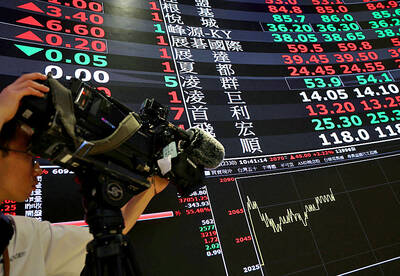
After several years flying high as Asia’s best Nvidia Corp proxy, Taiwan Semiconductor Manufacturing Co (TSMC, 台積電) is increasingly vying with other artificial intelligence (AI) stocks for investor attention. Stock traders are chasing a wider array of beneficiaries as mainstream usage of AI creates demand for hardware beyond the most-advanced chips TSMC makes for Nvidia. Subthemes from the deepening memory crunch to advances in robotics are also luring bids. At the same time, investment caps on single stocks are pushing funds to diversify, while retail investors long familiar with TSMC through its US depositary receipts are being offered a broader set of
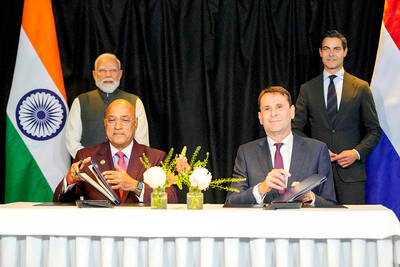
NEW MARKET: The partnership opens up India to the Dutch company, which already has a strong hold in the semiconductor market of South Korea, Taiwan and China ASML Holding NV entered into a partnership agreement with Tata Electronics Pvt Ltd aimed at ramping up India’s goal to develop domestic chip-manufacturing capabilities. The Dutch company’s technology would help power Tata Electronics’ planned 300 millimeter (mm) semiconductor foundry in Gujarat, according to a joint statement from the two companies on Saturday. The signing of a memorandum of understanding coincides with a visit by Indian Prime Minister Narendra Modi to the Netherlands, which is looking to deepen bilateral relations with New Delhi. ASML, whose top customers include Taiwan Semiconductor Manufacturing Co (台積電) and Samsung Electronics Co, makes lithography machines that can print

TECH RELIANCE: Growth is increasingly reflecting an unequal K-shaped distribution, where technology sectors outperform and other industries struggle, an expert said Standard Chartered Bank has significantly raised its forecast for Taiwan’s economic growth to 9.5 percent this year, up from 7.6 percent previously, citing surging artificial intelligence (AI) demand driving exports, semiconductor production and investment. The upgrade reflects a sustained AI supercycle that continues to fuel demand for advanced chips and technology infrastructure, which form the backbone of Taiwan’s exports, the bank said in a report this week. “We raise our 2026 growth forecast to reflect a much stronger-than-expected first-quarter GDP figure,” Standard Chartered senior economist for greater China and Asia Tommy Wu (胡東安) said in the report. Driven largely by a 35.3 percent

Two of Taiwan’s international carriers, Starlux Airlines Co (星宇航空) and EVA Airways Corp (長榮航空), have retained the five-star airline rating awarded by international airline review organization Skytrax. Starlux was awarded the distinction for a second consecutive year, while EVA Air received it for the 11th straight year, Skytrax said in statements released yesterday and on Thursday last week, respectively. The five-star rating is considered one of the airline industry's highest honors and is awarded following professional audits of airline product and frontline service standards, Skytrax said. The ratings are based on in-depth assessments using unified global quality standards rather than customer review scores


 RSS
RSS