


Oneness Biotech Co Ltd (合一生技) yesterday said that preliminary third-phase clinical trials of a new drug called ON101, used to treat chronic diabetic foot ulcers, have been successful in improving wound healing.
The study showed that 60.3 percent of patients in the ON101 group had made a full recovery from their wounds, a 25.9 percentage point improvement compared with the 34.4 percent in the group treated with Aquacel Ag hydrocolloid dressings made by UK-based ConvaTec Inc, Oneness said in a filing with the Taiwan Stock Exchange.
The study, which was conducted on 236 patients divided equally into two groups, showed a statistically significant p-value of 0.004 in its full analysis set, the filing said.
The full analysis set includes all patients who have participated in the study.
In the modified intention-to-treat set, ON101 demonstrated a 62.7 percent wound recovery rate, compared with the 23.3 percent of the Aquacel group, while the p-value was gauged at less than 0.001, the company added.
The modified intention-to-treat set allows for the exclusion of some randomized subjects, such as patients who were deemed ineligible based on the prior condition of their wounds or patients who never started treatment, the company said.
Among patients with foot ulcers and wounds larger than 5cm2, ON101 demonstrated a healing rate of 63.6 percent and 57.1 percent respectively, which was 40.3 percent and 51.2 percent greater than the control group.
The company said that the study is still ongoing, and that the results may change after the data set is locked and analyzed.
An application is expected to be filed with the Food and Drug Administration once the study is completed, the company said, adding that other studies are planned for the European and Chinese markets to test the drug’s effectiveness on a variety of ethnic groups.
ON101 is an ointment containing extracts commonly used traditional Chinese medicinal herbs, Plectranthus amboinicus and Centella asiatica urban, the company said.
The drug mainly reduces inflammation, facilitates epithelialization of epidermal tissues, promotes production of collagen and minimizes granulation tissue formation.
It is designed to reduce ulcerations among diabetic patients with a higher risk of chronic infection due to diminished blood supply to the wound site.
Trading of Oneness shares was suspended yesterday as per regulations, as the company disclosed material information. The shares closed at NT$34.85 on Friday last week.


The domestic unit of the Chinese-owned, Dutch-headquartered chipmaker Nexperia BV will soon be able to produce semiconductors locally within China, according to two company sources. Nexperia is at the center of a global tug-of-war over critical semiconductor technology, with a Dutch court in February ordering a probe into alleged mismanagement at the company. The geopolitical tussle has disrupted supply chains, with some carmakers reportedly forced to cut production due to chip shortages. Local production would allow Nexperia’s domestic arm, Nexperia Semiconductors (China) Ltd (安世半導體中國), to bypass restrictions in place since October on the supply of silicon wafers — etched with tiny components to

Taiwan is open to joining a global liquefied natural gas (LNG) program if one is created, but on the condition that countries provide delivery even in a scenario where there is a conflict with China, an energy department official said yesterday. While Taiwan’s priority is to have enough LNG at home, the nation is open to exploring potential strategic reserves in other countries such as Japan or South Korea, Energy Administration Deputy Director-General Chen Chung-hsien (陳崇憲) said. While the LNG market does not have a global reserve for emergencies like that of oil, the concept has been raised a few times —

Taiwan Semiconductor Manufacturing Co (TSMC, 台積電) yesterday received government approval to deploy its advanced 3-nanometer (3nm) process at its second fab currently under construction in Japan, the Ministry of Economic Affairs said in a news release. The ministry green-lit the plan for the facility in Kumamoto, which is scheduled to start installing equipment and come online in 2028 with a monthly production capacity of 15,000 12-inch wafers, the ministry said. The Department of Investment Review in June 2024 authorized a US$5.26 billion investment for the facility, slated to manufacture 6- to 12nm chips, significantly less advanced than 3nm process. At a meeting with
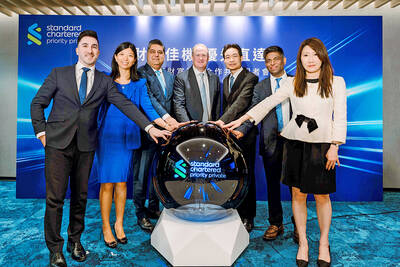
Standard Chartered Taiwan on March 26 announced that it has partnered with international fintech firm FinIQ to build an “Automated Structured Products Pricing Platform.” The bank is also introducing products from global issuers including Goldman Sachs Group Inc, Barclays PLC and BNP Paribas SA. The new platform enables an end-to-end process whereby it finds the most competitive pricing across multiple issuers in a matter of minutes, followed by automated documentation and transaction execution, which significantly shortens time-to-market and delivers a superior wealth management experience. Standard Chartered Bank Taiwan CEO Anthony Yu (游天立) said: “Standard Chartered is increasingly leveraging its wealth management


 RSS
RSS