


The recovery in China’s housing market that helped underpin the economy in the first half is showing signs of tapering off.
New home prices — excluding government-subsidized housing — climbed in 60 cities last month, down from 65 in April, among the 70 tracked, China’s National Bureau of Statistics said on Saturday.
With less of a boost from a recovering property market likely in the second half, Beijing needs to find other drivers, such as infrastructure investment, to meet its growth goal of at least 6.5 percent this year, said Shen Jianguang (沈建光), head economist for Asia at Mizuho Securities Asia Ltd.
“The housing market is in flux,” Shen said. “The government is likely to step up policies to encourage home buying in places where demand is weak and inventories of unsold housing are still high as the destocking policy did not yield the expected results.”
Faced with a massive pile of unsold homes in smaller cities, the government and People’s Bank of China (PBOC) have unleashed a range of measures aimed at improving demand for homes to clear the overhang. While inventory levels might not have budged much, mortgage demand has, rising to a record last month, according to the latest data from the PBOC.
Still, the recovery in home prices last month abated as local governments put curbs in top economic centers like Shanghai and Shenzhen, where prices have been surging, while they deployed home buying stimulus in smaller cities to clear the glut of unsold residences.
“Out of 60 cities with price gains last month, 36 had slower increases than in April, leading overall growth to “abate,” the statistics bureau said.
The average new home price rose 0.84 percent last month from April, down from 1.03 percent in the previous month and slowing for the first time since October last year, according to Bloomberg calculations based on government data.
Price gains slowed in some of the largest cities, indicating tightening measures have started to take effect. Values rose 2.3 percent in Shanghai, a slower pace than in April, while Shenzhen saw a gain of 0.5 percent, down from 2.3 percent in the previous month. The two cities, where residential price gains topped the nation earlier this year, tightened buying criteria for non-resident homebuyers, raised downpayment requirements for some second homes and banned unregulated lending.
Housing policy is likely to show more divergence in the second half, said Niu Li, economist at the State Information Center affiliated to the National Development and Reform Commission.
“The question in big cities for officials will be how to curb prices, while in some of the smaller places prices are too high for inventory to come down,” he said.
The port city of Xiamen in the southern Fujian Province led gains last month, with prices climbing 5.5 percent from April and 28.3 percent from the previous year. Hefei, the capital of the eastern Anhui Province, saw a gain of 5.1 percent from the previous month and 23.3 percent from a year earlier.
While stoking sales in smaller cities to reduce an oversupply, policymakers are also being vigilant about the threat of financial instability in the housing market, an unwelcome risk for an economy that last year saw the slowest economic growth in 25 years.
PBOC Governor Zhou Xiaochuan (周小川) in March told banks to reduce risk by better assessing customer credit worthiness in mortgage lending and said unauthorized loans by real-estate agents increase the chance of bad debts.
Existing home prices rose in 49 cities last month, compared with 51 in April. They dropped in 13 and were unchanged in eight.
Prices last month gained in 74 cities among the 100 tracked by SouFun Holdings Ltd, the owner of China’s biggest property Web site, compared with increases in 71 in the previous month. Average new home prices rose 1.7 percent, a slower pace than increases of 1.45 percent seen in March.

The domestic unit of the Chinese-owned, Dutch-headquartered chipmaker Nexperia BV will soon be able to produce semiconductors locally within China, according to two company sources. Nexperia is at the center of a global tug-of-war over critical semiconductor technology, with a Dutch court in February ordering a probe into alleged mismanagement at the company. The geopolitical tussle has disrupted supply chains, with some carmakers reportedly forced to cut production due to chip shortages. Local production would allow Nexperia’s domestic arm, Nexperia Semiconductors (China) Ltd (安世半導體中國), to bypass restrictions in place since October on the supply of silicon wafers — etched with tiny components to

Singapore-based ride-hailing and delivery giant Grab Holdings Ltd has applied for regulatory approval to acquire the Taiwan operations of Germany-based Delivery Hero SE's Foodpanda in a deal valued at about US$600 million. Grab submitted the filing to the Fair Trade Commission on Friday last week, with the transaction subject to regulatory review and approval, the company said in a statement yesterday. Its independent governance structure would help foster a healthy and competitive market in Taiwan if the deal is approved, Grab said. Grab, which is listed on the NASDAQ, said in the filing that US-based Uber Technologies Inc holds about 13 percent of
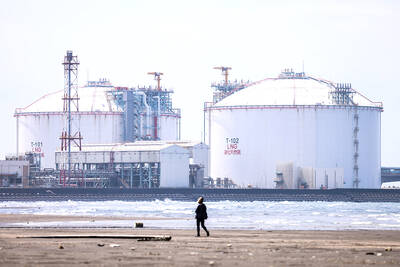
Taiwan is open to joining a global liquefied natural gas (LNG) program if one is created, but on the condition that countries provide delivery even in a scenario where there is a conflict with China, an energy department official said yesterday. While Taiwan’s priority is to have enough LNG at home, the nation is open to exploring potential strategic reserves in other countries such as Japan or South Korea, Energy Administration Deputy Director-General Chen Chung-hsien (陳崇憲) said. While the LNG market does not have a global reserve for emergencies like that of oil, the concept has been raised a few times —

Taiwan Semiconductor Manufacturing Co (TSMC, 台積電) yesterday received government approval to deploy its advanced 3-nanometer (3nm) process at its second fab currently under construction in Japan, the Ministry of Economic Affairs said in a news release. The ministry green-lit the plan for the facility in Kumamoto, which is scheduled to start installing equipment and come online in 2028 with a monthly production capacity of 15,000 12-inch wafers, the ministry said. The Department of Investment Review in June 2024 authorized a US$5.26 billion investment for the facility, slated to manufacture 6- to 12nm chips, significantly less advanced than 3nm process. At a meeting with


 RSS
RSS