


Taiwan Mobile Co (台灣大哥大) is studying the possibility of investing in the telecom markets of India and Indonesia, company chairman Richard Tsai (蔡明興) said at the annual general meeting.
Tsai told shareholders that the two markets offer good potential for growth, so the company is evaluating opportunities to invest there.
He said that while India already has many telecom services providers, leading to intense competition and a price war, it has a huge population, creating business opportunities, in particular in data transmission, which is expected to rise.
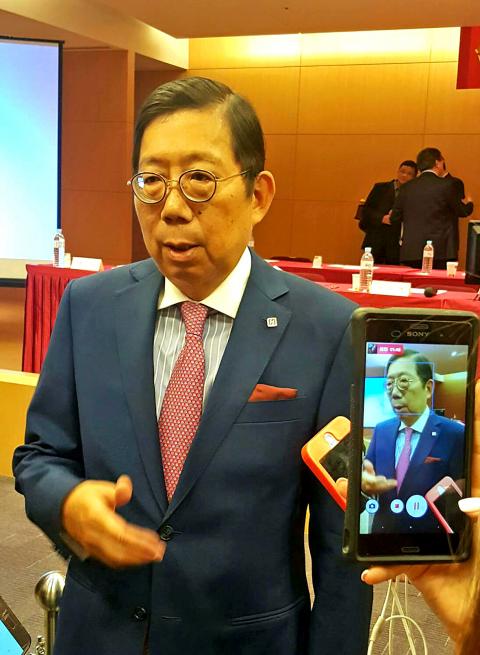
Photo: CNA
Tsai said that Taiwan Mobile is evaluating the likelihood of teaming up with local telecom operators to win a slice of the 4G market at a time when the Indian market is migrating to 4G technology.
However, any plans about investment in India still needs time to be finalized, he said.
In addition to the expansion in telecom services overseas, Tsai said that Taiwan Mobile has been eying the e-commerce potential in Southeast Asia, adding that Momo.com Inc (富邦媒), its e-commerce subsidiary, has been gearing up to explore the markets in the Philippines and Vietnam.
In particular, Momo.com is seeking a business partner in the Philippines and an agreement on a strategic partnership is expected to be reached by the end of this year, he said.
Taiwan Mobile holds a 51 percent stake in Momo.com, which has been listed on the local main board since December 2014.
In Thailand, Momo.com owns a 35 percent stake in e-commerce operator TVD Shopping.
Tsai said that TVD Shopping has become profitable and is planning to file an application next year to list its shares in Thailand’s stock market.
In Taiwan, Taiwan Mobile is determined to develop its third-party payment business, Tsai said, adding that the company is planning to start an over-the-top (OTT) content business by signing up for good drama series and movies from across the Taiwan Strait.
OTT content can be transmitted through delivery of audio, video and other media over the Internet without the involvement of a multiple-system operator.
Tsai said that Taiwan Mobile has set a target of boosting the number of its 4G subscribers to 5 million next year, up from 3 million at the end of last year, by encouraging existing 2G and 3G subscribers to migrate to 4G.
Shareholders approved a proposal for Taiwan Mobile to distribute NT$5.6 in cash dividends based on last year’s earnings per share of NT$5.76 for a payout ratio of 97 percent.

The domestic unit of the Chinese-owned, Dutch-headquartered chipmaker Nexperia BV will soon be able to produce semiconductors locally within China, according to two company sources. Nexperia is at the center of a global tug-of-war over critical semiconductor technology, with a Dutch court in February ordering a probe into alleged mismanagement at the company. The geopolitical tussle has disrupted supply chains, with some carmakers reportedly forced to cut production due to chip shortages. Local production would allow Nexperia’s domestic arm, Nexperia Semiconductors (China) Ltd (安世半導體中國), to bypass restrictions in place since October on the supply of silicon wafers — etched with tiny components to

Singapore-based ride-hailing and delivery giant Grab Holdings Ltd has applied for regulatory approval to acquire the Taiwan operations of Germany-based Delivery Hero SE's Foodpanda in a deal valued at about US$600 million. Grab submitted the filing to the Fair Trade Commission on Friday last week, with the transaction subject to regulatory review and approval, the company said in a statement yesterday. Its independent governance structure would help foster a healthy and competitive market in Taiwan if the deal is approved, Grab said. Grab, which is listed on the NASDAQ, said in the filing that US-based Uber Technologies Inc holds about 13 percent of

Taiwan Semiconductor Manufacturing Co (TSMC, 台積電) yesterday received government approval to deploy its advanced 3-nanometer (3nm) process at its second fab currently under construction in Japan, the Ministry of Economic Affairs said in a news release. The ministry green-lit the plan for the facility in Kumamoto, which is scheduled to start installing equipment and come online in 2028 with a monthly production capacity of 15,000 12-inch wafers, the ministry said. The Department of Investment Review in June 2024 authorized a US$5.26 billion investment for the facility, slated to manufacture 6- to 12nm chips, significantly less advanced than 3nm process. At a meeting with

Taiwan’s food delivery market could undergo a major shift if Singapore-based Grab Holdings Ltd completes its planned acquisition of Delivery Hero SE’s Foodpanda business in Taiwan, industry experts said. Grab on Monday last week announced it would acquire Foodpanda’s Taiwan operations for US$600 million. The deal is expected to be finalized in the second half of this year, with Grab aiming to complete user migration to its platform by the first half of next year. A duopoly between Uber Eats and Foodpanda dominates Taiwan’s delivery market, a structure that has remained intact since the Fair Trade Commission (FTC) blocked Uber Technologies Inc’s


 RSS
RSS