


Green Energy Technology Inc (綠能科技) yesterday reported losses of NT$124 million (US$3.78 million) for last quarter and said it aimed to return to profit this year after getting rid of heavy depreciation costs from its thin-film solar equipment.
The Taoyuan-based company said its gross margin returned to positive territory last quarter, helping the nation’s biggest solar wafer maker shrink last year’s losses.
In the final quarter of last year, gross margin improved to 8 percent, from minus-1 percent in the third quarter. The company lost NT$567 million in the third quarter last year.
For the whole of last year, Green Energy reduced its losses to NT$1.7 billion, from losses of NT$2.1 billion in 2014.
The company said in a statement that it has terminated its thin-film solar business because of cost disadvantages and is working with global partners in developing high-end solar wafers, as well as integrating its supply chain to enhance its profitability.
The overcapacity-driven slump of the solar industry also extends to solar cell manufacturers.
Solar cell maker Gintech Energy Corp (昱晶) on Thursday posted its fifth consecutive year of losses at NT$99 million for last year, compared with losses of NT$378 million in the previous year.
However, the company posted a second straight quarterly net profit of NT$390 million for the final quarter of last year, more than doubling from NT$139 million in the third quarter.
Gintech attributed the profitable quarter last quarter to an increase in solar cell prices and a better product portfolio, according to a company statement released on Thursday.
The company said its gross margin could climb further this quarter after it opened a new plant in Thailand. The plant’s products enjoy a 15 percent higher in average selling prices than those from its other plants, the company said.
The company said it was cautiously optimistic that demand would pick up in the second half of this year.
Gintech’s board approved a fundraising plan by launching a right issue of up to 80 million common shares to improve its capital structure.
However, Yuanta Securities Investment Consulting Co (元大投顧) yesterday said that a lackluster outlook for the solar cell segment amid increasing price pressure and inventory adjustment in China poses challenges for the company.
Yuanta has lowered its net profit forecast for Gintech by 3 percent to NT$1.74 billion for this year.
Last week, solar cell maker Neo Solar Power Corp (新日光能源) said it swung into a profit of NT$139 million in the fourth quarter of last year, reversing losses of NT$371 million in the prior quarter.
Last year as a whole, Neo Solar lost NT$1.46 billion.
As order visibility is clearer this quarter, the company expects higher revenue and shipments going forward, it said.
Gintech shares plunged 5.58 percent to NT$26.25 yesterday, while Neo Solar and Green Energy also fell 0.93 percent and 2.91 percent to NT$21.25 and NT$20 respectively.

The domestic unit of the Chinese-owned, Dutch-headquartered chipmaker Nexperia BV will soon be able to produce semiconductors locally within China, according to two company sources. Nexperia is at the center of a global tug-of-war over critical semiconductor technology, with a Dutch court in February ordering a probe into alleged mismanagement at the company. The geopolitical tussle has disrupted supply chains, with some carmakers reportedly forced to cut production due to chip shortages. Local production would allow Nexperia’s domestic arm, Nexperia Semiconductors (China) Ltd (安世半導體中國), to bypass restrictions in place since October on the supply of silicon wafers — etched with tiny components to

Singapore-based ride-hailing and delivery giant Grab Holdings Ltd has applied for regulatory approval to acquire the Taiwan operations of Germany-based Delivery Hero SE's Foodpanda in a deal valued at about US$600 million. Grab submitted the filing to the Fair Trade Commission on Friday last week, with the transaction subject to regulatory review and approval, the company said in a statement yesterday. Its independent governance structure would help foster a healthy and competitive market in Taiwan if the deal is approved, Grab said. Grab, which is listed on the NASDAQ, said in the filing that US-based Uber Technologies Inc holds about 13 percent of

Taiwan Semiconductor Manufacturing Co (TSMC, 台積電) yesterday received government approval to deploy its advanced 3-nanometer (3nm) process at its second fab currently under construction in Japan, the Ministry of Economic Affairs said in a news release. The ministry green-lit the plan for the facility in Kumamoto, which is scheduled to start installing equipment and come online in 2028 with a monthly production capacity of 15,000 12-inch wafers, the ministry said. The Department of Investment Review in June 2024 authorized a US$5.26 billion investment for the facility, slated to manufacture 6- to 12nm chips, significantly less advanced than 3nm process. At a meeting with
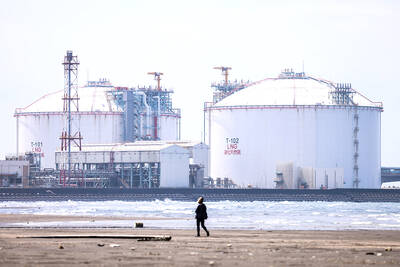
Taiwan is open to joining a global liquefied natural gas (LNG) program if one is created, but on the condition that countries provide delivery even in a scenario where there is a conflict with China, an energy department official said yesterday. While Taiwan’s priority is to have enough LNG at home, the nation is open to exploring potential strategic reserves in other countries such as Japan or South Korea, Energy Administration Deputy Director-General Chen Chung-hsien (陳崇憲) said. While the LNG market does not have a global reserve for emergencies like that of oil, the concept has been raised a few times —


 RSS
RSS