


Shin Kong Financial Holding Co (新光金控), which reported worse-than-expected losses last month, on Friday said the sale of an office building in Taipei’s Xinyi District (信義) could improve its bottom line this month.
Shin Kong Financial is the only financial holding company among its domestic peers to report a loss last month, totaling NT$734 million (US$22.27 million), dragged down by its subsidiary Shin Kong Life Insurance Co’s (新光人壽) equity portfolio adjustment.
Last month, Shin Kong Life, the major earnings source of the financial conglomerate, reported a loss of NT$1.7 billion as it continued to dispose of its loss-making stock investments.
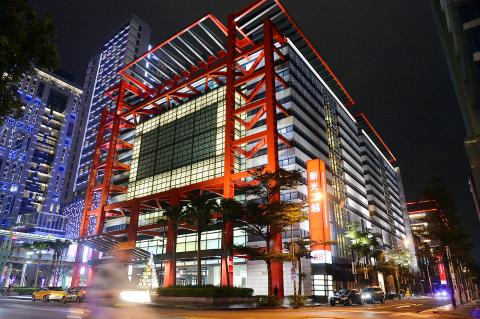
Photo: CNA
On Friday, the life insurer said in a statement that it is poised to book NT$7.8 billion in gains after selling its A8 commercial building to Fubon Life Insurance Co (富邦人壽) in a NT$27.034 billion deal. The building houses a branch of the Shin Kong Mitsukoshi Department Store (新光三越百貨) chain.
The firm had failed to secure a buyer during an auction in October, as potential bidders, mainly insurance companies, had been reluctant to make the purchase prior to the Financial Supervisory Commission’s decision last month to lower the minimum yield required for domestic insurers investing in commercial properties from 2.805 percent to 2.555 percent.
From January to last month, Shin Kong Financial’s net income lagged far behind its domestic peers at NT$5.19 billion, or earnings per share of NT$0.42, with Shin Kong Life’s net losses amounting to NT$826 million in the same period.
Fubon Financial Holding Co (富邦金控) continued to lead its domestic peers in profitability in the first 11 months, reporting net income of NT$62.13 billion, or earnings per share of NT$6.07, up by 4.9 percent year-on-year.
Cathay Financial Holding Co (國泰金控) clinched second place by posting a net income of NT$57.41 billion in the first 11 months, or earnings per share of NT$ 4.53, up 17.81 percent year-on-year.
However, both Fubon Financial and Cathay Financial reported declines in net income from October, with Fubon’s earnings falling nearly 60 percent to NT$1.25 billion and Cathay Financial’s profits dropping from NT$1.37 billion to NT$1.15 billion.
The two companies said last month’s earnings performance was affected by diminished contributions from their life insurance subsidiaries, with a NT$1.5 million profit at Fubon Life Insurance and NT$240 million at Cathay Life Insurance Co (國泰人壽), separate company statements said.
The local financial sector might see its downturn in earnings growth persist until the first half of next year, Yuanta Securities Investment Consulting Co (元大投顧) said.
“November’s preliminary results of domestic financial companies have shown significant sequential and annual declines, for insurers especially,” Yuanta analyst Peggy Shih (施姵帆) said in a client note on Thursday.
State-run Mega Financial Holding Co (兆豐金控) reported net income of NT$2.85 billion last month, the highest among its domestic peers. In the first 11 months, the company ranked third in profitability, with net income of NT$26.8 billion, or NT$2.16 per share.
Bank-focused CTBC Financial Holding Co (中信金控) also reported a profit of NT$1.82 billion last month, pushing its earnings for the first eleven months to NT$29.02 billion, or NT$1.74 per share.
Shih said she expects that three US Federal Reserve rate hikes, speculated to take place this month, would add 0.75 percent to the policy rate and would have limited benefits for domestic banks and insurers.
“We estimate a NT$5.8 billion increase to net interest income across the financial sector next year, equivalent to 2 percent of the NT$32 billion in additional industry earnings forecast for next year,” Shih said.
Shih said that an anticipated 0.125 percent rate hike by Taiwan’s central bank, expected to take place in the fourth quarter of next year, would boost banks’ interest spread and net interest margin by 3 basis points and 2.5 basis points respectively, and boost insurers’ earnings per share by 1 percent to 3 percent next year.

Cairo’s new monorail slices across the city skyline, running above the familiar chaos of blaring horns and aging buses’ exhaust fumes that mark rush hour below. The US$4.5 billion monorail, opened this month, is among Egypt’s most prominent new transport projects, part of a debt-funded infrastructure drive criticized for sapping state finances while bringing limited benefits to most of the country’s 109 million people. “It feels like you’re in a different country,” said Ramy Sayed, a restaurant manager, aboard a driverless Innovia 300 train. “No noise, no traffic, we’re not used to this.” The eastern line runs 56km from the bustling middle-class

Taiwanese firms have increased investment in the Philippines in recent years as Manila’s ties with Washington deepen and global supply chains continue to shift away from China, an expert at the Chung-Hua Institution for Economic Research (CIER, 中華經濟研究院) said yesterday. The Philippines had not been among Taiwanese investors’ top choices in Southeast Asia, CIER Taiwan ASEAN Studies Center director Kristy Hsu (徐遵慈) said at a seminar in Taipei. However, Taiwan’s investment in the country has grown significantly since the COVID-19 pandemic, reaching US $257 million last year, a high in recent years, she said. Although Taiwan’s total investment in the Philippines still lags

Intel Corp regards Taiwan Semiconductor Manufacturing Co (TSMC, 台積電) as a longstanding partner, as the US chipmaker would continue outsourcing production of advanced chips to TSMC, Intel chief executive officer Lip-Bu Tan (陳立武) said yesterday. “I don’t look at people as competitors. I look at the collaboration... Nvidia is also, you know, a good friend,” Tan told a news conference following his keynote speech at the Computex trade show in Taipei. “It’s a very trusted partnership for us... We are a big, top customer for them, and we’re going to continue doing that,” he said, referring to TSMC, the world’s largest foundry

Artificial intelligence (AI) agents would supplant smartphones as the center of people’s digital lives, fundamentally reshaping personal devices and driving a major computing upgrade cycle, Qualcomm Inc CEO Cristiano Amon said yesterday. In his keynote speech for this year’s Computex trade show in Taipei, Amon said that the rise of "agentic AI" — AI systems capable of reasoning, planning and carrying out tasks autonomously — would transform how people interact with technology across phones, PCs, vehicles and wearable devices. Describing the technology as the next major evolution in computing, Amon said that "2026 is the year of agents.” For decades, smartphones have sat


 RSS
RSS