


Multinational corporations doing business in China face a losing battle when it comes to keeping copies of their products off the market: The anti-counterfeiting industry they rely on is plagued with allegations of fraud, making it that much easier for potentially dangerous fake goods — from air bags to Christmas lights — to reach consumers, an Associated Press investigation has found.
Most Western companies subcontract anticounterfeiting work to private investigators paid on commission. More seizures mean higher fees, creating powerful incentives to cheat in an industry with little oversight. As a result, money spent fighting counterfeiting often does not make things better, and sometimes makes them worse.
AP found instances of alleged fraud involving products that could be hazardous: counterfeit auto parts, pharmaceuticals, personal care products and electrical components.
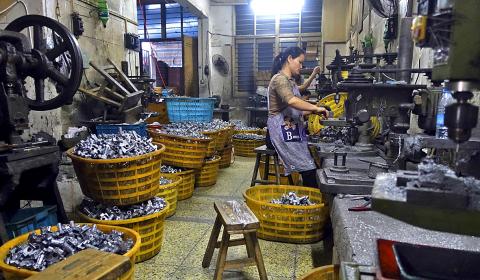
Photo: AP
The practices took many forms:
‧ Western firms paid investigators who were themselves allegedly manufacturing or selling counterfeit versions of their clients’ own goods.
‧ Investigators allegedly doctored documents, fabricating raids that never took place.
‧ Investigators allegedly colluded with factories to make counterfeit goods they could “seize” and present to their Western bosses for payment.
As counterfeiting has flourished in China over decades, a lucrative, parallel industry has blossomed to fight it. Counterfeiting today is a multibillion-dollar business in China, which produces nearly nine of every 10 fake items seized at US borders.
Chinese authorities have been getting better at fining counterfeiters and sending them to jail. However, the momentum of reform has yet to reach the front lines of the fight against fakes, according to previously undisclosed material from legal cases and internal corporate investigations in China, lawsuits, and interviews with 16 private investigators, lawyers and law-enforcement officials.
All described a broken system, beset by endemic and under-reported fraud, made worse by Western companies that have a poor command over how to successfully fight fraud.
Shanghai’s Public Security Bureau took the unusual step of warning foreign brand owners to be watchful of the investigators they hire.
For instance, one of the world’s largest consumer-goods companies hired an investigator to track down counterfeit anti-dandruff shampoo. Instead of finding real counterfeiters, the investigator, Wang Yunming, set up a factory to produce counterfeit shampoo himself, which he then “seized” and billed to the firm as a successful raid, according to two employees involved in the investigation.
It was not the first such factory Wang founded. It was the fourth.
Wang was convicted of fraud and is due to be released from prison in 2023, according to a copy of a judgement from Hefei Intermediate People’s Court in Anhui Province.
Swiss power technology giant ABB Asea Brown Boveri Ltd (ABB) found that one of the investigators it was paying to hunt counterfeiters was herself selling fake ABB circuit breakers.
ABB sued the firm she worked for, the China United Intellectual Property Protection Center (中聯知識產權調查中心), which was one of China’s oldest and largest investigations companies.
ABB lost its case in Beijing, despite the investigator, a woman who called herself Flaming Lee (李悅), being convicted of selling ABB counterfeits by a court in Dubai, where she lived.
ABB, a US$40 billion company whose products range from simple switches to sophisticated industrial robotics, declined to comment.
However, in court filings, the company said it was astounded to learn that its exclusive brand protection agent in China had itself “directly participated in infringing acts against the ABB trademark.”
They accused China United of protecting a factory that produced ABB fakes and of engineering its work to maximize billing, rather than truly solve ABB’s multimillion-dollar counterfeiting problem.
In one case, ABB said it ended up paying China United US$5,000 for a raid that uncovered US$1 worth of fakes.
China United denied any wrongdoing.
Chinese judges acknowledged Lee’s double-dealing, but exonerated upper management and dismissed the rest of the accusations.
They ordered ABB to pay China United more than US$500,000 in back investigation fees.
In the end, China United’s legal victory proved hollow. Its reputation damaged, the firm closed.
Now, three top China United executives — Li Changxu (李長旭), Li Guorong (李國榮) and Fan Liming (范利明) — are staging a quiet comeback.
They bought stakes in and hold executive positions at the Shanghai intellectual property protection company Sinofaith IP Group (新淨信知識產權服務), according to corporate filings.
None responded to detailed requests for comment.
Sinofaith advertised an impressive client list, including General Electric Co, Toyota Motor Corp, 3M Co, Nike Inc and Schneider Electric SA.
That was a surprise to GE, spokesman Geoff Li (李國威) said.
“Normally if they want to put a company’s logo, they should let us know,” Li said.
GE and 3M said they had no current plans to continue working with the company.
Nike said it has not been a client since 2013. Toyota said it was no longer working with Sinofaith and had not authorized the firm to use its name.
Schneider Electric said it stopped working with China United because of the ABB litigation.
Sinofaith did not respond to requests for comment.
After AP began making inquiries, it removed all client names from its Web site.

Singapore-based ride-hailing and delivery giant Grab Holdings Ltd has applied for regulatory approval to acquire the Taiwan operations of Germany-based Delivery Hero SE's Foodpanda in a deal valued at about US$600 million. Grab submitted the filing to the Fair Trade Commission on Friday last week, with the transaction subject to regulatory review and approval, the company said in a statement yesterday. Its independent governance structure would help foster a healthy and competitive market in Taiwan if the deal is approved, Grab said. Grab, which is listed on the NASDAQ, said in the filing that US-based Uber Technologies Inc holds about 13 percent of

The domestic unit of the Chinese-owned, Dutch-headquartered chipmaker Nexperia BV will soon be able to produce semiconductors locally within China, according to two company sources. Nexperia is at the center of a global tug-of-war over critical semiconductor technology, with a Dutch court in February ordering a probe into alleged mismanagement at the company. The geopolitical tussle has disrupted supply chains, with some carmakers reportedly forced to cut production due to chip shortages. Local production would allow Nexperia’s domestic arm, Nexperia Semiconductors (China) Ltd (安世半導體中國), to bypass restrictions in place since October on the supply of silicon wafers — etched with tiny components to

Taiwan Semiconductor Manufacturing Co (TSMC, 台積電) yesterday received government approval to deploy its advanced 3-nanometer (3nm) process at its second fab currently under construction in Japan, the Ministry of Economic Affairs said in a news release. The ministry green-lit the plan for the facility in Kumamoto, which is scheduled to start installing equipment and come online in 2028 with a monthly production capacity of 15,000 12-inch wafers, the ministry said. The Department of Investment Review in June 2024 authorized a US$5.26 billion investment for the facility, slated to manufacture 6- to 12nm chips, significantly less advanced than 3nm process. At a meeting with

Taiwan’s food delivery market could undergo a major shift if Singapore-based Grab Holdings Ltd completes its planned acquisition of Delivery Hero SE’s Foodpanda business in Taiwan, industry experts said. Grab on Monday last week announced it would acquire Foodpanda’s Taiwan operations for US$600 million. The deal is expected to be finalized in the second half of this year, with Grab aiming to complete user migration to its platform by the first half of next year. A duopoly between Uber Eats and Foodpanda dominates Taiwan’s delivery market, a structure that has remained intact since the Fair Trade Commission (FTC) blocked Uber Technologies Inc’s


 RSS
RSS