


China Airlines Ltd (CAL, 中華航空) yesterday signed a memorandum of understanding with Yang Ming Marine Transport Corp (陽明海運), seeking to improve passenger and cargo transport services as well as electronic commerce through integration of resources, such as bonded warehouses and freight capacity.
“We hope that the strategic alliance would improve the competitiveness of the two companies amid challenges of falling demand for international freight, exacerbated by a glut of capacity in the sector,” CAL chairman Sun Hung-hsiang (孫洪祥) said at the signing ceremony.
CAL, the nation’s leading carrier, and Yang Ming, the nation’s second-largest container shipper in terms of fleet size, have more than 210 and 118 overseas operation bases respectively.
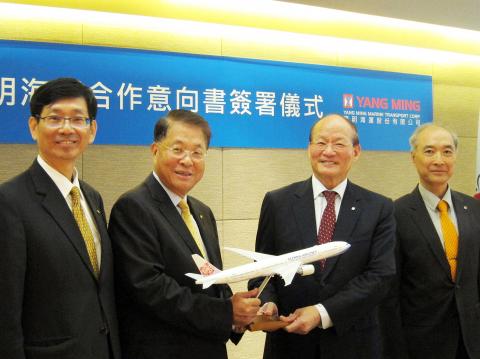
Photo: Wang Yi-hung, THE Taipei Times
The two companies said that the integration of resources would yield cost savings and more flexible offerings for clients than separate efforts would.
“Based on preliminary resources of our global physical presence, we have identified the best collaborative opportunities lie in major international hubs that have both air and sea links, such as Singapore, San Francisco, Los Angeles, Amsterdam and Frankfurt,” Yang Ming chairman Frank Lu (盧峰海) said.
In addition to maximizing sales, the two companies are to refer clients to each other and jointly offer a one-stop solution for comprehensive transportation services by sea and air, he said.
With the alliance, Yang Ming can redirect time-sensitive shipments to CAL during labor strikes or congestion at major ports, managers of the two companies said.
A collaborative business model between the two companies has already been established in Manila, while Frankfurt, Dubai and Myanmar appear to be suitable hubs to deploy the new joint operations, the companies said.
Regarding electronic commerce collaboration, CAL is to provide air freight support for Yes Logistics Corp (好好國際物流), a subsidiary of Yang Ming, the companies said.
Yes Logistics has begun internal testing of its My Captain online shopping platform, which is to feature duty-free and travel-related products by CAL.
In terms of passenger flights, CAL said that air fare expenses for Yang Ming employees totaled NT$10 million (US$303,260) last year and that it hopes to see the figure double next year, reaching NT$50 million in 2017.
In the first three quarters, CAL reported a net income of NT$5.1 billion or earnings of NT$0.94 per share, while Yang Ming incurred losses of NT$3.94 billion, or NT$1.15 loss per share, over the same period.

The domestic unit of the Chinese-owned, Dutch-headquartered chipmaker Nexperia BV will soon be able to produce semiconductors locally within China, according to two company sources. Nexperia is at the center of a global tug-of-war over critical semiconductor technology, with a Dutch court in February ordering a probe into alleged mismanagement at the company. The geopolitical tussle has disrupted supply chains, with some carmakers reportedly forced to cut production due to chip shortages. Local production would allow Nexperia’s domestic arm, Nexperia Semiconductors (China) Ltd (安世半導體中國), to bypass restrictions in place since October on the supply of silicon wafers — etched with tiny components to

Singapore-based ride-hailing and delivery giant Grab Holdings Ltd has applied for regulatory approval to acquire the Taiwan operations of Germany-based Delivery Hero SE's Foodpanda in a deal valued at about US$600 million. Grab submitted the filing to the Fair Trade Commission on Friday last week, with the transaction subject to regulatory review and approval, the company said in a statement yesterday. Its independent governance structure would help foster a healthy and competitive market in Taiwan if the deal is approved, Grab said. Grab, which is listed on the NASDAQ, said in the filing that US-based Uber Technologies Inc holds about 13 percent of

Taiwan Semiconductor Manufacturing Co (TSMC, 台積電) yesterday received government approval to deploy its advanced 3-nanometer (3nm) process at its second fab currently under construction in Japan, the Ministry of Economic Affairs said in a news release. The ministry green-lit the plan for the facility in Kumamoto, which is scheduled to start installing equipment and come online in 2028 with a monthly production capacity of 15,000 12-inch wafers, the ministry said. The Department of Investment Review in June 2024 authorized a US$5.26 billion investment for the facility, slated to manufacture 6- to 12nm chips, significantly less advanced than 3nm process. At a meeting with
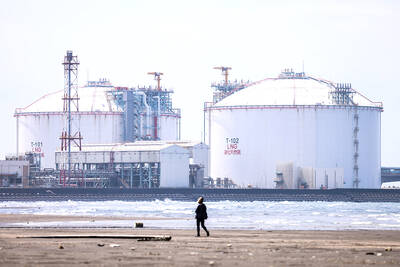
Taiwan is open to joining a global liquefied natural gas (LNG) program if one is created, but on the condition that countries provide delivery even in a scenario where there is a conflict with China, an energy department official said yesterday. While Taiwan’s priority is to have enough LNG at home, the nation is open to exploring potential strategic reserves in other countries such as Japan or South Korea, Energy Administration Deputy Director-General Chen Chung-hsien (陳崇憲) said. While the LNG market does not have a global reserve for emergencies like that of oil, the concept has been raised a few times —


 RSS
RSS