


Rifling through sweaters in India’s first Gap store in a glitzy New Delhi mall, 21-year-old Ridhi Goel said her grandmother does not mind how she dresses, as long as it is not too revealing.
“She’s fine with me wearing Western clothes like a shirt, but not jeans and a crop top,” said the journalism student, her grey leggings contrasting sharply with her mother’s colorful kurta. “All my family wears Indian clothes, but I find them too uncomfortable. I think maybe there is a generational divide.”
Most women in India still wear traditional dress such as saris or shalwar kameez — but the picture is changing, and on city streets, dazzling silks mingle with logoed T-shirts and jeans. Young people’s appetite for Western clothes has led a fresh flurry of foreign brands to open up in India in the past few months, including US chain Gap and Sweden’s H&M.
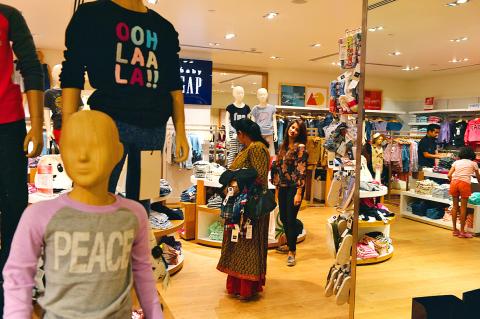
Photo: AFP
Others are expanding fast, including popular Spanish retailer Zara and British high-street staple Marks & Spencer, which last month opened its 50th shop in India, its biggest market outside the UK.
Urbanization, a growing middle class, rising disposable incomes and one of the youngest populations in the world make India hard to ignore.
“The time has come for Western wear to have exponential growth,” said J. Suresh, the managing director of textile group Arvind Lifestyle Brands.
“If you look at any girl born after 1990, she will be wearing Western wear. That is the generation coming into college, their first job,” he said. “They will be completely in Western wear.”
While globally women are the biggest shoppers, in India men’s clothing dominates, with 42 percent of the US$38 billion market last year, consultancy Technopak said.
Shoppers are also younger — the average customer targeted by Gap in its US stores is 35, but their Indian counterpart is five to 10 years their junior, Suresh said.
Gap had a head start in India thanks to Bollywood megastar Shah Rukh Khan, whose ubiquitous orange hoodie in 1990s hit Kuch Kuch Hota Hai (“Something Happens”) handed the brand a ready-made following.
However, it is young Indian women, increasingly affluent and joining the workforce in expanding numbers, who are driving change, with data showing sales of womenswear growing faster than men’s.
And while Western clothes currently make up only about one-quarter of Indian womenswear, their sales are outpacing traditional dress.
A Marks & Spencer spokesperson cited its Indigo denim range and lingerie as two of its best-performing lines in India, with more than 300,000 bras sold in 2014-2015.
“As an increasing number of women move into white collar and blue-collar roles, they are also adopting Western attire,” said Devangshu Dutta, chief executive of Third Eyesight, a retail consultancy in Delhi.
More negatively, media stereotypes of overseas fashion as a proxy for “a modern thought process” and conversely, Indian clothing as “backward or repressive, certainly are an important influencer,” he said.
While Indian Prime Minister Narendra Modi is famous for wearing a short-sleeved kurta, he is in the minority among India’s men.
They already dress predominantly in Western clothes, as do children, whose parents see it as a practical choice for school uniforms.
For foreign brands, fast-growing India is a welcome change from sluggish markets like Britain, and a loosening of foreign direct investment laws has made it easier to open stores.
Yet the retail landscape in India — geographically about as large and diverse as the EU — is hard to navigate, leading some entrants, including British department store Debenhams, to pull out. “Tackling the Indian market successfully requires a different mind-set,” Dutta said.
Foreign newcomers also face competition from Indian-owned, Western-style brands, such as Allen Solly or Louis Philippe, which are more familiar with the nuances of the market.
The successful ones adapt their ranges — Marks & Spencer “stretches” its seasons to cater for the long Indian summer and offers polo shirts in four times as many colors as in Britain.
Others aggressively cut prices.
In a nation where the average monthly wage is US$215, according to 2012 International Labour Organization figures, brands that are mid-market in Europe or the US are much higher end in India.
Dressed in a pink polo shirt and jeans in the capital’s new H&M store, airline officer Sunil Bassi, 49, says he is “not fussy” about his clothes and came to shop for his wife.
“Obviously, Western fashion is very popular. How many people in here do you see wearing Indian clothes?” he said.

The domestic unit of the Chinese-owned, Dutch-headquartered chipmaker Nexperia BV will soon be able to produce semiconductors locally within China, according to two company sources. Nexperia is at the center of a global tug-of-war over critical semiconductor technology, with a Dutch court in February ordering a probe into alleged mismanagement at the company. The geopolitical tussle has disrupted supply chains, with some carmakers reportedly forced to cut production due to chip shortages. Local production would allow Nexperia’s domestic arm, Nexperia Semiconductors (China) Ltd (安世半導體中國), to bypass restrictions in place since October on the supply of silicon wafers — etched with tiny components to

Singapore-based ride-hailing and delivery giant Grab Holdings Ltd has applied for regulatory approval to acquire the Taiwan operations of Germany-based Delivery Hero SE's Foodpanda in a deal valued at about US$600 million. Grab submitted the filing to the Fair Trade Commission on Friday last week, with the transaction subject to regulatory review and approval, the company said in a statement yesterday. Its independent governance structure would help foster a healthy and competitive market in Taiwan if the deal is approved, Grab said. Grab, which is listed on the NASDAQ, said in the filing that US-based Uber Technologies Inc holds about 13 percent of
Taiwan Semiconductor Manufacturing Co (TSMC, 台積電) yesterday received government approval to deploy its advanced 3-nanometer (3nm) process at its second fab currently under construction in Japan, the Ministry of Economic Affairs said in a news release. The ministry green-lit the plan for the facility in Kumamoto, which is scheduled to start installing equipment and come online in 2028 with a monthly production capacity of 15,000 12-inch wafers, the ministry said. The Department of Investment Review in June 2024 authorized a US$5.26 billion investment for the facility, slated to manufacture 6- to 12nm chips, significantly less advanced than 3nm process. At a meeting with

Taiwan’s food delivery market could undergo a major shift if Singapore-based Grab Holdings Ltd completes its planned acquisition of Delivery Hero SE’s Foodpanda business in Taiwan, industry experts said. Grab on Monday last week announced it would acquire Foodpanda’s Taiwan operations for US$600 million. The deal is expected to be finalized in the second half of this year, with Grab aiming to complete user migration to its platform by the first half of next year. A duopoly between Uber Eats and Foodpanda dominates Taiwan’s delivery market, a structure that has remained intact since the Fair Trade Commission (FTC) blocked Uber Technologies Inc’s


 RSS
RSS