


SinoPac Securities Co (永豐金證券) on Friday said it is to acquire two brokerages in a bid to bolster its wealth management business in Taiwan and expand the operational scale of SinoPac Securities (Asia) Ltd (永豐金證券亞洲), its Hong Kong-based subsidiary.
SinoPac Securities plans to acquire BEA Wealth Management Services Taiwan Ltd (東亞證券) for NT$375 million (US$11.53 million) and Tung Shing Holdings Co (東盛控股) for HK$540 million (US$69.68 million), the securities arm of SinoPac Financial Holdings Co (永豐金控) announced at a news conference in Taipei.
BEA Wealth Management is a Taiwan-based subsidiary of Hong Kong’s Bank of East Asia Ltd (BEA, 東亞銀行) specializing in re-consigned trading and has two service locations.
Tung Shing Holdings is also a subsidiary of BEA, which specializes in agency brokerage and margin financing, according to SinoPac Securities.
SinoPac Securities expects the purchase of BEA Wealth Management to boost its reconsigned trading business through larger operating scale with better efficiency, while pushing the company’s ranking among domestic peers to third place from fourth, the company said.
Bringing Tung Shing Holdings under its fold is expected to help SinoPac Securities better serve Hong Kong customers, the Taiwanese brokerage said, adding that its Hong Kong-based subsidiary would rise to be the second-largest agency broker among Taiwanese peers in Hong Kong.
“We hope to answer the Financial Supervisory Commission’s call to tap into the vast Asian markets with these two acquisitions,” SinoPac Securities chairman Chen Wei-long (陳惟龍) said. “Continuous innovation and expansions in economies of scale are key to improving competitiveness, and acquisition is the fastest method to achieve the latter.”
The two deals are expected to be completed before the end of March next year, pending regulatory approval, the company said.
“We are seeking other markets amid an unfavorable investment environment and limited upside potential on the local bourse, despite a recent recovery in average daily turnover,” said Mei Lan (藍玫君), senior executive vice president of SinoPac Securities wealth management and offshore securities business group.
She said the two companies involved in the acquisition plan do not service retail investors who trade Taiwan stocks, as they focus on wealth management and investments in international financial products.
SinoPac Securities is expected to purchase BEA Wealth Management with cash, and the company is seeking a syndicated loan to fund its acquisition of Tung Shing Holdings, company president Yeh Huang-chi (葉黃杞) said.
The deals are the first time a Taiwanese brokerage has acquired its Hong Kong-based peers.
Meanwhile, Hontai Life Insurance Co (宏泰人壽) on Friday announced that it had devised a NT$8.13 billion capital increase plan, which is expected to receive approval at an extraordinary general meeting scheduled to take place next month.
The company said the proposed capital enhancement is aimed at preventing being put under government receivership by the Financial Supervisory Commission.
The commission had warned that the insurer’s risk-based capital (RBC) ratio was inadequate.
Hontai Life’s capital increase plan consists of NT$6.98 billion in real estate assets, and NT$1.15 in funds raised through a public offering of new shares at NT$5.76 per share.
Hontai president and chief executive officer Tom Tang (湯維華) expects the capital plan to push the company’s RBC to a more favorable level of more than 250 percent.


The domestic unit of the Chinese-owned, Dutch-headquartered chipmaker Nexperia BV will soon be able to produce semiconductors locally within China, according to two company sources. Nexperia is at the center of a global tug-of-war over critical semiconductor technology, with a Dutch court in February ordering a probe into alleged mismanagement at the company. The geopolitical tussle has disrupted supply chains, with some carmakers reportedly forced to cut production due to chip shortages. Local production would allow Nexperia’s domestic arm, Nexperia Semiconductors (China) Ltd (安世半導體中國), to bypass restrictions in place since October on the supply of silicon wafers — etched with tiny components to
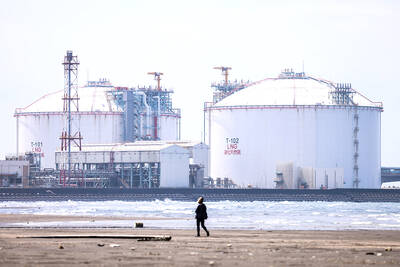
Taiwan is open to joining a global liquefied natural gas (LNG) program if one is created, but on the condition that countries provide delivery even in a scenario where there is a conflict with China, an energy department official said yesterday. While Taiwan’s priority is to have enough LNG at home, the nation is open to exploring potential strategic reserves in other countries such as Japan or South Korea, Energy Administration Deputy Director-General Chen Chung-hsien (陳崇憲) said. While the LNG market does not have a global reserve for emergencies like that of oil, the concept has been raised a few times —

Taiwan Semiconductor Manufacturing Co (TSMC, 台積電) yesterday received government approval to deploy its advanced 3-nanometer (3nm) process at its second fab currently under construction in Japan, the Ministry of Economic Affairs said in a news release. The ministry green-lit the plan for the facility in Kumamoto, which is scheduled to start installing equipment and come online in 2028 with a monthly production capacity of 15,000 12-inch wafers, the ministry said. The Department of Investment Review in June 2024 authorized a US$5.26 billion investment for the facility, slated to manufacture 6- to 12nm chips, significantly less advanced than 3nm process. At a meeting with
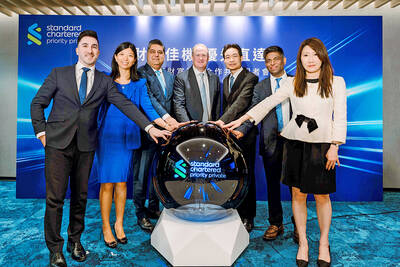
Standard Chartered Taiwan on March 26 announced that it has partnered with international fintech firm FinIQ to build an “Automated Structured Products Pricing Platform.” The bank is also introducing products from global issuers including Goldman Sachs Group Inc, Barclays PLC and BNP Paribas SA. The new platform enables an end-to-end process whereby it finds the most competitive pricing across multiple issuers in a matter of minutes, followed by automated documentation and transaction execution, which significantly shortens time-to-market and delivers a superior wealth management experience. Standard Chartered Bank Taiwan CEO Anthony Yu (游天立) said: “Standard Chartered is increasingly leveraging its wealth management


 RSS
RSS