


Twelve-year-old Myat Noe dashes between tables taking orders and sweeping up cigarette butts, working for about a US$1 a day in Myanmar, which has one of the worst records for child labor in the world.
There are millions like Myat Noe — child workers are widely accepted in the former junta-ruled nation — who prop up everything from tea rooms to factories. However, pressure is building for a change of attitude and law.
Weeks away from the landmark Nov. 8 election, a coalition of campaign groups are seizing the opportunity for debate and urging lawmakers to provide universal, compulsory and free education within five years.
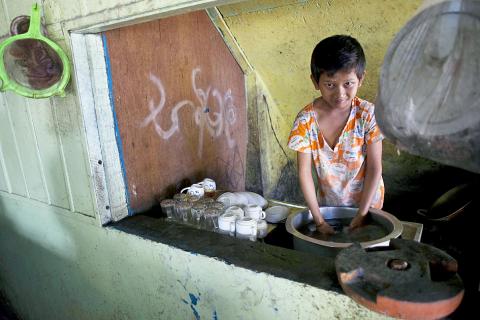
Photo: AFP
Aung San Suu Kyi’s National League for Democracy is expected to make major gains in the election, and has identified education as the cornerstone in reducing poverty, but so far has not committed to this demand.
A quick glance along Yangon’s streets reveals there is some way to go.
Streetside tea shops — the busy jumbles of plastic tables and chairs usually patronized by chain-smoking men — are mostly staffed by children, some as young as seven-years-old.
“I come from the countryside and I have to help my parents, because they don’t have enough money,” said Myat Noe, whose name has been changed to protect her identity.
Like many of the child workers in Yangon, she comes from one of Myanmar’s poor ethnic minority groups and has worked for about US$1 a day since she was nine.
Child workers often toil 14 hours a day, seven days a week, sleeping in large dormitories with other children or on makeshift beds made from the plastic tables which they wait on by day.
There is no time for school let alone play, condemning most child workers to a lifetime of manual labor and poverty.
According to data from last year’s census, Myat Noe is one of an estimated 4.4 million under-18s who do not attend school in Myanmar.
The impoverished country is the world’s seventh-worst for child labor, according to risk analysts Verisk Maplecroft, just ahead of India and Liberia.
The rates look set to rise as the economy booms four years after opening up to the world, with new hotels, cafes and factories providing jobs to willing workers, irrespective of age.
A tangle of labor laws do not ban children from work, said Piyamal Pichaiwongse, of the International Labor Organization (ILO) in Yangon.
“There’s nothing clear on the age at which you can start work and the laws are not applied,” she said.
In 2013, Myanmar joined an ILO convention that outlaws the worst forms of child labor, such as forced work, including in the army or sex industry.
The government says it wants to address the situation, but until a binding law is crafted, children will remain ever-present in the workforce.
“As parents are poor, they send their kids to tea shops to make money,” Win Shein of the Burmese Ministry of Labor said.
In an attempt to reach working children, several organizations provide free schooling on the job.
Three nights a week for the past six months, 15-year-old Naing Lin Aung has attended class after a full day working the teashop tables.
“I don’t know what will happen to me in the future, so I want to learn some English, some computer skills, some knowledge of health in case I get sick,” he said, his eyes red with fatigue.
The Myanmar Mobile Education project (myME), teaches 600 children in Yangon and Mandalay, holding classes inside teashops after closing time.
For youngsters working at 24-hour establishments, they run an improvised classroom in a converted minibus parked up outside.
Some attend for basic literacy and mathematics, while those with a bit of schooling under their belt want to improve their English and computer skills.
Teaching over-worked youngsters is no easy task.
“Most of the children work all day long, so sometimes they can’t focus on the lessons. It’s a challenge,” teacher Thaw Wai Htoo said.
Another organization, Scholarships for Street Kids, compensates parents for the income they lose from their child leaving work.
“This country is really poor and the education system destroyed ... so it’s hard to value education and to persuade the parents to send their kids to school,” founder John McConnell said.
It has provided about 300 scholarships so far, but for every child they reach, many more have little choice but to work in a nation where the education system was ravaged by decades of junta under-funding.
For Tim Aye-Hardy, founder of myME, a whole generation is being sacrificed by poverty.
“What kind of jobs will they get, what kind of future is open for them and for the country?” he asked.

Cairo’s new monorail slices across the city skyline, running above the familiar chaos of blaring horns and aging buses’ exhaust fumes that mark rush hour below. The US$4.5 billion monorail, opened this month, is among Egypt’s most prominent new transport projects, part of a debt-funded infrastructure drive criticized for sapping state finances while bringing limited benefits to most of the country’s 109 million people. “It feels like you’re in a different country,” said Ramy Sayed, a restaurant manager, aboard a driverless Innovia 300 train. “No noise, no traffic, we’re not used to this.” The eastern line runs 56km from the bustling middle-class

Taiwanese firms have increased investment in the Philippines in recent years as Manila’s ties with Washington deepen and global supply chains continue to shift away from China, an expert at the Chung-Hua Institution for Economic Research (CIER, 中華經濟研究院) said yesterday. The Philippines had not been among Taiwanese investors’ top choices in Southeast Asia, CIER Taiwan ASEAN Studies Center director Kristy Hsu (徐遵慈) said at a seminar in Taipei. However, Taiwan’s investment in the country has grown significantly since the COVID-19 pandemic, reaching US $257 million last year, a high in recent years, she said. Although Taiwan’s total investment in the Philippines still lags

Intel Corp regards Taiwan Semiconductor Manufacturing Co (TSMC, 台積電) as a longstanding partner, as the US chipmaker would continue outsourcing production of advanced chips to TSMC, Intel chief executive officer Lip-Bu Tan (陳立武) said yesterday. “I don’t look at people as competitors. I look at the collaboration... Nvidia is also, you know, a good friend,” Tan told a news conference following his keynote speech at the Computex trade show in Taipei. “It’s a very trusted partnership for us... We are a big, top customer for them, and we’re going to continue doing that,” he said, referring to TSMC, the world’s largest foundry

Artificial intelligence (AI) agents would supplant smartphones as the center of people’s digital lives, fundamentally reshaping personal devices and driving a major computing upgrade cycle, Qualcomm Inc CEO Cristiano Amon said yesterday. In his keynote speech for this year’s Computex trade show in Taipei, Amon said that the rise of "agentic AI" — AI systems capable of reasoning, planning and carrying out tasks autonomously — would transform how people interact with technology across phones, PCs, vehicles and wearable devices. Describing the technology as the next major evolution in computing, Amon said that "2026 is the year of agents.” For decades, smartphones have sat


 RSS
RSS