

Drugstore chain Cosmed (康是美) yesterday marked its 20th anniversary by unveiling four new concept stores and a revamped corporate branding that is to be implemented nationwide as the company upgrades its stores to provide consumers with a new shopping experience.
Cosmed, the nation’s second-largest drugstore chain operator after Watson’s Personal Care Stores (Taiwan) Co (台灣屈臣氏), is operated by President Drugstore Business Corp (統一生活事業), a subsidiary of President Chain Store Corp (統一超商).
The company unveiled four distinctive concept stores: the “Urban Oasis” in Taoyuan; the “European Garden” in Hsinchu; and the “Fashion Lab” and “Modern Forest” in Kaohsiung.
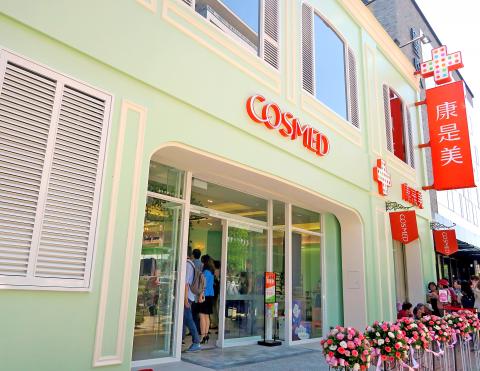
Photo: CNA
The company is upbeat on its growth prospects, citing data by the Ministry of Economic Affairs that showed total sales by Taiwan’s pharmacies and drugstores rose 4 percent annually to NT$182.9 billion (US$5.59 billion) last year.
However, the company acknowledged that consumers are making more purchases online than before, with total sales surging to NT$613.8 billion in the first half of this year from NT$382 billion in 2012.
“While online sales compete on content, the attraction of a physical store lies in the shopping experience,” President Drugstore Business Corp president’s office manager Aaron Chang (張世勳) said.
Chang said the “Fashion Lab” concept shop is focused on makeup, while the “Urban Oasis” store features a comfortable cabin-like decor to provide busy professionals with a respite. Meanwhile, the “European Garden” invokes the elegant atmosphere of the old continent and the “Modern Forest” store features a theme combining nature and technology.
“The four new concept stores reflect the results of our research on what our customers want. The themes will be implemented to suit the needs of the customer base in each business district covered by our 370 stores nationwide as they complete their upgrade cycle every five to six years,” President Drugstore Business Corp president Martin Chang (張聰本) said.
Stores are to be adjusted according to sales, and that the company is prioritizing quality and not necessarily looking to expand the number of stores, Martin Chang said, adding that new products are to be added to the mix, such as South Korean fashion accessories and jewelry.
“We anticipate sales will grow 5 percent annually this year to more than NT$10 billion, surpassing last year’s NT$9.6 billion,” Martin Chang said.
The firm also retired its woodpecker logo, replacing it with a cross comprised of colorful dots, a tribute to each consumer’s individual pursuit of personal health, style and beauty.
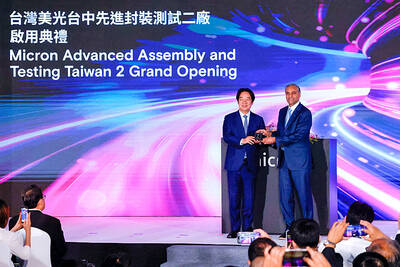
IN GOOD FAITH: Lai said he appreciates Micron’s commitment to Taiwan and that it would continue expanding its investment in the country, while also working with labor President William Lai (賴清德) yesterday called for US memory maker Micron Technology Inc and its workers to negotiate “sincerely” ahead of a possible strike by the company’s union in Taiwan. Last week, a Taiwanese union representing workers at Micron said it had secured authorization from its members to strike over a dispute concerning the company’s bonus scheme, escalating a labor conflict at the chipmaker’s largest manufacturing hub. Micron employs about 15,000 people in Taiwan and has said it invested more than NT$1.6 trillion (US$49.6 billion) in the country. Speaking in Taichung at the opening of a new Micron advanced assembly and testing facility,

China proposed adding advanced artificial intelligence (AI) technologies to its export-control list, potentially restricting overseas transfers of AI models and chip designs in an effort to keep closer control over homegrown advancements in a strategically important sector. The draft proposal covers 23 AI technologies, including large language models, agents, chip designs and computing clusters. Restricted technologies would include model weights and source code for products exceeding certain performance thresholds. Chinese AI startups have this summer made significant progress in closing the gap on US industry leaders. Models such as Moonshot (月之暗面) AI’s Kimi K3 and DeepSeek’s (深度求索) latest editions offer better pricing,
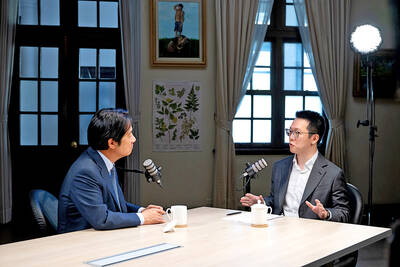
Taiwan should not rule out any energy source or abandon environmental sustainability in favor of ideology and short-term benefits, President William Lai (賴清德) said in an interview, calling for a “professional assessment” of whether nuclear power should be reintroduced into Taiwan’s energy mix. In an online interview with influencer Yu Ting-hao (游庭皓) that aired yesterday, Lai reiterated his position on nuclear power. SHIFT Lai’s remarks marked a shift from the Democratic Progressive Party’s (DPP’s) longstanding opposition to nuclear power. As premier from 2017 to 2019, Lai pushed for more gas-fired power capacity while sticking to the DPP’s nuclear free homeland ideology and rejected the
CoreWeave Inc has become caught in a tug of war between investors who see rising bond yields as a potential rally killer for the artificial intelligence (AI) trade and those who think demand for computing power will make those concerns seem passe before long. The cloud-computing services provider’s shares plunged 20 percent in the first three sessions of last week, including more than 15 percent on Wednesday, as its debt tumbled to levels that typically indicate distress. On Thursday morning, the cost of protecting CoreWeave bonds against default rose to the highest intraday level on record, while swaps priced in a


 RSS
RSS