


The hulking Soviet-era mineral refinery in Pikalyovo, one of Russia’s hundreds of factory towns hit by a crippling economic crisis, has been a blessing, and at times a curse, for a place dependent on a single industry.
Standing outside hangars housing throbbing machinery, the plant’s technical director said that the town of 20,000, located about 250km east of Saint Petersburg, cannot survive without its refinery, which produces alumina, an oxide used in aluminum production.
“All residents are tied to the refinery in one way or another,” refinery technical director Oleg Khristich said, wearing a hard helmet. “We provide heating and electricity to the city. When the children finish their studies, they come work for us.”
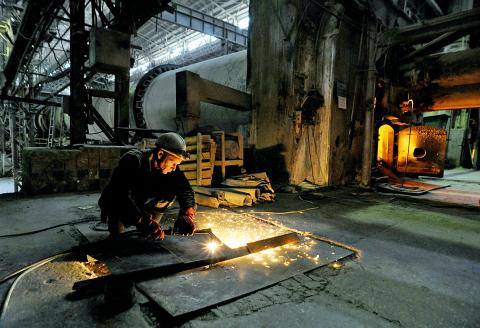
Photo: AFP
Pikalyovo is one of 319 Russian industrial towns classified as “monocities” because of their dependency on a single economic activity.
These cities and towns are home to about 14 million people, or 10 percent of Russia’s population.
Russia’s “monocities” have been in steady decline since the collapse of the Soviet Union, but have become all the more vulnerable as the country battles a recession spurred by low energy prices and Western sanctions over the Ukraine crisis.
At a recent government meeting, Russian Minister of Economic Development Alexey Ulyukayev enumerated the woes of Russia’s “monocities”: the exodus of 20 percent of their populations, unemployment rates double the national average and collapsed social institutions.
Pikalyovo is essentially a product of the Soviet Union, its Lenin monument, Palace of Culture and “Soviet Street” attesting to the town’s industrial origins.
After developing around a cement factory using local limestone deposits in the early Soviet era, Pikalyovo turned to alumina production in 1959.
The Basel Cement Pikalyovo company — which produces alumina — today employs more than 2,100 people, or more than one-tenth of the population.
The heavy industries that dominate Russian factory towns often depend heavily on the international price of oil, aluminum and coal markets, and can be victims of their volatility, said Ilya Krivogov, the head of the Russian Monocity Development Fund.
“They [monocities] often have not been modernized since the 1950s or 1960s and their competitiveness is weak,” he said.
Financially strangled and plagued with disagreements among its owners during the 2008-2009 global economic crisis, Pikalyovo’s industrial complex announced massive job cuts after its workers had gone unpaid for months.
After several hundred people blocked a federal highway in protest in June 2009, then-Russian prime minister Vladimir Putin flew in on a helicopter to publicly castigate the complex’s owners, including oligarch Oleg Deripaska, in an intervention broadcast on national television.
Putin tossed a pen on the table and forced Deripaska to sign an agreement resolving the dispute, before the Kremlin strongman snarkily asked for his pen back.
The incident increased interest from the authorities toward “monocities,” leading to the creation of a federal fund for their development with about 30 billion rubles (US$452 million at the current exchange rate) over three years.
The fund participates in investment projects and trains local bureaucrats and businessman to diversify their cities’ single-industry economies.
A 2010 state-sponsored economic diversification plan has led Pikalyovo to open a greenhouse facility producing cucumbers, lettuce and tomatoes. Last month, the town inaugurated the construction site of a new industrial zone.
“We want to increase production, create products that have more added value,” said Maxim Volkov, the new chief executive of the alumina refinery.
Volkov boasted that the refinery had reduced its production costs and lowered its losses, even without state assistance.
Although the paint on the refinery’s hangars is chipped and its pipes rusted, major renovations have been launched and production has not slowed in spite of the crisis, Volkov said.
The refinery’s workers — who like other Russians have seen their purchasing power shrink with the collapse of the ruble and soaring inflation — have to work overtime to make ends meet, workers union chief Svetlana Antropova said.
Social benefits have been drastically cut since the Soviet era, where the state-run firms provided workers with wide-ranging benefits, including housing and vacations in certain workplaces.
“At the time [the Soviet era], the management of the refinery strove to increase production, to develop social gains, kindergartens and cultural centers, because everything depended on it,” Antropova said. “But since then we have lost everything, little by little.”

The domestic unit of the Chinese-owned, Dutch-headquartered chipmaker Nexperia BV will soon be able to produce semiconductors locally within China, according to two company sources. Nexperia is at the center of a global tug-of-war over critical semiconductor technology, with a Dutch court in February ordering a probe into alleged mismanagement at the company. The geopolitical tussle has disrupted supply chains, with some carmakers reportedly forced to cut production due to chip shortages. Local production would allow Nexperia’s domestic arm, Nexperia Semiconductors (China) Ltd (安世半導體中國), to bypass restrictions in place since October on the supply of silicon wafers — etched with tiny components to

Singapore-based ride-hailing and delivery giant Grab Holdings Ltd has applied for regulatory approval to acquire the Taiwan operations of Germany-based Delivery Hero SE's Foodpanda in a deal valued at about US$600 million. Grab submitted the filing to the Fair Trade Commission on Friday last week, with the transaction subject to regulatory review and approval, the company said in a statement yesterday. Its independent governance structure would help foster a healthy and competitive market in Taiwan if the deal is approved, Grab said. Grab, which is listed on the NASDAQ, said in the filing that US-based Uber Technologies Inc holds about 13 percent of

Taiwan Semiconductor Manufacturing Co (TSMC, 台積電) yesterday received government approval to deploy its advanced 3-nanometer (3nm) process at its second fab currently under construction in Japan, the Ministry of Economic Affairs said in a news release. The ministry green-lit the plan for the facility in Kumamoto, which is scheduled to start installing equipment and come online in 2028 with a monthly production capacity of 15,000 12-inch wafers, the ministry said. The Department of Investment Review in June 2024 authorized a US$5.26 billion investment for the facility, slated to manufacture 6- to 12nm chips, significantly less advanced than 3nm process. At a meeting with

Taiwan’s food delivery market could undergo a major shift if Singapore-based Grab Holdings Ltd completes its planned acquisition of Delivery Hero SE’s Foodpanda business in Taiwan, industry experts said. Grab on Monday last week announced it would acquire Foodpanda’s Taiwan operations for US$600 million. The deal is expected to be finalized in the second half of this year, with Grab aiming to complete user migration to its platform by the first half of next year. A duopoly between Uber Eats and Foodpanda dominates Taiwan’s delivery market, a structure that has remained intact since the Fair Trade Commission (FTC) blocked Uber Technologies Inc’s


 RSS
RSS