


Belgium has long been a leading exponent of the traditional printed comic book, but a recent exhibition of South Korean “webtoons” has caused soul-searching in the land of Tintin and The Smurfs.
The animated online comics, which are wildly popular in South Korea, have made some Belgian artists wonder whether they might be falling behind the times after a long period of global success.
The Belgian-Korean Comics Exhibition running until the end of next month at the Korean Cultural Center in Brussels offers a chance to compare the old and the new forms, with clips of webtoons being shown on screens.
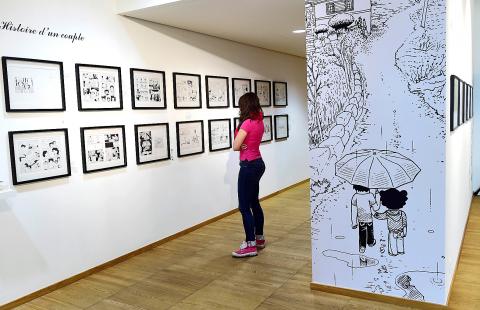
Photo: AFP
Belgian comic artist Bernard Yslaire, whose works include the fanciful saga Sambre and the romantic series Bidouille et Violette, said South Korean readers were trendsetters.
“That’s [webtoons] all they read. It’s very rare in Korea to publish comic books,” said Yslaire, whose originals are on show at the exhibition.
“But that really grabs me. It’s been 15 years that I have been trying to do the same thing. Everyone knows that [South] Korea is the future, but we have the weight of the past,” he added.
Center director Chung Hae-tal said that South Koreans are now massive consumers of webtoons.
“People are watching this everywhere in South Korea,” he said.
Webtoons, sometimes known as web comics, are published online and are usually accessible for free on smartphones or tablets. They combine fixed and moving images, changing colors, special effects, sound and music.
And what works well in Seoul is now being exported, with some leading webtoons being published in English-language versions.
Yet the traditional printed comic book became what the French-speaking academic world dubs the “Ninth art form” thanks in large part to Belgian artists like Herge, who produced Tintin, and Peyo, who gave the world The Smurfs, small blue creatures who live in mushroom-shaped houses in the forest.
And old-fashioned comic books remain enormously popular in Belgium. A comic book festival at the start of the month in Brussels drew up to 100,000 fans, enticed by the opportunity to meet artists or take part in creative workshops.
In South Korea, comic strips known as manhwa first surfaced in 1909 under the Japanese occupation, with the aim of stirring people against imperialist rule, exhibition organizers said.
In the mid-1960s, people started flocking to manhwabang — libraries and private rooms where they could read manhwa. A decade later, the historic graphic novel dominated until a wave of Japanese manga comics invaded South Korea in the 1980s.
South Korean artists reacted by creating comics about sexuality, everyday violence and other adult themes and distributed their work on the Internet and eventually via smartphones.
Both Belgian authors and their South Korean counterparts say they find similar sources of inspiration, often from everyday life.
For example, the Brussels exhibition features pages from A Couple’s Story, a graphic novel by South Korean author Hong Yeon-sik, about a comic artist who decides to leave the big city with his wife and settle in the countryside.
For French-speaking readers, this immediately brings to mind the comic book Return to Earth by Manu Larcenet and Jean-Yves Ferri — but the book is completely unknown in South Korea.
“Never heard of it,” a smiling Hong said.
His compatriot Ancco, who goes by one name, recalled having “discovered European authors in a museum for comic books” in South Korea, but admitted “not having real personal contacts” with her peers in Europe.
Ancco’s accounts, which draw from her recollections of an “unhappy” youth in the suburbs of Seoul, has echoes of the story that Flemish artist Delphine Frantzen tells in Madame Pipi, about a caretaker at public toilets who sees people from all walks of life come to meet the same basic need.
“In reading Belgian authors, I find similarities, both in the way the images and storylines are presented. Each one can reveal emotion,” Ancco said after contemplating both Belgian and Korean comic strips.
Frantzen agreed even if she said she has “not yet tried to publish work on the Internet.”
“I still prefer a book to a screen, but the latter is the future. We have to find an audience for these kinds of things,” she said.

The domestic unit of the Chinese-owned, Dutch-headquartered chipmaker Nexperia BV will soon be able to produce semiconductors locally within China, according to two company sources. Nexperia is at the center of a global tug-of-war over critical semiconductor technology, with a Dutch court in February ordering a probe into alleged mismanagement at the company. The geopolitical tussle has disrupted supply chains, with some carmakers reportedly forced to cut production due to chip shortages. Local production would allow Nexperia’s domestic arm, Nexperia Semiconductors (China) Ltd (安世半導體中國), to bypass restrictions in place since October on the supply of silicon wafers — etched with tiny components to

Singapore-based ride-hailing and delivery giant Grab Holdings Ltd has applied for regulatory approval to acquire the Taiwan operations of Germany-based Delivery Hero SE's Foodpanda in a deal valued at about US$600 million. Grab submitted the filing to the Fair Trade Commission on Friday last week, with the transaction subject to regulatory review and approval, the company said in a statement yesterday. Its independent governance structure would help foster a healthy and competitive market in Taiwan if the deal is approved, Grab said. Grab, which is listed on the NASDAQ, said in the filing that US-based Uber Technologies Inc holds about 13 percent of

Taiwan Semiconductor Manufacturing Co (TSMC, 台積電) yesterday received government approval to deploy its advanced 3-nanometer (3nm) process at its second fab currently under construction in Japan, the Ministry of Economic Affairs said in a news release. The ministry green-lit the plan for the facility in Kumamoto, which is scheduled to start installing equipment and come online in 2028 with a monthly production capacity of 15,000 12-inch wafers, the ministry said. The Department of Investment Review in June 2024 authorized a US$5.26 billion investment for the facility, slated to manufacture 6- to 12nm chips, significantly less advanced than 3nm process. At a meeting with

Taiwan is open to joining a global liquefied natural gas (LNG) program if one is created, but on the condition that countries provide delivery even in a scenario where there is a conflict with China, an energy department official said yesterday. While Taiwan’s priority is to have enough LNG at home, the nation is open to exploring potential strategic reserves in other countries such as Japan or South Korea, Energy Administration Deputy Director-General Chen Chung-hsien (陳崇憲) said. While the LNG market does not have a global reserve for emergencies like that of oil, the concept has been raised a few times —


 RSS
RSS