


SMARTPHONES
Global assembly rankings
Hon Hai Precision Industry Co (鴻海精密), a major supplier of Apple Inc, was ranked as the world’s second-largest assembler of smartphones in the second quarter of the year, the International Data Corp (IDC) said in its latest report. Hon Hai, also known as Foxconn Technology Group (富士康), still trailed behind South Korea’s Samsung Electronics Co in the top 10 rankings for global smartphone original design manufacturers (ODMs), IDC said yesterday. Pegatron Corp (和碩) dropped one notch to the fourth place in terms of global smartphone ODM shipments in the Apirl-to-June quarter, after LG Electronics Inc but ahead of Flextronics International Ltd. From the sixth to the 10th places are Huaqin Technology Co (華勤通訊技術), Vivo Electronics Corp (維沃移動通信), Inventec Appliances Corp (英華達), Oppo Mobile Telecommunications Corp (歐珀移動) and Wingtech Group Ltd (聞泰集團), IDC said.
SOLAR MAKERS
Neo Solar secures loan
Neo Solar Power Corp (新日光) yesterday received a three-year NT$3.3 billion (US$101 million) syndicated loan from eight banks, coordinated by Taiwan Cooperative Bank (合作金庫銀行), the company said in a filing to the Taiwan Stock Exchange yesterday. The funds will be used to buy equipment, materials and boost working capital, the filing said. Neo Solar chairman Quincy Lin (林坤禧) said the company’s business has shown positive signs this quarter and order visibility is extending into next quarter, adding that revenue is expected to grow strongly in the fourth quarter on the back of demand pick-up in China and the US. During the January-August period, the company’s cumulative revenue plunged 28.39 percent to NT$13.31 billion from NT$18.59 billion a year earlier.
PHARMACEUTICALS
TWi shares dive 8.94%
Shares in TWi Pharmaceuticals Inc (安成) fell 8.94 percent yesterday after the developer of specialty generic drugs said it had raised up to US$2.83 billion by issuing new global depositary receipts (GDR), triggering investors’ concern about the potential share dilution. TWi said it issued a total of 14.4 million GDRs at a price of US$6.05 per share, which is equivalent to NT$197. That represents a 12 percent discount from the stock’s closing price of NT$224 yesterday in Taipei trading. TWi plans to use the proceeds from the GDR sale to strengthen its research capability, invest in a Chinese subsidiary and expand its capacity in Taiwan. The company’s cumulative revenue in the first eight months dropped 2.45 percent from a year earlier to NT$250.4 million.
REAL ESTATE
No bids for luxury apartment
A second-round foreclosure auction of a luxury apartment in Taipei’s Daan District (大安) failed to attract any bidders yesterday. The apartment, measuring 139.96 ping, was owned by model-turned-celebrity Lei Hung (洪曉蕾) and her husband Wang Shih-chun (王世均). The apartment failed to attract interested buyers during a first-round foreclosure sale on Aug. 13, when it was listed at NT$246.95 million by the Taipei District Court. The unit was to be sold for NT$197.57 million, or NT$1.46 million per ping yesterday, but again failed to attract buyers because of a cooling-down in the luxury property market. Property broker Taiwan Realty Co (台灣房屋) expects the floor price to drop to NT$158.05 million if the unit proceeds to a third-round foreclosure.

The domestic unit of the Chinese-owned, Dutch-headquartered chipmaker Nexperia BV will soon be able to produce semiconductors locally within China, according to two company sources. Nexperia is at the center of a global tug-of-war over critical semiconductor technology, with a Dutch court in February ordering a probe into alleged mismanagement at the company. The geopolitical tussle has disrupted supply chains, with some carmakers reportedly forced to cut production due to chip shortages. Local production would allow Nexperia’s domestic arm, Nexperia Semiconductors (China) Ltd (安世半導體中國), to bypass restrictions in place since October on the supply of silicon wafers — etched with tiny components to

Singapore-based ride-hailing and delivery giant Grab Holdings Ltd has applied for regulatory approval to acquire the Taiwan operations of Germany-based Delivery Hero SE's Foodpanda in a deal valued at about US$600 million. Grab submitted the filing to the Fair Trade Commission on Friday last week, with the transaction subject to regulatory review and approval, the company said in a statement yesterday. Its independent governance structure would help foster a healthy and competitive market in Taiwan if the deal is approved, Grab said. Grab, which is listed on the NASDAQ, said in the filing that US-based Uber Technologies Inc holds about 13 percent of

Taiwan Semiconductor Manufacturing Co (TSMC, 台積電) yesterday received government approval to deploy its advanced 3-nanometer (3nm) process at its second fab currently under construction in Japan, the Ministry of Economic Affairs said in a news release. The ministry green-lit the plan for the facility in Kumamoto, which is scheduled to start installing equipment and come online in 2028 with a monthly production capacity of 15,000 12-inch wafers, the ministry said. The Department of Investment Review in June 2024 authorized a US$5.26 billion investment for the facility, slated to manufacture 6- to 12nm chips, significantly less advanced than 3nm process. At a meeting with
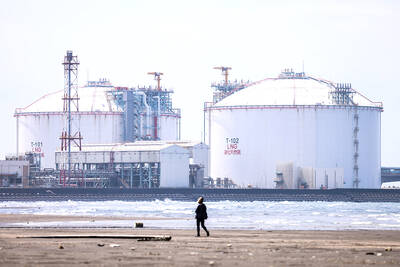
Taiwan is open to joining a global liquefied natural gas (LNG) program if one is created, but on the condition that countries provide delivery even in a scenario where there is a conflict with China, an energy department official said yesterday. While Taiwan’s priority is to have enough LNG at home, the nation is open to exploring potential strategic reserves in other countries such as Japan or South Korea, Energy Administration Deputy Director-General Chen Chung-hsien (陳崇憲) said. While the LNG market does not have a global reserve for emergencies like that of oil, the concept has been raised a few times —


 RSS
RSS