


Taiwanese PC maker Asustek Computer Inc (華碩) is to tap into the interactive service robots industry in a bid for long-term business growth, a company executive said.
In an interview with multilingual technology blog network Engadget, Asustek chairman Jonney Shih (施崇棠) said that the company has established an advanced research center, the Da Vinci Lab, to undertake research and development for the robotics business.
Shih said he is personally driving the robotics project and the company aims to manufacture a robot with the ability to interact with humans, similar to the intelligent Pepper robot co-developed by Hon Hai Precision Industry Co (鴻海精密) and Japan’s Softbank Corp’s.
The report said Asustek would unveil its first service robot as soon as next year.
Asustek spokesman Nick Wu (吳長榮) yesterday said that the robotic project is still in the development stages.
Yuanta Securities Investment Consulting Co (元大投顧) said it is a positive business move for Asustek; shifting away from its PC business amid the declining PC industry.
A Yuanta analyst, who declined to be named, told the Taipei Times that Asustek’s establishment of a research center for its robotic segment shows that the company still has strong research and development capabilities, which is important in the competitive global market.
“Asustek’s domestic rival Acer Inc (宏碁), on the other hand, is weaker in term of research and development,” the analyst said, adding that this is one of the reasons Acer is transitioning slower than Asustek.
However, the analyst said that as developing and manufacturing robots require significant funding, Asustek should seek a strategic partner for the project.
Apart from robotics, Asustek also sees the Internet of Things (IoT) as part of their business growth amid the rising “cloud” computing era.
At a news conference in Taipei yesterday, Asustek said the company is to form a strategic cloud-computing platform this quarter, welcoming international IoT-related software or hardware suppliers to join the platform in a bid to expand Asustek’s cloud-computing ecosystem.
The company’s chief executive officer of cloud services Peter Wu (吳漢章), said US-based start-up Zoom Video Communications Inc, which has more than 40 million registered users, has joined Asustek’s cloud-computing platform “ZenWorld.”
Wu said that as Asustek’s strategic partner, Zoom could utilize its cloud storage for video and Web conferencing, while Asustek could expand its reach in the IoT-related industry.
Asustek’s stock price grew 0.72 to NT$280 yesterday, in Taipei trading outperforming the TAEX, which lost 1.11 percent.

Netherlands-based semiconductor equipment supplier ASML Holding NV yesterday said that it is planning to hire an additional 1,000 people in Taiwan this year in response to growing demand from clients. ASML had previously planned to recruit 600 people this year, but that the plan has been adjusted upward, ASML vice president and ASML Taiwan general manager Grace Wang (汪佳慧) told reporters. ASML has a workforce of more than 4,500 in Taiwan, accounting for about 10 percent of its global total, Wang said. This year’s recruitment campaign would focus on adding people in the customer support, manufacturing and supply chain domains to assist ASML
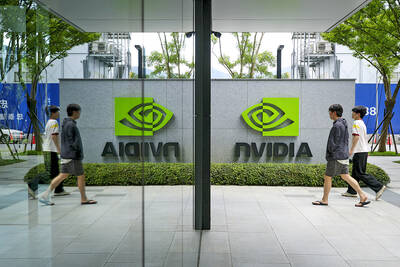
UNDER MICROSCOPE: Taiwan detained three people who allegedly conspired to buy servers in Taiwan and export them using fraudulent documentation, prosecutors said Nvidia Corp chief executive officer Jensen Huang (黃仁勳) on Saturday urged Super Micro Computer Inc to tighten up on compliance after Taiwan detained three people this week for allegedly making fraudulent declarations about artificial intelligence (AI) servers made by its US partner. The development marked the nation’s first crackdown on semiconductor smuggling, which grew after the US slapped restrictions on exports of high-end chips such as Nvidia AI accelerators to China. Nvidia is “rigorous” in explaining regulations to all of its partners, Huang told reporters after arriving in Taipei. “Ultimately Super Micro has to run their own company,” he said in response to

Nvidia Corp yesterday announced that CEO Jensen Huang (黃仁勳) would attend an employee meeting in Taipei tomorrow to celebrate the launch of the company’s Taiwan headquarters project. Huang would attend a gathering at the site of Nvidia’s planned headquarters in Beitou Shilin Technology Park (北投士林科技園區), the company said in a statement. After arriving in Taiwan on Saturday last week, Huang told reporters that he plans to meet with Quanta Computer Inc (廣達) chairman Barry Lam (林百里) and Taiwan Semiconductor Manufacturing Co (TSMC, 台積電) chairman C.C. Wei (魏哲家), and would attend the groundbreaking ceremony for Nvidia’s Taiwan headquarters tomorrow. Nvidia has not yet applied

Huawei Technologies Co (華為) said it has come up with a new pathway to shorten its gap with industry leader Taiwan Semiconductor Manufacturing Co (TSMC, 台積電), potentially achieving a breakthrough in making advanced semiconductors without cutting-edge equipment. Right now there is about a five-year gap between what TSMC is capable of and what Huawei, together with its manufacturing partner Semiconductor Manufacturing International Corp (中芯), can produce. Huawei is to start making 1.4-nanometer chips by 2031 with its own “LogicFolding” technology, Huawei semiconductor chief He Tingbo (何庭波) said in a rare public appearance during a chip conference yesterday, while TSMC has


 RSS
RSS