


Nan Liu Enterprise Co (南六) has ramped up capital expenditure this year, as the nation’s leading nonwoven fabrics manufacturer expands production capacity in Taiwan and China to meet rising market demand.
Nan Liu, which spent NT$260 million (US$8.27 million) on capital expenditure last year, on Wednesday said it is expecting a larger scale of operations this year to further enhance its sales and earnings.
The company has reached a 50-year rental agreement for 10 hectares of land in Kaohsiung’s Yanchao District (燕巢) to build production facilities focusing on biodegradable nonwoven products, Nan Liu finance department manager Chuang Chun-chin (莊春金) said at an investors’ conference organized by the Taiwan Stock Exchange.
In China, two air-through and thermal-bond nonwoven fabric production lines have begun operations at the company’s plant in Pinghu, Zhejiang Province, and Chuang said its clients are assessing the first batches of products from them.
“Capital expenditure will continue rising over the next three years,” she said, without offering exact numbers.
Nan Liu makes polypropylene nonwoven fabrics for diapers for Japanese company UniCharm Co, and US firms Procter & Gamble Co and Kimberly-Clark Corp. The company’s other products include nonwoven fabrics for surgical scrub suits, facial masks, microfiber cleaning cloths, dust cloths and mops.
The company is aware of intensifying competition in the Chinese market, but is confident that it can retain a significant technological lead over its Chinese peers for the next decade, Nan Liu president Huang Ho-tsun (黃和村) said.
“While it is true that deep-pocketed Chinese rivals can buy the same German machines as we do, Nan Liu’s engineers have been working closely with German machinery makers since the design phase,” Huang said.
As a result, the same machines can yield about 150m to 160m of nonwoven fabric in one minute, significantly outpacing the default capacity of 70m to 80m, a major factor contributing to Nan Liu’s favorable profit margins ranging between 18 and 22 percent, he said.
While wages are increasing in China, the company expects the upgrade of automated production systems to meaningfully reduce labor costs, Chuang said.
“We are not concerned over rising wages in China, as we utilize automated production extensively,” she said.
“In fact, we welcome the change, as rising wage levels translate to higher consumption in the Chinese market [and therefore make a greater contribution to the company’s sales],” she added.
As a slew of leading local and foreign makers have entered the Chinese market in a bid to grab a slice of the consumer boom there, Nan Liu hopes Chinese consumers can first get acquainted with its nonwoven fabric household products through diapers.
“As babies outgrow diapers, it is hoped that their parents would start using wet wipes and mop heads for other household cleaning needs,” Chuang said.
Nan Liu has not released its earnings results for the first half of the year.
In the first quarter, net profit leaped 55.3 percent year-on-year to NT$151 million, or NT$2.08 per share, on the back of tax refunds and foreign-exchange gains.
In the first six months, revenue rose 15.82 percent year-on-year to NT$3.003 billion, while revenue in the second half is expected to be higher than the first half, boosted by sizeable orders of nonwoven fabrics for surgical scrubs from Japanese clients, Chuang said.
Nan Liu also expects to secure a 30 percent global market share for the company’s spunlace nonwoven fabrics this year, compared with last year’s 20 percent, she said.
Nan Liu shares rose 0.6 percent to NT$169 yesterday in Taipei trading. They have risen 20.28 percent so far this year, while the broader market has declined 5.55 percent over the same period.

The domestic unit of the Chinese-owned, Dutch-headquartered chipmaker Nexperia BV will soon be able to produce semiconductors locally within China, according to two company sources. Nexperia is at the center of a global tug-of-war over critical semiconductor technology, with a Dutch court in February ordering a probe into alleged mismanagement at the company. The geopolitical tussle has disrupted supply chains, with some carmakers reportedly forced to cut production due to chip shortages. Local production would allow Nexperia’s domestic arm, Nexperia Semiconductors (China) Ltd (安世半導體中國), to bypass restrictions in place since October on the supply of silicon wafers — etched with tiny components to

Singapore-based ride-hailing and delivery giant Grab Holdings Ltd has applied for regulatory approval to acquire the Taiwan operations of Germany-based Delivery Hero SE's Foodpanda in a deal valued at about US$600 million. Grab submitted the filing to the Fair Trade Commission on Friday last week, with the transaction subject to regulatory review and approval, the company said in a statement yesterday. Its independent governance structure would help foster a healthy and competitive market in Taiwan if the deal is approved, Grab said. Grab, which is listed on the NASDAQ, said in the filing that US-based Uber Technologies Inc holds about 13 percent of

Taiwan Semiconductor Manufacturing Co (TSMC, 台積電) yesterday received government approval to deploy its advanced 3-nanometer (3nm) process at its second fab currently under construction in Japan, the Ministry of Economic Affairs said in a news release. The ministry green-lit the plan for the facility in Kumamoto, which is scheduled to start installing equipment and come online in 2028 with a monthly production capacity of 15,000 12-inch wafers, the ministry said. The Department of Investment Review in June 2024 authorized a US$5.26 billion investment for the facility, slated to manufacture 6- to 12nm chips, significantly less advanced than 3nm process. At a meeting with
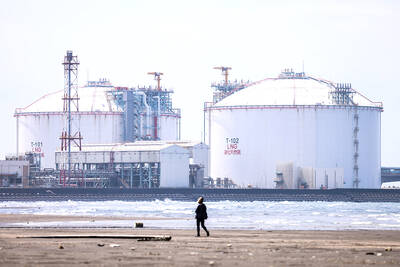
Taiwan is open to joining a global liquefied natural gas (LNG) program if one is created, but on the condition that countries provide delivery even in a scenario where there is a conflict with China, an energy department official said yesterday. While Taiwan’s priority is to have enough LNG at home, the nation is open to exploring potential strategic reserves in other countries such as Japan or South Korea, Energy Administration Deputy Director-General Chen Chung-hsien (陳崇憲) said. While the LNG market does not have a global reserve for emergencies like that of oil, the concept has been raised a few times —


 RSS
RSS