


Offer Roberto Ceretti a fortune for one of his coveted hand-made guitars and he will likely turn you down: The Italian craftsman may be in demand among collectors, but only plies his trade for top musicians in need.
Tucked away in the hills of northwest Italy, Ceretti’s workshop is hung with half-finished models, the walls lined with stacks of cedar, mahogany and apple wood, and a large drawing board is littered with classical guitar designs.
“I made my first guitar when I was 12-years old, out of cardboard. It did not work of course, but the passion stuck,” said Ceretti, 50, who began his business in earnest 15 years ago after transforming his run-down holiday home in the Piedmont woods into an atelier.
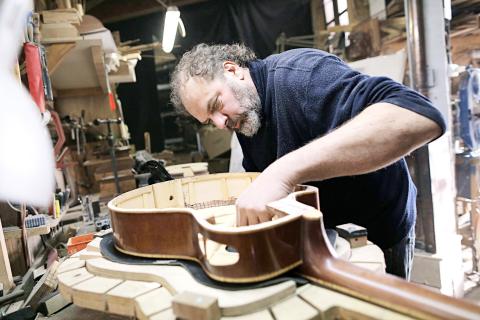
Photo: AFP
Now he makes five or six guitars a year, selling them for a song to help musicians hit hard by the economic crisis and cuts in culture budgets.
The father of three fells trees himself during the winter — the best season because the wood is less likely to split — hauling them back to the remote workshop in his truck before chopping them down to size in the clearing, his dog at his side.
He also rescues trees such as redwoods or firs destined for the chop in gardens around the region. He selects the best grain aesthetic from those to carve out the back, front and neck of his guitars, and uses all natural materials — such as boiled cow femurs — to make parts like the bridge and nut.
In crafting his instruments, Ceretti takes inspiration from master makers like Antonio Torres Jurado, the 19th-century Spanish luthier (stringed instrument maker) renowned for designing the first modern classical guitar — Ceretti likes his instrument bodies rounded rather than flat.
Modern artisanal guitars, sought for their rich tonal qualities, can sell for up to 25,000 euros (US$28,500), but Ceretti is not in business for the money.
“Guitars aren’t prostitutes to put in the window. They’re instruments to be kept for a lifetime, to be played and lovingly cared for,” Ceretti said.
“I only have musicians as clients. I don’t make guitars for collectors or people who just want something fashionable to put on their wall,” he added.
White-bearded and decked out in a lumberjack shirt and workman’s boots, Ceretti sees himself as more of a carpenter than an artist.
Breaks are spent walking alongside a nearby river, waiting patiently for the right moment to collect fresh materials — a timetable he says is often dictated by the waxing and waning of the moon, which affects the presence of woodworm.
From the moment the wood is ready, it takes him about a month to craft the instrument, which he sometimes rounds off with inlay on the rosette or fingerboard.
It is a painstaking, time-consuming vocation he says his children are unlikely to want to inherit, but one Ceretti says he finds “incredibly rewarding.”
“If you’re a musician living in Italy today, you are not making any money. So I don’t charge for many of my guitars — I exchange things for them,” Ceretti said, adding that in the past he has been paid in machines or tools he needs, and even a cement mixer.
His family lives in the house adjoining the workshop, and Ceretti saves money by using spring water rather than tap, and wood stoves for both central heating and cooking.
However, even out here in the wilderness, his philosophy is based on sharing.
“With the best musicians, that’s always been the way I’ve worked. If they can afford to pay, I might charge between 2,000 euros and 7,000 euros for a guitar, but it doesn’t happen often,” he said. “With the economic crisis as it is, I help out real musicians in need.”

The government yesterday approved applications by Alphabet Inc’s Google to invest NT$27.08 billion (US$859.98 million) in Taiwan, the Ministry of Economic Affairs said in a statement. The Department of Investment Review approved two investments proposed by Google, with much of the funds to be used for data processing and electronic information supply services, as well as inventory procurement businesses in the semiconductor field, the ministry said. It marks the second consecutive year that Google has applied to increase its investment in Taiwan. Google plans to infuse NT$25.34 billion into Charter Investments Ltd (特許投資顧問) through its Singapore-based subsidiary Fructan Holdings Singapore Pte Ltd, and

Micron Technology Inc is a driving force pushing the US Congress to pass legislation that would put new export restrictions on equipment its Chinese competitors use to make their chips, according to people familiar with the matter. A US House of Representatives panel yesterday was to vote on the “MATCH Act,” a bill designed to close gaps in restrictions on chipmaking equipment. It would also pressure foreign companies that sell equipment to Chinese chipmaking facilities to align with export curbs on US companies like Lam Research Corp and Applied Materials Inc. The bill targets facilities operated by China’s ChangXin Memory Technologies Inc

SECOND-RATE: Models distilled from US products do not perform the same as the original and undo measures that ensure the systems are neutral, the US’ cable said The US Department of State has ordered a global push to bring attention to what it said are widespread efforts by Chinese companies, including artificial intelligence (AI) start-up DeepSeek (深度求索), to steal intellectual property from US AI labs, according to a diplomatic cable. The cable, dated Friday and sent to diplomatic and consular posts around the world, instructs diplomatic staff to speak to their foreign counterparts about “concerns over adversaries’ extraction and distillation of US AI models.” Distillation is the process of training smaller AI models using output from larger, more expensive ones to lower the costs of training a powerful new

Singapore-based ride-hailing and delivery giant Grab Holdings’ planned acquisition of Foodpanda’s Taiwan operations has yet to enter the formal review stage, as regulators await supplementary documents, the Fair Trade Commission (FTC) said yesterday. Acting FTC Chairman Chen Chih-min (陳志民) told the legislature’s Economics Committee that although Grab submitted its application on March 27, the case has not been officially accepted because required materials remain incomplete. Once the filing is finalized, the FTC would launch a formal probe into the deal, focusing on issues such as cross-shareholding and potential restrictions on market competition, Chen told lawmakers. Grab last month announced that it would acquire


 RSS
RSS