


At Geneva’s annual luxury watch fair this week, the brand’s marketing manager was delighting in the intricacies of a gleaming timepiece from Vacheron Constantin, one of Switzerland’s most prestigious watchmakers.
The price starts at 288,000 euros.
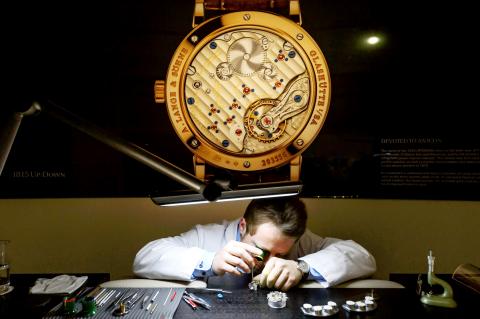
Photo: AFP
However, when it came to confirming whether that pricing, equivalent to US$334,000 at current exchange rates, would hold by the time the watch went on display next year, the marketing manager threw up his hands in a gesture of “who knows?”
So goes the angst of Swiss watchmakers, many of them reeling from the abrupt scrapping of a currency cap by the Swiss National Bank on Jan. 15. The move sent the Swiss franc soaring, making exports like watches a good deal more expensive and pressuring companies to increase prices or book lower profits.

Photo: Reuters
The currency shock has the Swiss companies especially perplexed because the country is the leading exporter of luxury watches and the sector was already feeling the effects of slowed sales to wealthy buyers in China and Russia, as well as competition from a new batch of smartwatches.
The country, home to 8 million, is also a top competitor in areas like pharmaceuticals, machinery and chemicals. With exports expected to dip, UBS last week cut its growth forecast for Switzerland for this year to 0.5 percent from 1.8 percent.
The Swiss National Bank for more than three years had pegged the franc to the euro mostly to protect Swiss exporters against a weakening of the euro, but the sudden reversal of the policy of preventing the franc from appreciating beyond 1.20 euros caused the currency to spike as much as 30 percent. It remained high this week, trading at about 1 Swiss franc per euro.

Photo: AFP
The chorus of complaints against the central bank’s U-turn was led by Nick Hayek, chief executive of Swatch Group, the world’s largest watchmaker, who said last week the decision was “a tsunami: for the export industry and for tourism, and finally for the entire country.”
Its ripple effect has been felt far beyond Switzerland. Some currency brokerage firms in London and New York, unable to cover the franc’s unprecedented volatility, have closed or been pushed close to collapse. In Poland, the authorities are studying how to support borrowers who took Swiss franc-denominated mortgages, in the belief that a Swiss investment guaranteed not only favorable rates, but also stability.
However, nowhere are the gyrations of the Swiss franc more directly felt than among the Swiss watch industry, which exports more than 90 percent of its timepieces, while maintaining a largely domestic cost base because of its reliance on the appeal of a “Made in Switzerland” label.
Switzerland recently toughened its label protection rules to ensure that at least 60 percent of the value of a Swiss product would be generated within the country.
In the industry’s most rarefied precincts, timepieces with highly complex movements that require years to develop and assemble can cost more than US$2 million even without diamonds.
At Patek Philippe, a timepiece introduced in October to honor the brand’s 175th anniversary has an esoteric chiming mechanism and a perpetual calendar; it took seven years to develop and costs US$2.6 million.
On the more modest end, a new Cartier model that leaves the moving parts exposed and is housed in a ghostly 47mm case of 18-karat white gold starts at US$150,000.
Even before the Swiss franc’s rise, watchmakers faced other challenges. Based on preliminary estimates, the worldwide sales growth of Swiss watches tapered to about 2 percent last year, compared with 22 percent in 2010.
Last week, Richemont, parent to brands like Cartier, Vacheron Constantin and Piaget watches, reported that sales rose almost 4 percent to 3.05 billion euros in the fourth quarter. However, the announcement was eclipsed by the Swiss currency shock, which sent Richemont shares plunging 16 percent that day and a further 7 percent the following day. Shares in Swatch also slumped, although both companies this week recouped a small part of their stock market losses.
Even if the mood was less ebullient at the watch show in Geneva this year than in past years, executives insisted it was too early to calculate the impact of a stronger franc on earnings.
Some sounded defiant.
lain Bernard, president of the Americas for Van Cleef & Arpels, said the company had “no plans to change anything,” as far as the pricing of watches was concerned.
“At least when we get tired of talking about watches, we’ll have something else to talk about,” he joked.
Other watchmakers said that deep-pocketed buyers of luxury watches rarely focused on pricing.
“When you set a watch at, say, US$600,000, the fact that you come to US$650,000 or US$680,000 doesn’t change much,” said Richard Mille, founder and chairman of the Richard Mille brand. “I’m not going to create myself any headache that I don’t deserve.”

Singapore-based ride-hailing and delivery giant Grab Holdings Ltd has applied for regulatory approval to acquire the Taiwan operations of Germany-based Delivery Hero SE's Foodpanda in a deal valued at about US$600 million. Grab submitted the filing to the Fair Trade Commission on Friday last week, with the transaction subject to regulatory review and approval, the company said in a statement yesterday. Its independent governance structure would help foster a healthy and competitive market in Taiwan if the deal is approved, Grab said. Grab, which is listed on the NASDAQ, said in the filing that US-based Uber Technologies Inc holds about 13 percent of

The domestic unit of the Chinese-owned, Dutch-headquartered chipmaker Nexperia BV will soon be able to produce semiconductors locally within China, according to two company sources. Nexperia is at the center of a global tug-of-war over critical semiconductor technology, with a Dutch court in February ordering a probe into alleged mismanagement at the company. The geopolitical tussle has disrupted supply chains, with some carmakers reportedly forced to cut production due to chip shortages. Local production would allow Nexperia’s domestic arm, Nexperia Semiconductors (China) Ltd (安世半導體中國), to bypass restrictions in place since October on the supply of silicon wafers — etched with tiny components to
Taiwan Semiconductor Manufacturing Co (TSMC, 台積電) yesterday received government approval to deploy its advanced 3-nanometer (3nm) process at its second fab currently under construction in Japan, the Ministry of Economic Affairs said in a news release. The ministry green-lit the plan for the facility in Kumamoto, which is scheduled to start installing equipment and come online in 2028 with a monthly production capacity of 15,000 12-inch wafers, the ministry said. The Department of Investment Review in June 2024 authorized a US$5.26 billion investment for the facility, slated to manufacture 6- to 12nm chips, significantly less advanced than 3nm process. At a meeting with

Taiwan’s food delivery market could undergo a major shift if Singapore-based Grab Holdings Ltd completes its planned acquisition of Delivery Hero SE’s Foodpanda business in Taiwan, industry experts said. Grab on Monday last week announced it would acquire Foodpanda’s Taiwan operations for US$600 million. The deal is expected to be finalized in the second half of this year, with Grab aiming to complete user migration to its platform by the first half of next year. A duopoly between Uber Eats and Foodpanda dominates Taiwan’s delivery market, a structure that has remained intact since the Fair Trade Commission (FTC) blocked Uber Technologies Inc’s


 RSS
RSS