


Richard Ji (季衛東), whose little-known fund was the biggest investor in leading Chinese smartphone maker Xiaomi Inc’s (小米) US$1.1 billion fundraising last month, is a numbers man looking to spot “category killers” — start-ups with the power to disrupt.
Ji, a former Morgan Stanley technology industry analyst, co-founded All-Stars Investment Ltd (全明星投資基金) in Hong Kong in April last year with half a dozen colleagues from the Wall Street bank.
The fund swiftly raised about US$750 million to target China’s vast Internet sector, Ji told reporters in an interview at his small office in Hong Kong’s central business district. A Xiaomi-branded television hangs on the wall.
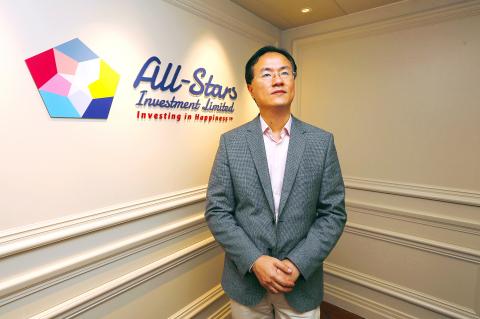
Photo: Reuters
Ji declined to name investors in his fund, but said half the money came from leading Asian corporations and the rest from business leaders in the IT, consumer and financial industries.
“As a fund, we focus on late-stage opportunities, or companies that are 2-3 years away from potential IPO,” he said. “If you focus on growth-stage companies, chances are you’ll pick the wrong horse.”
Last year’s record US$25 billion IPO from Alibaba Group Holding Ltd (阿里巴巴) injected new life into Chinese tech hopefuls. Alibaba and other Chinese companies raised a combined US$29.3 billion through US listings last year alone, minting millionaires and fueling a rush to fund tech start-ups.
Ji reckons only one in every 60,000 Internet start-ups in China makes it to a public listing.
Ji, whose 11 years as an industry analyst helped him build close ties with Chinese tech entrepreneurs, including Xiaomi founder and CEO Lei Jun (雷軍), said he targets what he calls “category leaders” and “category killers.”
“These companies have a disruptive product or business model, and they are the winners of tomorrow,” he said.
Xiaomi fits that bill.
Just three years after selling its first mobile phone, Beijing-based Xiaomi, dubbed “China’s Apple,” is worth US$45 billion, making it the most valuable start-up in the technology sector. Already, the world’s No. 3 smartphone maker, Xiaomi has ambitious plans to take on Samsung Electronics Co as it expands into home appliances, televisions and TV content.
“Lei Jun placed extraordinary faith in Richard by handing him the mandate,” one individual, who knows both men and is familiar with the fundraising, said. “That trust was built over a period of time, and Richard did not disappoint him.”
Xiaomi’s reliance on Ji, 46, to drive the fundraising last month underscores the importance of strong personal ties.
“He’s connected, well regarded, understands patterns and has learned that the odds are in his favor when he has the courage of his convictions — all in all, a powerful combination,” Mary Meeker, general partner at US-based venture capital firm Kleiner Perkins and Ji’s mentor at Morgan Stanley, said.
“He comes from an ordinary background. The remarkable thing about Richard is that he’s obsessed with analysis, even with simple things in life,” a former classmate of Ji’s from Fudan University said.
After a first degree from Fudan, Ji went on to Harvard, where he specialized in novel cancer therapy. During a brief stint in the pharmaceuticals industry, he dabbled in tech stocks and trebled his money in 1999, only to lose it all the following year as the Internet bubble burst.
“I was a victim of the previous technology crash, and so we’re extremely cautious about the [current] bubble. But there are key differences between the 2000 boom and now,” Ji said.
Ji notes that in early 2000, less than 5 percent of Chinese used the Internet. Today, about 630 million people — about half the country’s population — log on in some form, making China the world’s biggest Internet market, and Internet companies do not just rely on advertising revenues.
Apart from Xiaomi, Ji’s fund has also invested in Tencent Holdings Ltd-backed (騰訊) taxi-hailing app Didi Dache (滴滴打車), online fashion retailer Meilishuo.com (美麗說) and Alibaba.
Ji declined to say how much more money he plans to raise, but said there is no shortage of people looking to invest. His real test will be to secure commitments from international funds, giving him the profile and clout to take on global technology investors.
That will likely depend on the returns his current fund can generate.

The domestic unit of the Chinese-owned, Dutch-headquartered chipmaker Nexperia BV will soon be able to produce semiconductors locally within China, according to two company sources. Nexperia is at the center of a global tug-of-war over critical semiconductor technology, with a Dutch court in February ordering a probe into alleged mismanagement at the company. The geopolitical tussle has disrupted supply chains, with some carmakers reportedly forced to cut production due to chip shortages. Local production would allow Nexperia’s domestic arm, Nexperia Semiconductors (China) Ltd (安世半導體中國), to bypass restrictions in place since October on the supply of silicon wafers — etched with tiny components to

Singapore-based ride-hailing and delivery giant Grab Holdings Ltd has applied for regulatory approval to acquire the Taiwan operations of Germany-based Delivery Hero SE's Foodpanda in a deal valued at about US$600 million. Grab submitted the filing to the Fair Trade Commission on Friday last week, with the transaction subject to regulatory review and approval, the company said in a statement yesterday. Its independent governance structure would help foster a healthy and competitive market in Taiwan if the deal is approved, Grab said. Grab, which is listed on the NASDAQ, said in the filing that US-based Uber Technologies Inc holds about 13 percent of

Taiwan Semiconductor Manufacturing Co (TSMC, 台積電) yesterday received government approval to deploy its advanced 3-nanometer (3nm) process at its second fab currently under construction in Japan, the Ministry of Economic Affairs said in a news release. The ministry green-lit the plan for the facility in Kumamoto, which is scheduled to start installing equipment and come online in 2028 with a monthly production capacity of 15,000 12-inch wafers, the ministry said. The Department of Investment Review in June 2024 authorized a US$5.26 billion investment for the facility, slated to manufacture 6- to 12nm chips, significantly less advanced than 3nm process. At a meeting with

Taiwan is open to joining a global liquefied natural gas (LNG) program if one is created, but on the condition that countries provide delivery even in a scenario where there is a conflict with China, an energy department official said yesterday. While Taiwan’s priority is to have enough LNG at home, the nation is open to exploring potential strategic reserves in other countries such as Japan or South Korea, Energy Administration Deputy Director-General Chen Chung-hsien (陳崇憲) said. While the LNG market does not have a global reserve for emergencies like that of oil, the concept has been raised a few times —


 RSS
RSS