


Booming international demand for quinoa is fueling an increasingly bitter commercial feud between Bolivia and Peru, the two main producers of the Andean “superfood.” The fight pits hardscrabble, traditional organic growers based mostly in Bolivia’s semi-arid highlands against upstart Peruvian agribusinesses concentrated on the Pacific coast that include heavy pesticide users. Peru is about to overtake Bolivia as the top exporter, worrying Bolivians about their ability to compete.
As Peru boosts production of cheaper factory-farmed quinoa, the grain is increasingly being smuggled into landlocked Bolivia to be mixed with — and sometimes sold as — organic quinoa, Bolivia’s specialty growers and government officials say.
“They are trying to force us to lower prices,” said Reynaldo Mamani, who along with about 500 other Bolivian quinoa farmers marched on the presidential palace on Nov. 17 to demand that Bolivian President Evo Morales halt the “invasion” of Peruvian quinoa.
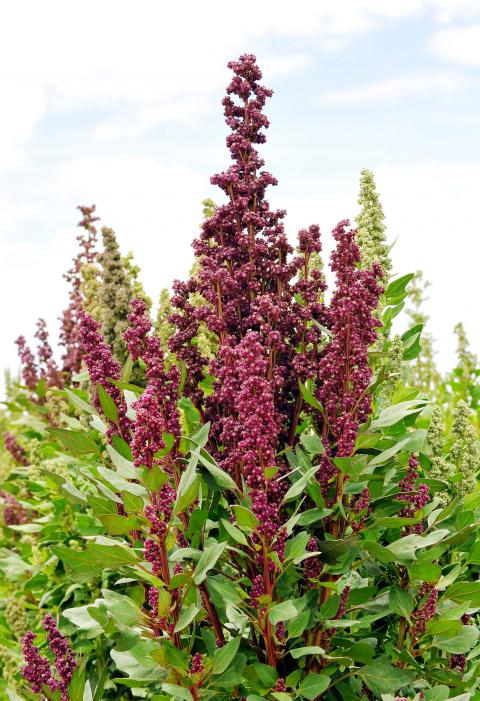
Photo: AFP
A week earlier, Bolivian authorities took 23 tonnes of Peruvian quinoa seized at a checkpoint near the border, dumped it into a ditch, soaked it with diesel and burned it in front of TV crews — an extreme measure in a country where nearly half the people are poor and about one in five toddlers suffers from malnutrition.
Peru and Bolivia both made quinoa — which scientists consider as nutritious as mother’s milk — an export priority even before the UN declared last year as International Quinoa Year. Although marketed as a grain, quinoa is actually a seed from the goosefoot plant family.
A decade ago, Peru accounted for just 6 percent of global sales, while Bolivia had 90 percent, according to UN figures. However, Peru is on track to supplant Bolivia this year as the top exporter, having doubled production to 95,000 metric tonnes since last year amid strong demand from the US and Europe.
Peru’s higher output stems from greater use of insecticides and chemical fertilizers as agribusiness steps up cultivation in coastal valleys, where there are two harvests a year compared to one in the highlands.
“It is a smaller grain and we know there is very little organic in Peru,” said Eduard Rollet, president of Alter Eco, a “fair trade” company that buys quinoa directly from organic Bolivian farmers.
Yet with quinoa prices increasing eight-fold in five years, “in the US a lot of buyers from supermarkets are looking at legally mixing quinoa from Peru and quinoa from Bolivia as a way to reduce price,” Rollet said.
Organic quinoa now fetches up to US$10 a pound (0.45kg) retail in the US, with the non-organic seed available for as much as half that price.
Yet for producers, the wholesale price for organic quinoa has dropped from a peak of a little more than US$8,000 per metric tonne early this year to about US$6,000, Rollet said. Non-organic quinoa fetches considerably less.
“There is so much supply on the market because of Peru’s big production that prices simply must go down,” said Pablo Laguna, a Bolivian anthropologist and quinoa expert. “The price downturn is irreversible.”
That worries Bolivia’s small-scale quinoa farmers, who cannot produce as cheaply as their Peruvian competitors.
Mamani grows the prized, larger-seeded reddish-purple royal quinoa at altitudes of nearly 3,650m using llama manure as fertilizer.
He complains that a 50kg sack that he could sell for US$347 last year now fetches just US$260.
“That simply no longer covers my costs,” said Mamani, who uses pesticides, but no chemical fertilizers.
Global warming is also hurting production as highlands weather becomes more erratic, with more frequent frosts and dry spells.
Sergio Nunez de Arco, CEO of Andean Naturals, a US importer of quinoa, said prices for Peru’s white-seed coastal “sweet” quinoa have been dropping consistently.
The coastal quinoa is more apt to be tainted by pesticide overuse because it grows on land previously occupied by other crops.
“Bugs love quinoa,” he said. “That’s one reason why it does so well in the highlands, where there are fewer pests.”
The US Food and Drug Administration rejects some shipments of quinoa from Andean countries due to high pesticide residues.
Before foreign demand soared, nearly all quinoa was organic because most people who farmed it were poor.
If Bolivians want to compete with Peru, many believe they need more government backing in certifying the organic product’s purity.
“It needs to demonstrate scientifically that it is the best, because it’s difficult to tell by taste,” Laguna said.

Cairo’s new monorail slices across the city skyline, running above the familiar chaos of blaring horns and aging buses’ exhaust fumes that mark rush hour below. The US$4.5 billion monorail, opened this month, is among Egypt’s most prominent new transport projects, part of a debt-funded infrastructure drive criticized for sapping state finances while bringing limited benefits to most of the country’s 109 million people. “It feels like you’re in a different country,” said Ramy Sayed, a restaurant manager, aboard a driverless Innovia 300 train. “No noise, no traffic, we’re not used to this.” The eastern line runs 56km from the bustling middle-class

Taiwanese firms have increased investment in the Philippines in recent years as Manila’s ties with Washington deepen and global supply chains continue to shift away from China, an expert at the Chung-Hua Institution for Economic Research (CIER, 中華經濟研究院) said yesterday. The Philippines had not been among Taiwanese investors’ top choices in Southeast Asia, CIER Taiwan ASEAN Studies Center director Kristy Hsu (徐遵慈) said at a seminar in Taipei. However, Taiwan’s investment in the country has grown significantly since the COVID-19 pandemic, reaching US $257 million last year, a high in recent years, she said. Although Taiwan’s total investment in the Philippines still lags

Intel Corp regards Taiwan Semiconductor Manufacturing Co (TSMC, 台積電) as a longstanding partner, as the US chipmaker would continue outsourcing production of advanced chips to TSMC, Intel chief executive officer Lip-Bu Tan (陳立武) said yesterday. “I don’t look at people as competitors. I look at the collaboration... Nvidia is also, you know, a good friend,” Tan told a news conference following his keynote speech at the Computex trade show in Taipei. “It’s a very trusted partnership for us... We are a big, top customer for them, and we’re going to continue doing that,” he said, referring to TSMC, the world’s largest foundry

Artificial intelligence (AI) agents would supplant smartphones as the center of people’s digital lives, fundamentally reshaping personal devices and driving a major computing upgrade cycle, Qualcomm Inc CEO Cristiano Amon said yesterday. In his keynote speech for this year’s Computex trade show in Taipei, Amon said that the rise of "agentic AI" — AI systems capable of reasoning, planning and carrying out tasks autonomously — would transform how people interact with technology across phones, PCs, vehicles and wearable devices. Describing the technology as the next major evolution in computing, Amon said that "2026 is the year of agents.” For decades, smartphones have sat


 RSS
RSS