


International buyers snapped up Chinese stocks yesterday at the debut of an exchange link that allows Hong Kong and Shanghai investors to trade shares on each other’s bourses, a major step toward opening China’s tightly controlled capital markets.
The so-called Stock Connect program gives foreign and Chinese retail investors unprecedented access to the two exchanges, which some analysts said could eventually lead to the creation of the world’s third-largest stock exchange.
Shares in both Shanghai and Hong Kong opened about 1 percent higher, but quickly gave up some gains, with Hong Kong markets falling into negative territory.
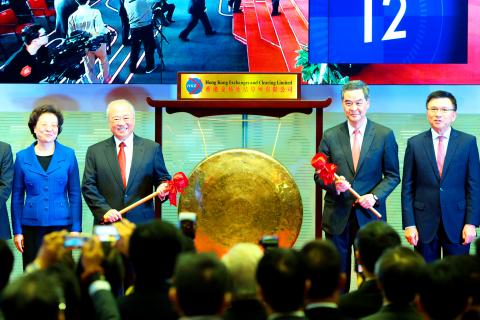
Photo: EPA
The volume of “northbound” trade — investors with Hong Kong accounts buying mainland shares — was far greater than trade from mainland investors in the opposite direction, with the daily buying quota for Shanghai stocks exhausted by mid-afternoon.
Investors were cautious of chasing up shares given the strong market rally in the lead-up to the launch on expectations of an increase in fund flows from the program, Shanghai Securities (上海證券) senior trader Zheng Weigang said.
“In the longer run, however, the connect will surely benefit both markets, as China increasingly opens up to the outside world,” Zheng added. “Particularly, the connect will help push the mainland’s rampant speculative stock culture toward a more investment-oriented market.”
The Shanghai Composite Index declined 0.2 percent to 2,474.01 at yesterday’s close. Hong Kong’s Hang Seng China Enterprises Index lost 1.8 percent, its biggest slide in five weeks. The daily quota of 13 billion yuan (US$2.12 billion) for foreign investors buying China shares was filled as of 1:57pm, compared with 16 percent of the 10.5 billion yuan southbound limit.
Analysts had expected much of the initial cash flow to be northbound, given the limit.
The expected fund inflow had helped push the SSE 180 Index and the SSE 380 Index — the two main Chinese destinations for foreign investment through the program — up more than 10 percent and 6.5 percent since late last month.
Southbound investment, capped by a daily quota of 10.5 billion yuan, is likely to be less active.
By mid-afternoon, with the daily northbound quota used, no further buy orders would be accepted for the remainder of the day.
“It took a longer-than-expected period of time for such a small daily quota to be used, indicating overall sentiment in Shanghai remains cautious,” Central Securities in Shanghai senior analyst Zhang Gang (張剛) said.
Turnover in both markets were about in line with daily numbers.
However, over the longer term, the stock connect could boost the average daily value of stock trading in Hong Kong by about 38 percent by next year, French bank BNP Paribas estimates, and might ultimately lead to the creation of the world’s third-largest stock exchange.
“Chinese investors will take Hong Kong as a place to put their long-term bets. So that is why I think in the long-run Hong Kong will benefit from this,” Hong Kong-based Ample Finance Group asset management director Alex Wong said.
For Shanghai, it is significant because it will allow foreign investors to get more actively involved in China’s capital market, he added.

Cairo’s new monorail slices across the city skyline, running above the familiar chaos of blaring horns and aging buses’ exhaust fumes that mark rush hour below. The US$4.5 billion monorail, opened this month, is among Egypt’s most prominent new transport projects, part of a debt-funded infrastructure drive criticized for sapping state finances while bringing limited benefits to most of the country’s 109 million people. “It feels like you’re in a different country,” said Ramy Sayed, a restaurant manager, aboard a driverless Innovia 300 train. “No noise, no traffic, we’re not used to this.” The eastern line runs 56km from the bustling middle-class

Taiwanese firms have increased investment in the Philippines in recent years as Manila’s ties with Washington deepen and global supply chains continue to shift away from China, an expert at the Chung-Hua Institution for Economic Research (CIER, 中華經濟研究院) said yesterday. The Philippines had not been among Taiwanese investors’ top choices in Southeast Asia, CIER Taiwan ASEAN Studies Center director Kristy Hsu (徐遵慈) said at a seminar in Taipei. However, Taiwan’s investment in the country has grown significantly since the COVID-19 pandemic, reaching US $257 million last year, a high in recent years, she said. Although Taiwan’s total investment in the Philippines still lags

Intel Corp regards Taiwan Semiconductor Manufacturing Co (TSMC, 台積電) as a longstanding partner, as the US chipmaker would continue outsourcing production of advanced chips to TSMC, Intel chief executive officer Lip-Bu Tan (陳立武) said yesterday. “I don’t look at people as competitors. I look at the collaboration... Nvidia is also, you know, a good friend,” Tan told a news conference following his keynote speech at the Computex trade show in Taipei. “It’s a very trusted partnership for us... We are a big, top customer for them, and we’re going to continue doing that,” he said, referring to TSMC, the world’s largest foundry

Artificial intelligence (AI) agents would supplant smartphones as the center of people’s digital lives, fundamentally reshaping personal devices and driving a major computing upgrade cycle, Qualcomm Inc CEO Cristiano Amon said yesterday. In his keynote speech for this year’s Computex trade show in Taipei, Amon said that the rise of "agentic AI" — AI systems capable of reasoning, planning and carrying out tasks autonomously — would transform how people interact with technology across phones, PCs, vehicles and wearable devices. Describing the technology as the next major evolution in computing, Amon said that "2026 is the year of agents.” For decades, smartphones have sat


 RSS
RSS